
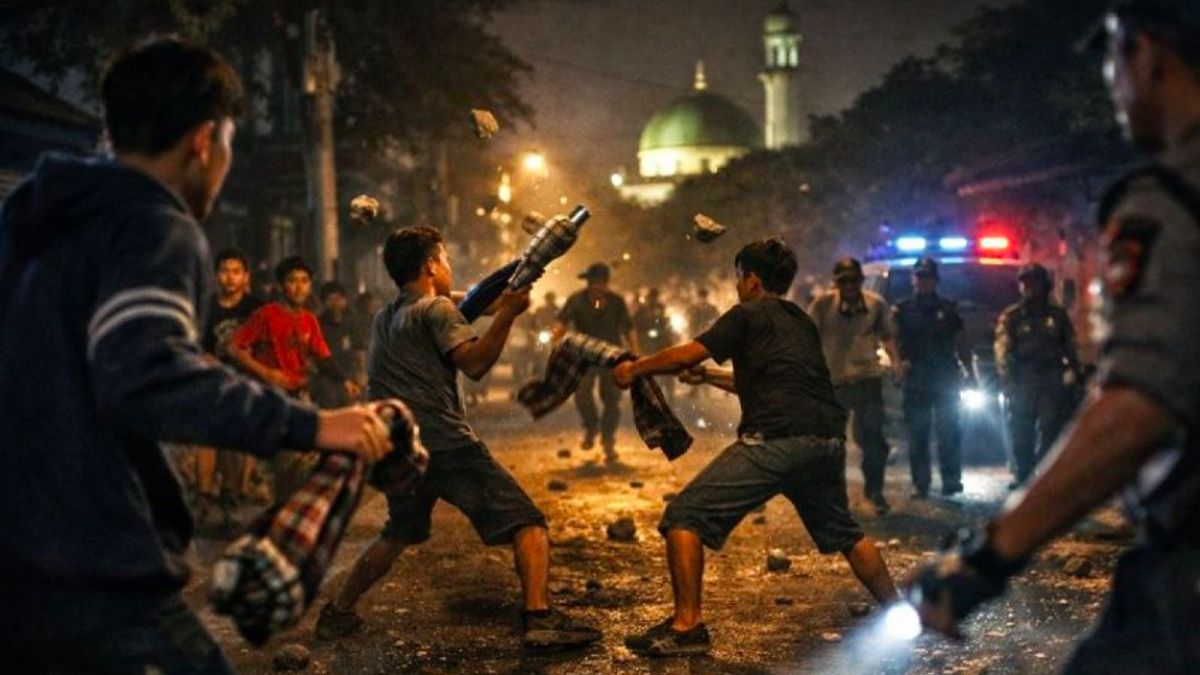


JAKARTA - The tradition of the sarung war, which often appears every month of Ramadan, was originally known as a spontaneous game for children after sahur. However, later, the activity turned into an action that was dangerous because the sarung was often modified with hard objects until it triggered clashes between groups of teenagers.
In a number of cases, this incident even resulted in serious injuries and casualties, which raised widespread concerns among the public.
The Indonesian Child Protection Commission (KPAI) considers the prevalence of the sarung war not just a normal mischief. Deputy Chairman of the KPAI, Jasra Putra, emphasized that the phenomenon reflects a more complex problem.
"The widespread phenomenon of 'sword fighting', even to the point of taking lives and causing brain trauma, is not just a normal teenage mischief. This is an emergency signal from the crisis of playing space, weak supervision, and the failure of the environment to facilitate the energy of our children," said Jasra Putra.
According to him, glove wars occur in densely populated residential areas that have little open space. He explained that changes in land functions also narrow the children's space.
"When large areas have been turned into factories or parking areas, children's movement space is very narrow. As a result, when Ramadan arrives and children have an excuse to leave the house at night, they run to find the widest possible space to express themselves," he said.
He added that the state had actually regulated the fulfillment of children's rights to leisure time through the Child-Friendly Regency/City (KLA) policy, especially in Cluster 4 on the Fulfillment of Children's Rights. However, its implementation in the region still requires budgetary support and more structured environmental planning.
In various regions, the police have taken preventive measures. In Surabaya, East Java, the police secured 16 children suspected of being involved in a glove war. In Garut, West Java, the police dispersed a group of residents who were involved in a similar action.
Supervision was also tightened in Ponorogo through raids in the alun-alun area to prevent glove wars and wild racing. Meanwhile, in Bantul, Yogyakarta Special Region, the police held a dawn patrol to anticipate glove wars and the use of firecrackers.
The series of events shows that the sarung war is no longer just a seasonal tradition, but a social issue that requires joint attention so that Ramadan remains a momentum for character building and security for children.
The English, Chinese, Japanese, Arabic, and French versions are automatically generated by the AI. So there may still be inaccuracies in translating, please always see Indonesian as our main language. (system supported by DigitalSiber.id)
Popular


