


JAKARTA - The awareness of the younger generation towards environmental issues is now increasingly visible, including in the way they view daily product packaging. For many students, packaging is no longer just a wrapper, but part of a sustainability responsibility that needs to be thought about from the design stage to post-consumption.
The impetus to present a more environmentally friendly solution also grew as concerns about the problem of waste in Indonesia increased.
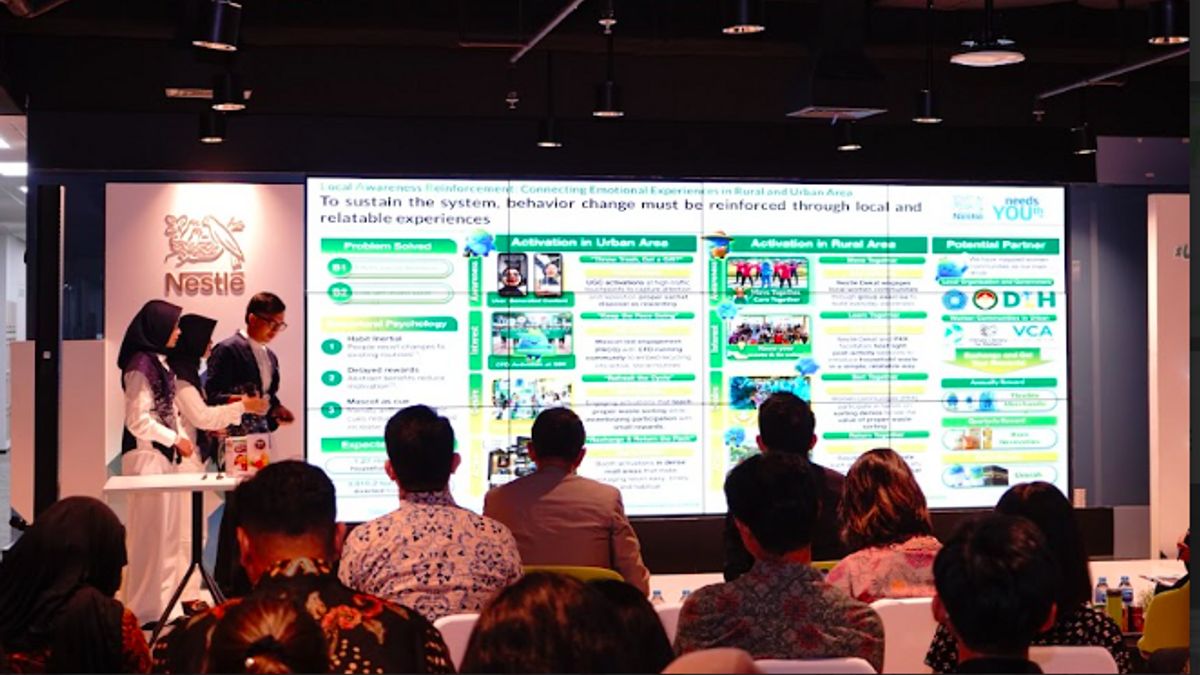
This spirit has found space through the #GreenGeneration Sustainability Business Case Competition initiated by Nestlé Indonesia. This competition invites students from across Indonesia to design business solutions that encourage a more circular and responsible packaging system.
The peak phase will be held on February 16, 2026 through a live presentation in front of the jury, including Waste4Change Founder & CEO M. Bijaksana Junerosano, CEO & Co-Founder of Rekosistem Ernest Layman, Chair of the Management Board of the Indonesia Packaging Recovery Organization Reza Andreanto, and Head of Packaging Nestlé Indonesia Emiliana Yulianti.
This competition was born from the real challenge of packaging management in Indonesia. The question is not only on design innovation or material selection, but also on the gap between the potential for recycling and waste management practices after the product is used.
Data from the National Waste Management Information System (SIPSN) notes that Indonesia produces more than 37 million tons of waste every year. About 19 percent of it comes from plastic packaging. However, the recycling rate only touches the range of 14 percent, while about 40 percent of waste has not been optimally handled.
This challenge is even more complex because the management system at the household level has not yet been fully effective. SIPSN also notes that only about 30 percent of waste is managed through the formal system of local governments, and more than half of households have not sorted waste consistently.
This condition shows that sustainable packaging solutions need to be accompanied by strengthening the system and changing people's behavior.
Through this movement, Nestlé Indonesia seeks to provide a collaborative space to answer these issues. This program is part of the company's global commitment to preserving and renewing natural resources for future generations.
"The most inspiring thing for us at the moment is to see the spirit and critical thinking of students who are in line with our goals. They present research-based ideas that not only enrich our perspective, but also encourage us to continue to grow and go further,"
"Their creativity and depth of analysis prove that the next generation is ready to be a strategic partner in providing solutions that are relevant, applicable, and have a real impact on the future," said Antonio Prochilo, Technical Director of Nestlé Indonesia.
More than just a race, #GreenGeneration is designed as a platform for cross-sector collaboration involving the government, communities, and packaging industry associations. Under the theme "Building Circular and Sustainable Systems for Everyday Products", this program encourages participants to design solutions that are not only innovative, but also have long-term implementation opportunities.
Student enthusiasm was also significant. More than 3,600 students who were members of 1,355 teams participated in the selection process. After passing the assessment based on the quality of ideas, relevance to national challenges, and potential for implementation, 20 finalist teams were selected before the five best teams presented their ideas in the final round.
M. Bijaksana Junerosano who was also a judge assessed the involvement of students as an important element in strengthening the environmental solution ecosystem.
"The involvement of the younger generation in answering the challenges of waste management is becoming increasingly crucial, given that most of the current environmental problems are systemic and require a cross-sector approach. Ideas that are built on data and understanding of reality in the field, have great potential to contribute to strengthening the national waste management system," he said.
One of the winning teams also admitted that this competition opened a new perspective on the complexity of the sustainability issue. Through the PackBack project, they realized that the waste problem in Indonesia is not just an awareness issue, but a systemic issue that is still fragmented and not fully integrated.
"Our project focuses on how to integrate technological innovation into an ecosystem that is relevant to the conditions and behavior of Indonesian people. Overall, the competition from Nestlé Indonesia encourages us to design solutions that are not only innovative, but also contextual, measurable, and ready to be implemented," said Perwakilan Tim Greenfluence, First Winner of the Nestlé Indonesia #GreenGeneration Sustainability Business Case Competition 2026.
As a form of appreciation, the five best teams receive awards and support for developing ideas so that the solutions designed can continue to be improved. Through this initiative, Nestlé Indonesia hopes that the younger generation will be more active in presenting applicable innovations and making a real contribution to a more sustainable packaging and food system.
The English, Chinese, Japanese, Arabic, and French versions are automatically generated by the AI. So there may still be inaccuracies in translating, please always see Indonesian as our main language. (system supported by DigitalSiber.id)
Most Popular Tags
#Prabowo Subianto #donald trump #2026 World Cup #Febrie Adriansyah #8791Popular


