

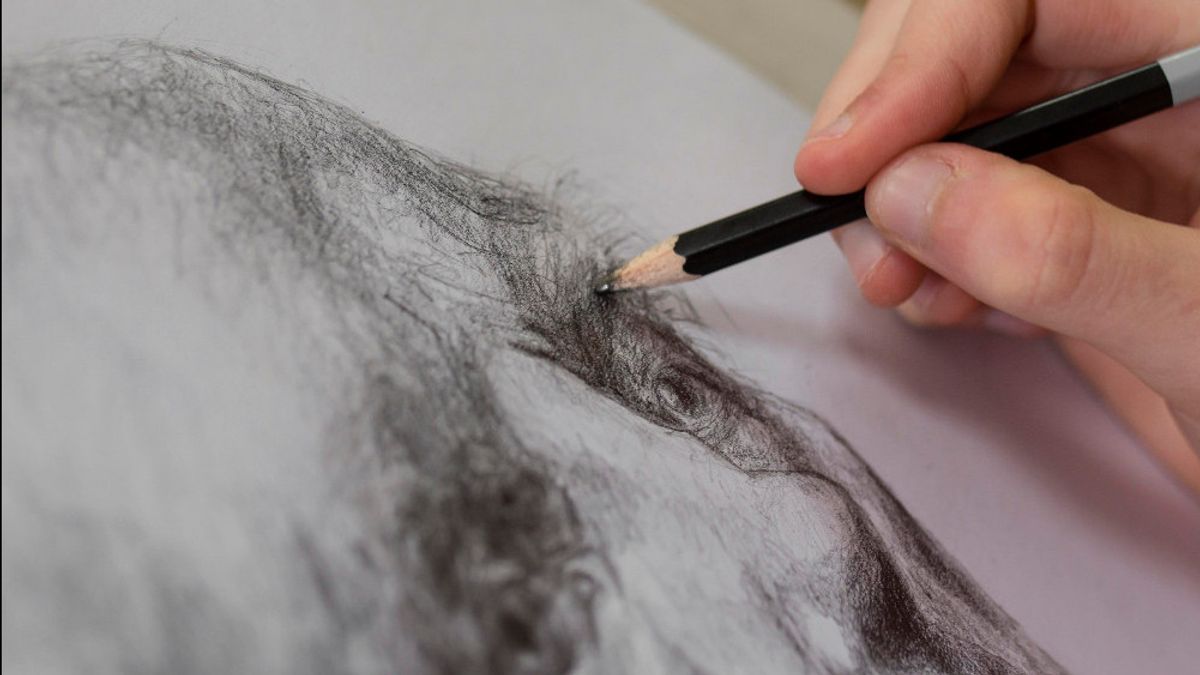


YOGYAKARTA - Do you often feel that your images look flat and lack dimension? The key to overcoming this problem is to master the technique of drawing. By mastering the right technique, your images will be more expressive.
Arsir is not just a line drawing, but it becomes the life of an object that creates the illusion of depth, texture, and light. Ready to turn ordinary images into stunning works of art?
10 Arsir Techniques (Shading) that Must Be MasteredTo significantly improve your drawing skills, as reported on the Gathered page, here are 10 drawing techniques that you must master:
BlendingBlending is the most important drawing technique used to smooth out scratches, create soft gradients, and a professional finish. Use a soft pencil (code B) for gradient exercises from light to dark.
However, if the result is still rough, use a Blending Stump (pointed paper tool) or tissue to blend it, so that the pencil lines disappear and the shading looks smooth.
Cross HatchingThis technique uses criss-crossing lines to build shadows. The more cross layers and the closer they are, the darker the area will be.
This technique is ideal for those of you who want to produce a rustic and expressive texture. Always start with a light layer (hard pencil H) and cover it with a denser cross layer (soft pencil B) to create contrast.
Also read the article discussing Drawing Techniques by Giving Points to the Object of the Picture, Do You Know?
Contour HatchingContour sketching is an intelligent technique where the contour lines are curved following the shape of the object, not straight. For example, on a ball, the contour should be curved like a layer of onion skin.
This technique is very effective to give the impression of accurate volume and dimension. The closer the line, the stronger the shadow.
HatchingHatching is the basis of hatching, that is, when the line is drawn in one direction (one direction) only. This technique is usually used together with cross hatching as a basic layer to keep the direction of the shadow consistent.
StipplingStippling is a technique that utilizes the density of small dots to create shadows. Although it takes patience, the results of stippling will be stunning.
The trick is, collect the meeting points for the dark area, and stretch it for the bright area (high value). The brightest area is left completely empty (highlight).
RenderingRendering is the process of applying graphite and then lifting it back up to create highlights. The key tool is a putty rubber eraser that can be shaped into a pointed tip.
How it works is when this eraser gently lifts the pencil lead, creating a subtle spot or highlight on the area that has been shaded dark.
ScribblingThis is the most free technique, using random and loose scribbles. The scribbles are stacked gradually to darken the area. Scribbling is suitable for adding a lively, casual, and dynamic texture to the work, as well as being a good warm-up exercise.
ScumblingScumbling in drawing is by making small, circular scratches and turning them. Just like regular hatching, the closer and more often the circular scratches are stacked, the darker the resulting tone.
Tick HatchingThis technique uses very short and close lines. It is between stippling and hatching. These short lines can be tilted to add dimension to an object or stacked for texture.
Woven HatchingThe unique hatching technique, where the lines are grouped and tilted in different directions so that they do not cross each other completely, but look like a basket weave pattern.
In addition to discussing the technique of arsir, follow other interesting articles at VOI, to get the latest news, don't forget to follow and monitor all our social media accounts!
The English, Chinese, Japanese, Arabic, and French versions are automatically generated by the AI. So there may still be inaccuracies in translating, please always see Indonesian as our main language. (system supported by DigitalSiber.id)


