


JAKARTA - Many people consider antique and modern furniture as two worlds that cannot be united. Because one is full of classic ornaments and past characters, while the other displays a clean line and contemporary simplicity. However, when the two are carefully and fully aware of the design, the combination can create a unique, personal, and visual attractive space.
In this article, VOI invites you to explore how to combine antique and modern furniture in the style of professional interior designers. So that your house feels warm, stylish, and full of stories adapted from Southern Living, Friday, October 3.
One of the main keys in combining antique and modern furniture is to find a unifying common thread even though the style and time are different. Joshua Evan Goldfarb and Michael Edward Moriano designers suggest that you try to combine a different wooden tone. Because it will add depth and character, rather than retaining only one wooden tone that can make the room feel flat.
For example, an antique cupboard made from a mahogany can be paired with a young coffee table. As long as there is a subtle tonal similarity or secondary color that binds the two, whether the color of the wood is repeated or small details such as the carving frame.
According to Baxter Hill Interiors designer Jen Baxter, when you combine different stylized elements, it is very important to selectively choose cohesion points and contrast points. That is, you can play with different eras and shapes, but there must be a connecting element, for example a curved pattern, a curved silhouette, or a recurring motif for the room to feel unified. If you have a modern Avantgarde chair with minimalist design, you can gap a small curve of antique furniture in a guest chair, a table or mirror frame so that a very different style of mutual dialogous.
Different styles are not the only challenge, scale also plays an important role. Moriano said that when entering some large antique furniture, it is better to mix it with modern elements that have a comparable size so that the room feels balanced.
In a reading space project, he once combined a big classic chair with a modern chair by Cini Boeri from the 1970s and a small Belle Badminton-style table as a small accent. Characters of each section look different, but their scale, color, and ingredients can talk to each other so that the room feels harmonious.
SEE ALSO:
-
 | LIFESTYLE
5 Inspirasi Dekorasi Kamar Tidur Japandi yang Fungsional dan Minimalis
01 Oktober 2025, 17:47 -
 | LIFESTYLE
Kenali Tipe Pencahayaan Ruangan, Ikuti 7 Tips Mengaturnya agar Tepat dan Efisien
30 September 2025, 17:47 -
 | LIFESTYLE
8 Tips Dekorasi Interior Bergaya Japandi yang Menciptakan Suasana Hangat dan Nyaman
29 September 2025, 17:47
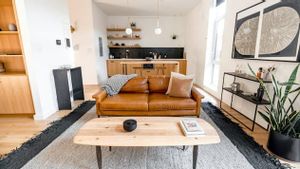
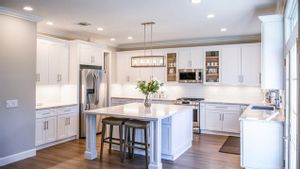
No need to force the harmony of each part dramatically, often small details are enough to unify the whole. You can choose one or two small elements that can be from textiles, metal accessories, or decorative elements present at several indoor points to create a visual balance.
For example, the idea of a copper metal tone at the feet of a table, a modern cupboard handle, or a repainted antique photo frame to match other modern elements in the room. These simple things can be a bridge' that connects different times.
While cohesion is important, contrast also gives breathing and visual assertiveness. You can choose one striking element. Maybe a large antique cupboard or contemporary hangout as a focal point. From that point, all other elements can be directed to support it or smear' the visual tension.
But don't play too much contrast in one room, so that the room doesn't feel chaotic. It's better if you have one area or an element that is more 'surprising' and the rest calm as an equalizer.
Anti- and modern furniture pads are not just about aesthetics, but about conveying the narrative and identity of the owner of the house. By combining the family heritage (anticiple function) with today's work (modern function), your space not only becomes visually beautiful, but has emotional meaning.
With the right approach, such as paying attention to color, shape, scale, and small details. You can create interior designs that are not only pleasing to the eye but also feel full of warmth and uniqueness.
The English, Chinese, Japanese, Arabic, and French versions are automatically generated by the AI. So there may still be inaccuracies in translating, please always see Indonesian as our main language. (system supported by DigitalSiber.id)


