
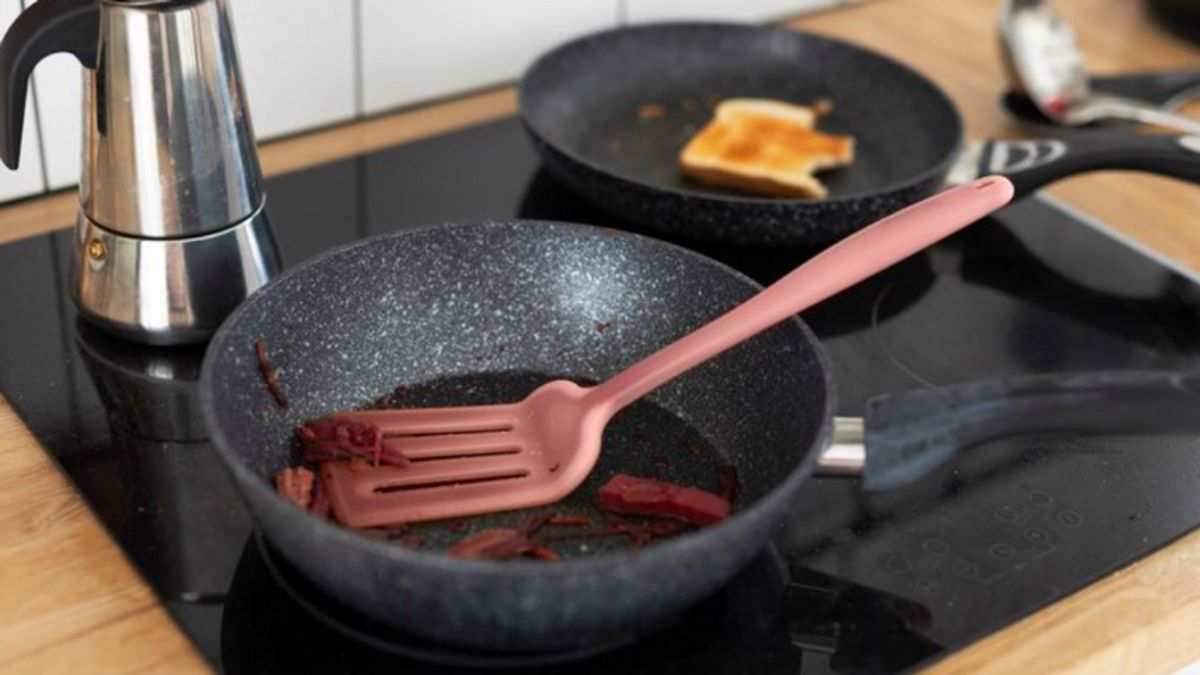


JAKARTA - Non-stick pans are indeed a favorite kitchen tool for many people. This tool is perfect for cooking foods that easily crumble or stick, such as scrambled eggs, thin fish fillets, pancakes, and even cheese-based dishes. However, that doesn't mean all types of dishes are safe to cook in this type of pan.
Some foods and cooking techniques can actually damage the non-stick coating, especially if they are frequently exposed to high temperatures. A chef and culinary instructor explains which foods should not be cooked in a non-stick pan.
The durability of a non-stick pan depends greatly on its quality and manufacturing process. Generally, this type of pan can only withstand heat up to around 400 degrees Fahrenheit (around 200°C).
"While that number sounds quite high, an empty pan heated directly over a flame can get much hotter than that. Excessive temperatures can quickly erode the non-stick coating and even risk releasing toxic gases from the pan," explained Shawn Matijevich, chef and lead online culinary instructor at the Institute of Culinary Education, as quoted from the Martha Stewart website.
That's why it's important to know when a non-stick pan is best used and when to avoid it. Here are the types of foods you should avoid cooking in a non-stick pan.
1. Acidic Foods
Matijevich reminds us that non-stick pans should be treated like special equipment that needs to be maintained. Therefore, he recommends avoiding cooking highly acidic foods in them, especially if they are cooked for a long time.
"The occasional squeeze of lemon to stir-fries or warming up tomato sauce for spaghetti is fine. But avoid cooking acidic foods in a non-stick pan for more than a few minutes," he explains.
Foods with high acid content can shorten the lifespan of the non-stick coating. In fact, if the coating is scratched and the aluminum underneath comes into contact with acidic foods, a reaction will occur that produces a metallic taste and discoloration.
2. Meat or Vegetables That Need to Be Seared
Technically, meat or vegetables can be heated until they appear charred on the surface of a non-stick pan. However, according to Matijevich, the temperatures required to achieve a good sear are not safe for this type of pan.
"A quick stir-fry of fish, shrimp, or vegetables is still fine. But if you have to really heat the pan to a very high temperature, it's best to use a different pan," he said.
To get the perfect sear on steak, chicken, or pork chops, Matijevich recommends a stainless steel or cast iron pan. Besides being heat-resistant, these two types of pans don't pose a risk of toxic gases or peeling coatings.
3. Dishes That Need to Be Stirred Frequently
Risotto, for example, is not an ideal dish to cook in a non-stick pan. This is because constant stirring can gradually wear down the pan's surface.
"Even if you use a spatula that's safe for non-stick pans, constant friction will still wear down the non-stick coating by microscopic amounts," Matijevich said.
The more frequently used for this type of cooking, the faster the pan loses its quality.
4. Dishes That Require Deglazing
Deglazing is a cooking technique that involves adding liquid to a hot pan to dissolve stuck-on food residue, usually to make a sauce. However, non-stick pans are designed to prevent food from sticking, making this process ineffective.
"Because non-stick pans prevent food from browning, you won't get a good base for your sauce," explains Matijevich.
To make a sauce from deglazing, it's best to use a stainless steel or cast iron pan.
The English, Chinese, Japanese, Arabic, and French versions are automatically generated by the AI. So there may still be inaccuracies in translating, please always see Indonesian as our main language. (system supported by DigitalSiber.id)


