
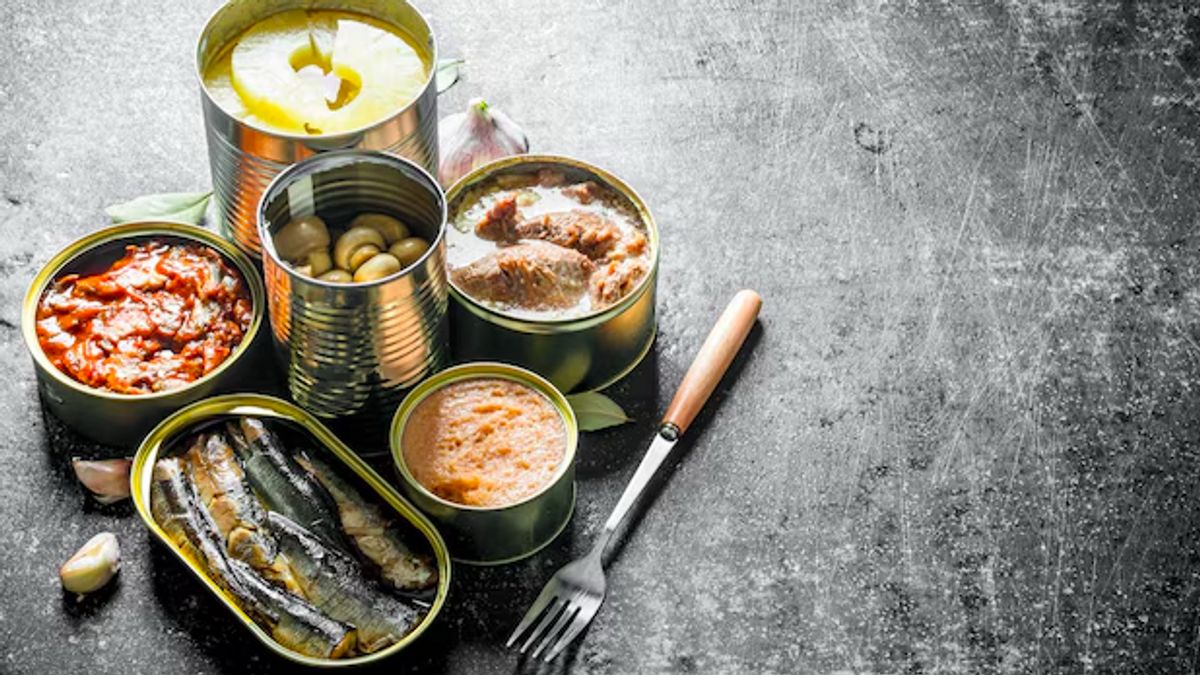


JAKARTA - Bisphenol A (BPA) is a chemical compound widely used in the manufacture of polycarbonate plastics and epoxy coatings in food packaging, including cans.
This layer functions to prevent direct contact between canned metals and food, while maintaining taste and product quality. However, various studies show that BPA can migrate into food, especially when food is stored or heated, so it has the potential to be a significant source of exposure to the human body.
Research in the United States and Canada published in PubMed.gov found that the BPA content in canned food was much higher than in gallons for a re-polycarbonate (PC) for drinking water.
Clinical Nutrition Specialist, dr. Karin Wiradarma, M.Gzi, Sp.GK, AIFO-K, FINEM, explained that the study examined the content of BPA in fresh, frozen, and canned foods.
"As a result, BPA was found in 73 percent of canned food, while in fresh and frozen food only about 7 percent," he said as quoted by ANTARA.
According to dr. Karin, canned food is the main source of exposure to BPA to humans. Research data shows that 60 70 percent of canned products, including well-known brands, contain BPA with a concentration of 730 nanograms/grams (ng/g) in the US. Meanwhile, surveys in Canada recorded an average of 137 ng/g in canned tuna, with the highest value reaching 534 ng/g.
SEE ALSO:

This finding is different from the results of tests on gallons of polycarbonates which show that the concentration of BPA is much lower, only around 0.128 0.145 ng/g. Regulation of the Food and Drug Supervisory Agency (BPOM) Number 20 of 2019 sets a BPA threshold in food packaging, including cans, of 0.6 parts per million (600 micrograms/kg), but figures from international studies still indicate potential exposure that needs to be watched out for.
Research in the US and Canada also emphasizes that the consumption of canned food is the main pathway for BPA exposure compared to other sources such as disposable plastic, home dust, or shopping receipt paper.
A study from Harvard School of Public Health (2011) even noted that consuming canned soup for five consecutive days could increase BPA levels in urine by up to 1,000 percent.
Unfortunately, the public discourse in Indonesia in recent years has more highlighted the issue of BPA in gallons of drinking water, while the contribution of canned food to BPA exposure is rarely discussed.
Professor of Food Safety & Nutrition at the Faculty of Human Ecology (FEMA) IPB, Prof. Ahmad Sulaeman, assessed that the content of BPA in canned packaging is more worrying than the gallon of a PC.
Canned food can be stored for a long time in warehouses or shops before being purchased, then often stored again at home. This means that the contact between food and the epoxy layer containing BPA becomes longer," he said.
The English, Chinese, Japanese, Arabic, and French versions are automatically generated by the AI. So there may still be inaccuracies in translating, please always see Indonesian as our main language. (system supported by DigitalSiber.id)


