


JAKARTA - A fun learning process is the main key in creating meaningful educational experiences, especially for early childhood. When children feel happy while studying, they are easier to absorb knowledge and develop creativity naturally.
This is also in line with the views of Dr. Koji Kurusu, MD, Ph.D., a child education expert from Japan, highlighting the importance of a learning approach that involves pleasure and exploration.
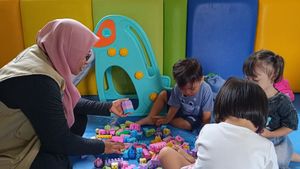
In Japan, early childhood education has widely applied the STEAM approach a method that combines scientific elements (science), Technology (technology), Engineering (engineering), Art (seni), and Mathematics (math) in learning activities.
In a statement in Jakarta last Friday, the founder of the Azalee Group explained that the core of STEAM's approach is when children learn in a way that makes them feel like they are playing. This process involves exploration, freedom of creation, and self-expression, so that learning becomes more enjoyable and not burdensome.
"When learning feels like playing, that's when children really learn with enthusiasm. This is the main philosophy of STEAM education from an early age," Kurusu said, as quoted by ANTARA.
SEE ALSO:
-
 | INFO SEHAT
Kekurangan Zat Besi pada Anak Dapat Menghambat Perkembangan Daya Pikirnya
06 Maret 2025, 22:25 -
 | INFO SEHAT
Mengontrol Penggunaan Gadget pada Anak untuk Perkembangan yang Sehat
31 Januari 2025, 13:25


Recently, Kurusu also held a meeting with the ranks of the Ministry of Elementary and Secondary Education (Kemendikdasmen) to discuss the future of the early childhood learning system in Indonesia. He sees a great opportunity for Indonesia to adopt the STEAM approach, especially if it is accompanied by strengthening teacher capacity through bilateral cooperation with Japan.
Director of Early Childhood Education (PAUD) and Non-formal Education (PNF) Kemendikdasmen, Suparto, welcomed the idea conveyed by Kurusu. He considered that experience-based learning and reflection, known as Deep Learning in Japan, is in line with the direction of Indonesian education policy.
"We support the idea that an in-depth learning process must go through stages of experiencing, reflecting, and then distributing back to others," said Suparto. He also noted that currently there are around 67,200 active PAUD teachers in Indonesia.
This discussion was facilitated by Sakuranesia Foundation founded by Sakura Ijuin and Tovic Rustam. They hope that this meeting can be the first step in building STEAM education policies in Indonesia and strengthening international partnerships in the development of teachers and early childhood education.
The English, Chinese, Japanese, Arabic, and French versions are automatically generated by the AI. So there may still be inaccuracies in translating, please always see Indonesian as our main language. (system supported by DigitalSiber.id)
Most Popular Tags
#Prabowo Subianto #donald trump #2026 World Cup #Febrie Adriansyah #8791Popular


