
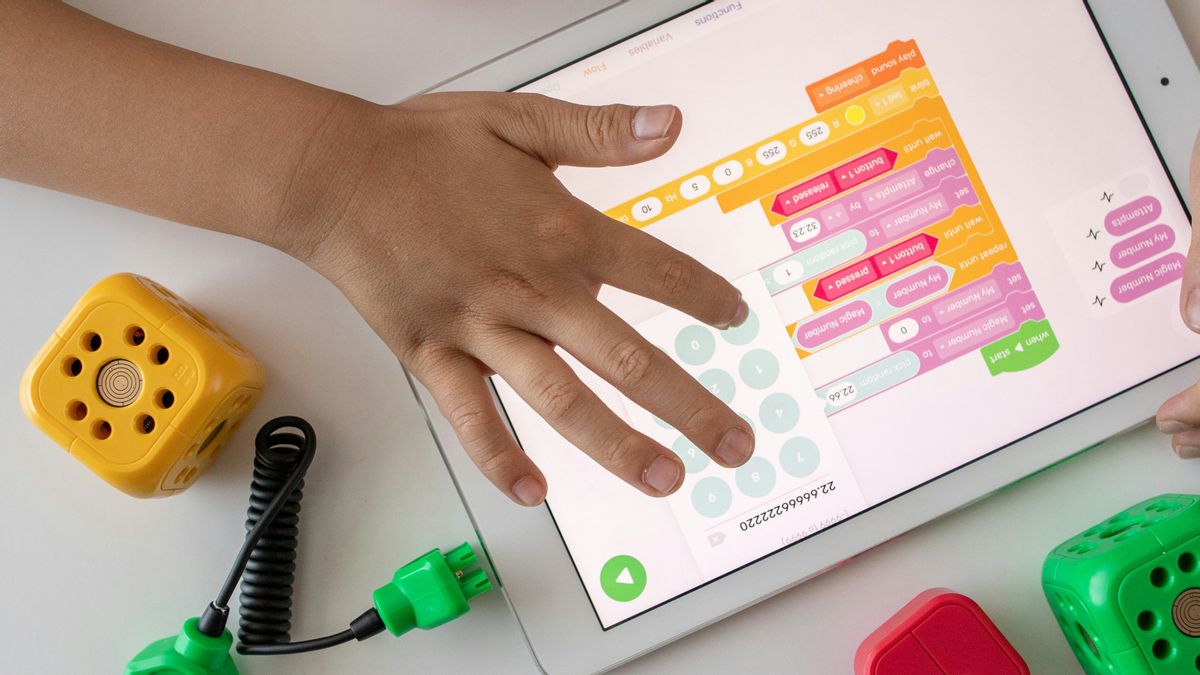


Relying on children about the business world or entrepreneurs from an early age, it is now increasingly important. Especially in the midst of being involved in artificial intelligence technology (AI) which is also a unit in the business world.
Aleima Aruna Sharuna, Head of the Kakap Foundation for the Nation, said parents and educators who want to equip their children with insight into artificial intelligence (AI) in the world of entrepreneurship, here are some points to know.
When Can Children Start Learning AI?
Children can get to know AI from an early age, as long as they are properly guided. According to Aleima, although early exploration can be started as a child, the ideal age for studying AI more seriously is around 13-14 years. At this stage, children generally already have a better understanding of the concepts of technology and its use ethics.
'Blessing is important. Don't release yourself using AI without direction," said Aleima.
This aims to ensure that children not only understand how to use AI, but also develop critical thinking and are responsible for using it.
AI As A Tool To Grow Entrepreneurs
Artificial intelligence (AI) can help children develop their business. Children can process and analyze data more quickly, so they can understand market trends, identify business opportunities, and make more appropriate decisions.
However, Aleima also reminded that AI is just a tool that supports human thinking processes, not a substitute for creativity and critical thinking skills. Humans still need to develop unique ideas, make decisions based on values and experience, and create relevant solutions. So that the balance between the use of technology and the ratification of human skills must be maintained.
The Role Of Parents In Using AI
Parents not only need to support, but also understand the potential and risks of AI.
"It doesn't mean that AI replaces the learning process, but it becomes a tool that can make it easier," said Aleima.
Without proper assistance, children are at risk of using AI less productively or even experiencing negative impacts. One of the main risks is the dependence on technology, where children tend to rely solely on AI to complete tasks without really understanding the concept or process of thinking behind it.
This can hinder the development of their cognitive skills, such as critical thinking, problem solving, and creativity. Therefore, parents need to be actively involved by supervising, discussing, and providing an understanding of how to use AI positively.
Avoid Dependence On AI
One of the concerns discussed is the dependence of children on AI. Aleima suggested that parents limit their time of use of AI, for example a maximum of 30 minutes per study session. But after that, children should still be invited to discuss, analyze, or write with their own thoughts. In order to still be able to hone their curiosity and invite them to think critically.
AI In Building Relations Of Parents And Children
AI can also be a tool that strengthens the relationship between parents and children, as long as it is used wisely and with full assistance. "Never too old to learn AI" said Aleima, inviting parents to learn to understand AI so that it can direct the optimal use of AI for their children.
SEE ALSO:
-
 | INFO SEHAT
Tips Menasehati Anak yang Kecewa Kalah Tanding Seperti Raffi Ahmad Menasehati Rafathar
18 September 2023, 20:10 -
 | INFO SEHAT
Cegah Anak Terbiasa Memendam Emosi, Komunikasi Efektif Perlu Diterapkan Orangtua
04 Desember 2024, 09:25 -
 | INFO SEHAT
Budaya Literasi Dimulai dari Rumah, Pahami Pentingnya Kebiasaan Membaca Bersama Anak
15 Oktober 2024, 21:55


Use AI wisely, according to its function, and always accompany children when using it. Technology should not replace the role of parents and teachers, but rather become a tool that supports the learning and creativity process of children.
The English, Chinese, Japanese, Arabic, and French versions are automatically generated by the AI. So there may still be inaccuracies in translating, please always see Indonesian as our main language. (system supported by DigitalSiber.id)
Most Popular Tags
#Prabowo Subianto #donald trump #2026 World Cup #venezuela #konflik timur tengahPopular


