
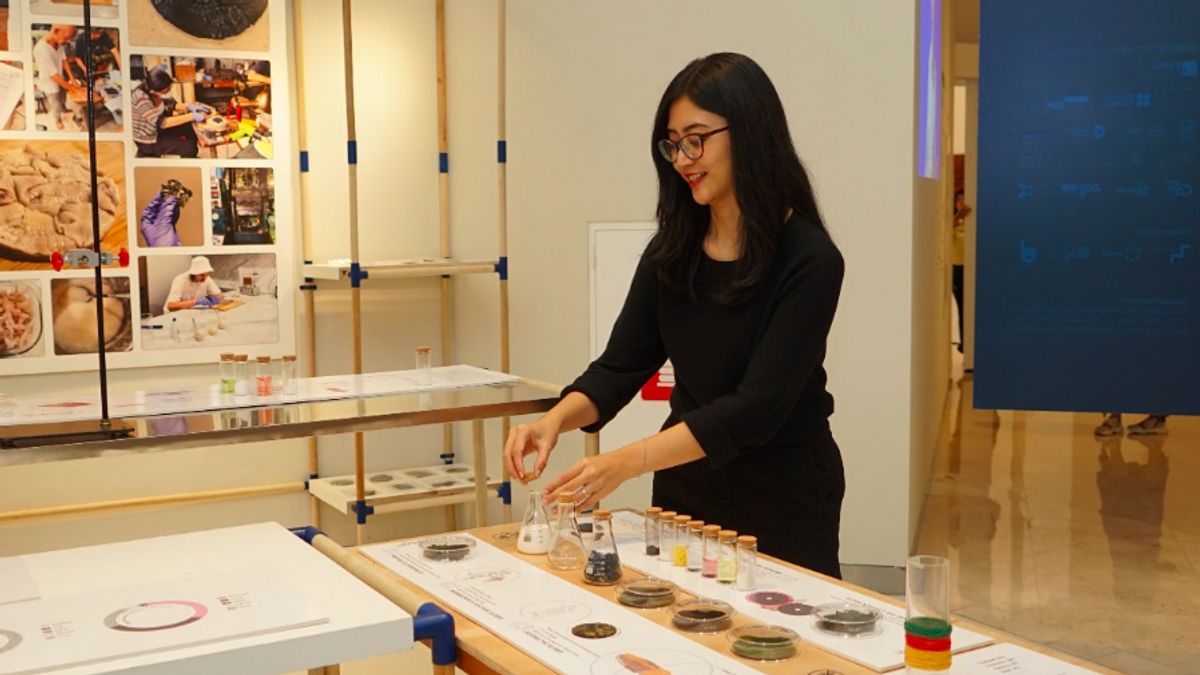


JAKARTA - The innovative collaboration in sustainability issues is increasingly gaining global attention, including in the field of design. EUIC Indonesia Cluster presents the Design Matters Lab Exhibition featuring five innovative products from the collaboration between Indonesian and European designers in responding to the global waste crisis.
The exhibition, which took place at Erasmus Huis from February 27 to May 3, 2025, highlighted the use of bio-based waste and materials, such as cigarette butts, cow's waste, mysselium, chicken's feet, and coffee grounds.
Through a cross-cultural collaborative approach, designers turn waste into valuable resources, proving how design can be a sustainability solution for environmental challenges.
In this creative process, five Indonesian designers were paired with colleagues from England, France, the Netherlands, Germany, and Ireland. They followed the online bootcamp for one month, followed by a 14-day residence in Bandung in December 2024.
Located in five local micro-factorys, designers collaborated with industry experts to explore alternative materials, develop designs, and create innovative prototypes that challenge conventional aesthetic concepts and functionality. This program is also a place for cultural exchange and knowledge, strengthening shared commitment to sustainability.
Summer Xia, Co-President of EUC Indonesia Cluster and Country Director of the British Council Indonesia, emphasized that this project shows design strength in creating positive changes.
"The Design Matters Lab proves that the combination of creativity and collaboration can produce innovative solutions. By connecting Indonesian and European designers, we are not only exchanging ideas, but also creating opportunities to address waste issues and climate change," he said.
Meanwhile, Nicolaas de Regt, Erasmus Huis Director and Head of the Dutch Embassy's Department of Culture and Communications, stated that hosting this exhibition was in line with their commitment to supporting sustainability innovative solutions.
"Through projects like What if Lab and Building with Nature, the Netherlands has long explored innovative approaches. Design Matters Lab emphasizes the importance of cross-cultural collaboration in creating impactful designs," he said.
Some of the flagship projects featured in this exhibition include TAC_tas by Chloe Xingyu Tao (England), Fariz Fadhlillah (Indonesia), and Conture Concrete Lab (Indonesia); Hylume by Le farla Bouyssou (France), Bani Muhammad (Indonesia), and MYCL (Indonesia); Lampoep by Ratna Djuwita (Indonesia), Pim van Baarsen (Netherlands), and Cowka (Indonesia); Cuirkah by Rininta Isdyani (Indonesia), Alve Lagercrantz (Germany), and Hirka (Indonesia); as well as ESPRESSO by Cokorda Gde Bagus (Indonesia), Ciana Martin (Ireland), and Bell Living Lab (Indonesia).
One of the designers, Chloe Xingyu Tao from England, revealed that her participation in Design Matters Lab is a unique experience that expands her perspective. "Our project, TAC_tas, encourages me to explore inclusive designs for people with visual disabilities. Seeing the public's enthusiasm for this issue is very inspiring, and I and Fariz plan to continue developing this project," he said.
SEE ALSO:
-
 | LIFESTYLE
Mudah Lakukan Perawatan Elektronik Rumah Tangga, Ini Servis yang Dibutuhkan Pelanggan
24 Februari 2025, 19:55 -
 | LIFESTYLE
Ide Konsep Pernikahan dengan Nuansa Alam, Lebih Intim, Romantis, dan Santai
16 Februari 2025, 23:56 -
 | LIFESTYLE
Cangkang Telur Bisa Dijadikan Pupuk Tanaman, Begini Cara Membuatnya
12 Februari 2025, 15:55


Material designer from Indonesia, Ratna Djuwita, also shared her experience in the Lampoep project that combines innovation and local wisdom. "This program opens space for me to meet with various cross-disciplinary experts, enriching the creative process in finding design-based solutions," he said.
This exhibition not only presents innovative products but also provides interactive experiences for visitors. They can see firsthand alternative materials and understand the process behind the processing through infographics and informative presentations. Thus, this exhibition aims to raise awareness of the potential for design in dealing with environmental issues in a sustainable manner.
Design Matters Lab is part of the European Spaces of Culture project that supports cultural collaboration between European actors and local partners in non-EU countries. The program is in line with the European Union's strategy to strengthen international cultural relations and is implemented by EUNIC in collaboration with the European Commission and European External Action Services (EEAS).
As a network of European national cultural institutes with 39 members from various EU countries and partners, EUNIC continues to seek to expand the positive impact of design-based innovations in supporting global sustainability.
The English, Chinese, Japanese, Arabic, and French versions are automatically generated by the AI. So there may still be inaccuracies in translating, please always see Indonesian as our main language. (system supported by DigitalSiber.id)
Most Popular Tags
#Prabowo Subianto #donald trump #2026 World Cup #venezuela #konflik timur tengahPopular


