
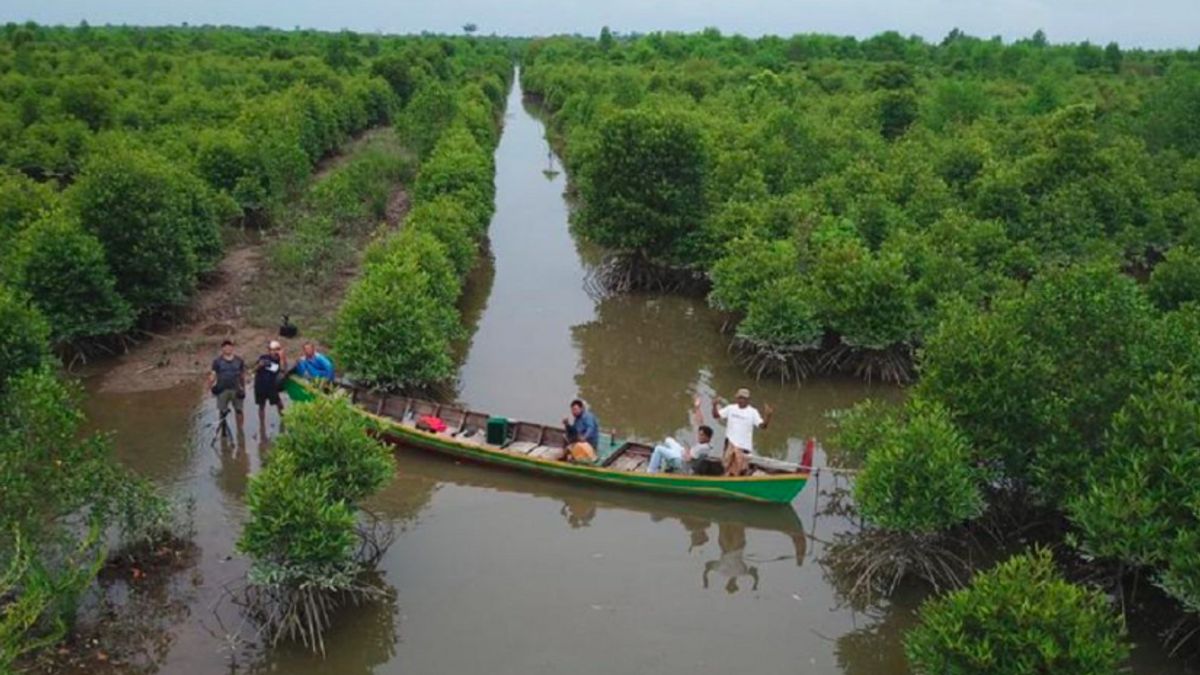


JAKARTA - Mangrove conservation efforts in Donggala Regency, Central Sulawesi, are an important key in preserving coastal ecosystems while protecting endangered rare species.
Mangroves not only act as coastal protectors of abrasion and climate change, but also become an important habitat for various flora and fauna, including two rare mangrove species that still thrive in the region.
Research conducted by Dr. Bau Toknok from the Faculty of Forestry, Tadulako University revealed that Sonneratia ovata and Brugiera cylindrica, two mangrove species that are on the endangered list version of the International Union for Conservation of Nature (IUCN), can still be found in South Banawa District, Donggala.
"Based on IUCN data, these two species are threatened with extinction, but in Donggala they still survive and have the potential to be developed further," said Dr. Toknok during the launch of the Climate Smart Shrimp (CSS) Program and mangrove planting activities in Donggala, as quoted by Antara.
Although it did not reveal the specific location of the existence of this rare mangrove, Dr. Toknok ensures that its habitat is still relatively safe and can be used to support environmentally friendly shrimp farming, without sacrificing ecosystem sustainability.
SEE ALSO:
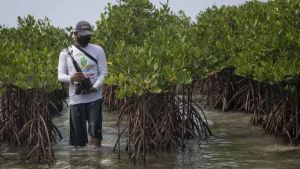
The mangrove vegetation area in South Banawa is recorded at around 300 hectares, with 9.64 hectares of which have been designated as protected forest areas in Lalombi Village. We have not found the species in Lalombi Village, but they are still growing in surrounding villages and this opens up wider conservation opportunities if there is cooperation from the community," he added.
As part of efforts to preserve and empower the environment, the Climate Smart Shrimp Program comes with a sustainable shrimp cultivation approach that prioritizes environmentally friendly principles and mangrove conservation. This method focuses not only on increasing shrimp harvest, but also on restoring the ecological function of mangroves that were previously damaged by land conversion.
This program involves collaboration between the Indonesian Conservation Foundation, the Faculty of Forestry, Tadulako University, the National Research and Innovation Agency (BRIN), and JALA a start-up company engaged in shrimp cultivation technology. They developed a sustainable shrimp cultivation system on the land of a former 10-hectare pond in Lalombi Village.
Through this approach, it is hoped that mangrove conservation will not only protect biodiversity, but also be able to improve the welfare of local communities through environmentally friendly and sustainable cultivation practices.
The English, Chinese, Japanese, Arabic, and French versions are automatically generated by the AI. So there may still be inaccuracies in translating, please always see Indonesian as our main language. (system supported by DigitalSiber.id)
Most Popular Tags
#Prabowo Subianto #donald trump #Febrie Adriansyah #8791 #giias 2026Popular


