
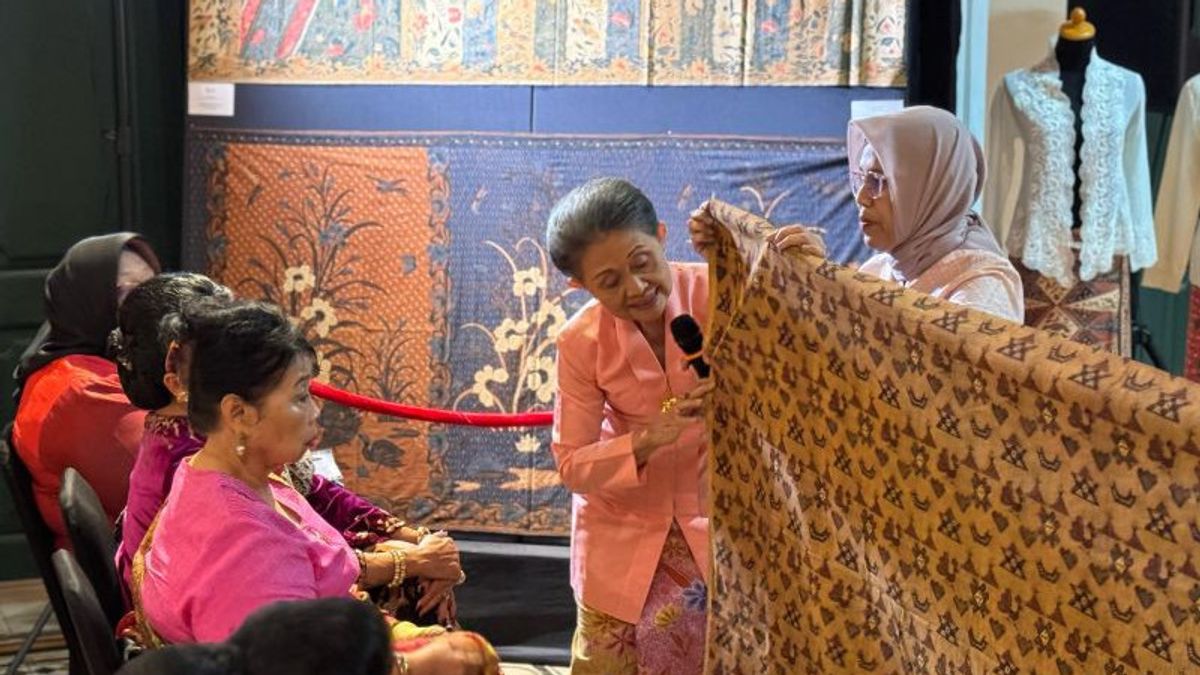


JAKARTA - Coastal batik is a batik that is often found in coastal areas north of Java. This batik has a combination of Indonesian cultural acculturation and the influence of foreign culture.
Coastal Batik emerged because it came from the northern coastal areas of Java, such as Cirebon, Indramayu, Lasem and Bakaran. Coastal batik comes from outside the cities of Solo and Yogyakarta.
In the talk of Wastra Berkarya, the General Chairperson of the Neneng Iskandar Wastraprema Association explained that around the 15th and 16th centuries, the roles of various countries, both from China, India, the Netherlands and Arabia, which arrived in the archipelago, developed their own clothes in the form of sarongs and kebaya.
In its development, the roleists need their own batik. Meanwhile, Coastal Batik began to develop around the 19th century.
"Batik Pesisir is prioritized as a traded economic item, and has only grown widely around the 19th century due to the decline in textile production from India, which at that time was the largest fabric producer to be sold to the island of Java," Neneng Iskandar said, as reported by ANTARA.
Neneng Iskandar explained that the various motifs for the Coastal Batik were very rich because they were not only influenced by the islands of Java but also from China, India, and Arabia.
"Ciri typical of coastal batik can be seen from the motifs that become symbols or acculturations of Indonesian culture with foreign cultures such as the motifs of dragons, ships, calligraphies and also motifs that represent the characteristics of the coastal environment. The influence of this culture, not only from the island of Java but also from Sumatran culture," he said.
In addition, on the same occasion, Clothing Designer Didi Budiardjo explained that this Coastal Batik is usually combined with a role model, namely a kebaya commonly worn by European women or Chinese.
According to Didi, now the use of the role of kebaya as a mode is increasingly existing and its use is quite increasing, although not as much as the use of the new kuthu kebaya.
"Chionghoa-Indonesia cultural assimilation gave birth to a roleal kebaya. The roleal kebaya continues to grow without leaving the existing standard," said Didi.
Didi said that in 1930 there were many various encim kebayas. However, it was never white except shortly after the death of a close relative. This is because the indigenous Chinese people and their roles are wearing white as the color of absence, death.
Initially the kebaya encim was known as kebaya masari, this nickname was first popularized by the Chinese community.
"The term kebaya encim is commonly used by non-Chinese to name the type of kebaya used by Chinese female actors," he said.
However, according to Didi, since 1911 at the collapse of the Chinese empire, Chinese people have begun to imitate the dress style of the Dutch Europeans.
At that time, the Dutch noni did not wear the luxury aristocrats' kebaya from the material. However, choosing a thin cotton material with a short cut.
"Starting from the inspiration of the noni kebaya, Chinese women modify it by inserting the pieces, materials, colors, border and accessories used," he said.
The Wastra Berkarya talk activity also presented a more than 100-page Coastal Batik exhibition made around 1900 of Ibu Eiko Adnan's collection of the Jakarta Textile Museum.
The English, Chinese, Japanese, Arabic, and French versions are automatically generated by the AI. So there may still be inaccuracies in translating, please always see Indonesian as our main language. (system supported by DigitalSiber.id)
Most Popular Tags
#Prabowo Subianto #donald trump #2026 World Cup #Febrie Adriansyah #8791Popular


