
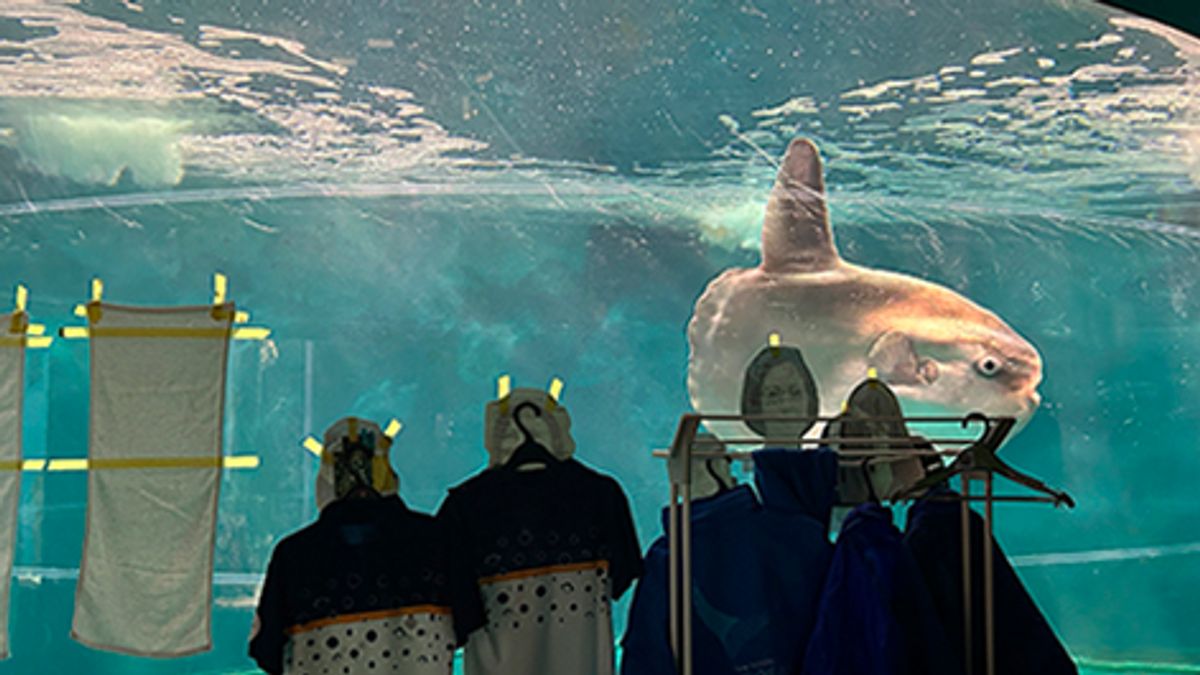


JAKARTA - In Japan, an aquarium finds a unique and creative way to keep their fish feeling accompanied during the closing period. This was done by the Kaiyokan Aquarium in the city of Shimonoseki, Yamaguchi Prefecture, Japan.
Reported by VOI from the socialnews24 page on Friday, January 24, this aquarium has been closed since last December for massive renovations. This project is quite time-consuming, with plans to reopen scheduled for next summer.
Although no human visitors have arrived, the marine inhabitants in the aquarium are still there, including the mola mola (ocean sunfish) which is one of Kaiyokan's main attractions.
However, shortly after the aquarium was closed, staff realized that this mola mola began to show unusual behavior. It looks lethargic, loses appetite, and often rubs its body into the aquarium glass.
The animal nurse team also discussed finding a solution. One of them then came up with a unique idea, namely hanging clothes and photos of human faces in front of the aquarium to create the illusion that visitors still came as usual.
As a background, this mola fish is very popular in Kaiyokan. Mola mola fish are generally popular in Japan because of its adorable appearance and a little ridiculous, similar to Shiba Inu's dog. The popularity of the mola mola in Kaiyokan is increasing after a viral video showing it swallowingferts in one bribe.
When discussing what might have bothered the mola mola, the fish-theory staff may feel lonely after suddenly losing a visitor's presence. The reason is, the mola mola in Kaiyokan has a habit of swimming close to the aquarium glass and looks comfortable when there is a crowd of people.
SEE ALSO:
-
 | LIFESTYLE
Pindah ke Pedesaan Jepang Ini, Penduduk Baru Bakal Dibayar Hampir Rp500 Juta
14 Januari 2025, 19:55 -
 | LIFESTYLE
Selain Jepang, 5 Tempat Wisata Terbaik untuk Menikmati Taman Bunga Sakura
06 November 2024, 15:55 -
 | LIFESTYLE
Informasi Musim Dingin di Jepang yang Berguna untuk Turis Indonesia
18 Desember 2024, 20:10

To overcome this, staff created a cardboard mannequin with an employee's face mask attached to a jacket on the clothes hanger. This idea is similar to the concept of rice fields people, but the goal is to make mola mola feel comfortable, not scare it.
The result? The next day, mola mola's mood began to improve. He looked more excited, and his appetite increased gradually. Although not fully recovered, this positive change shows that the staff's efforts have paid off.
It is still unclear whether this mola mola misses the presence of humans or is only disturbed by sudden environmental changes. However, for sure, the condition of this fish is getting better.
Moe Miyazawa, the biologist in charge of mola mola and its habitat, said staff will continue to try to maintain the happiness and health of this fish. He hopes that the mola will recover completely before the aquarium is reopened to the public.
The English, Chinese, Japanese, Arabic, and French versions are automatically generated by the AI. So there may still be inaccuracies in translating, please always see Indonesian as our main language. (system supported by DigitalSiber.id)
Most Popular Tags
#Prabowo Subianto #donald trump #2026 World Cup #Febrie Adriansyah #8791Popular


