
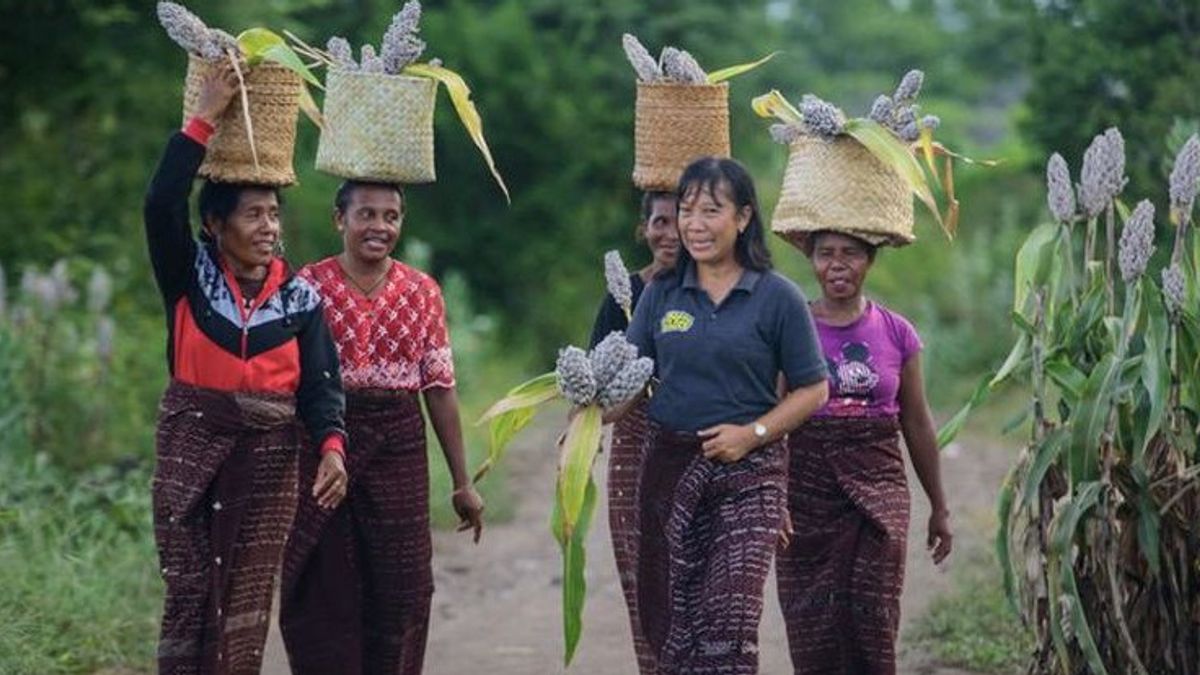


YOGYAKARTA - Sorghum plants are proven to be plants that can adapt to dry land so that they are not weak when the water is flooded. Sorghum, with the Latin name Sorghum bicolor (L) Moench, is grown in East Nusa Tenggara.
Maria Loretha, known as Mama Sorgum, said that the harvest of sorghum plants has been the staple food of the people of East Flores for a long time, reported the website of the Agricultural Technology Research and Development Agency (BBP2TP).
The people of East Flores call it solar corn, wata blolong, or wata holot. Meanwhile, the people of Sumba, call sorghum with wataru hemu tuji tinggi ke atas or wataru hemu kadipta hanging down. The Timorese know it as benwuka or bennina, Rote with rote corn and sabu corn, Ende calls lalo, the Sikka people call sorghum as watar, watar minten, and watar gahar. The Kedang people in Lembata call it watar woloq.
Based on Blench's mapping in 2016, reported on the Kehati website, the distribution of local languages in the term sorgum is found around Sumatra, Java, Bali, NTB and NTT, Sulawesi, to the Maluku Islands. In Central Java, sorgum is known as cantel, in West Java as gandrung, and in Sulawesi and Maluku is known as batari.
Maria Loretha started cultivating and preserving seeds from planting sorghum on her own land in Adonara. Supported by the dioceses of Larantuka and Lembata, Yaspensel (Larantuka Social and Economic Development Foundation), Mama Tata - Maria Loretha's nickname - developed 14 types of sorghum. Launching Mongabay, the types of seeds developed by Maria Loretha include Pega, Wolo, Warogoru, Black Mesak, Lepang, Watablolon, Merih, Okin, Wataru, Kuali, Terae Are, Terae Madare, Wata Mayung, and Wataru Hamu. The seeds were developed and planted in eight districts in NTT.
The woman who won the Kehati Award in the Sustainable Initiative Kehati category in 2012 explained that each farmer has a greater interest in certain types of sorghum. For Likotuden, the Kuali, Super-1, Okin, Numbu, Wolo, and Waiotan varieties are more developed.
As a seed keeper, this Dayak Kanayatn descendant woman plants all types of sorghum. Maria said, "I am a seed keeper, whether I like it or not, I still plant all types of sorghum."
The journey to plant the first sorghum seeds began in 1997. Maria and her husband, Jeremias, left Java and returned to her husband's hometown. The family's vast farmland was planted with various agricultural crops. The reason for being interested in planting sorghum was that he enjoyed sorghum dishes by his neighbor, Maria Helan. Falling in love with the delicious taste of sorghum dishes in dry and barren areas, Maria Loretha was encouraged to hunt for red sorghum seeds to Noba Village in Ile Buru. In 2007, he managed to harvest sorghum and believed that sorghum had great potential.
Together with the accompanying foundation he created, the Kadiare Agricultural Love Foundation, until 2016 it was recorded to accompany 34 farmer groups in eight districts, including in Ende, Nakegeo, West Manggarai, East Sumba, Rote Ndao, Lembata, Sikka, and East Flores. Maria Loretha has a big dream, namely to develop sorghum in the dry land of NTT, encourage the improvement of local food, farmers feel the economic impact, and raise Likotuden as an ecotourism destination area.
The English, Chinese, Japanese, Arabic, and French versions are automatically generated by the AI. So there may still be inaccuracies in translating, please always see Indonesian as our main language. (system supported by DigitalSiber.id)
Popular


