
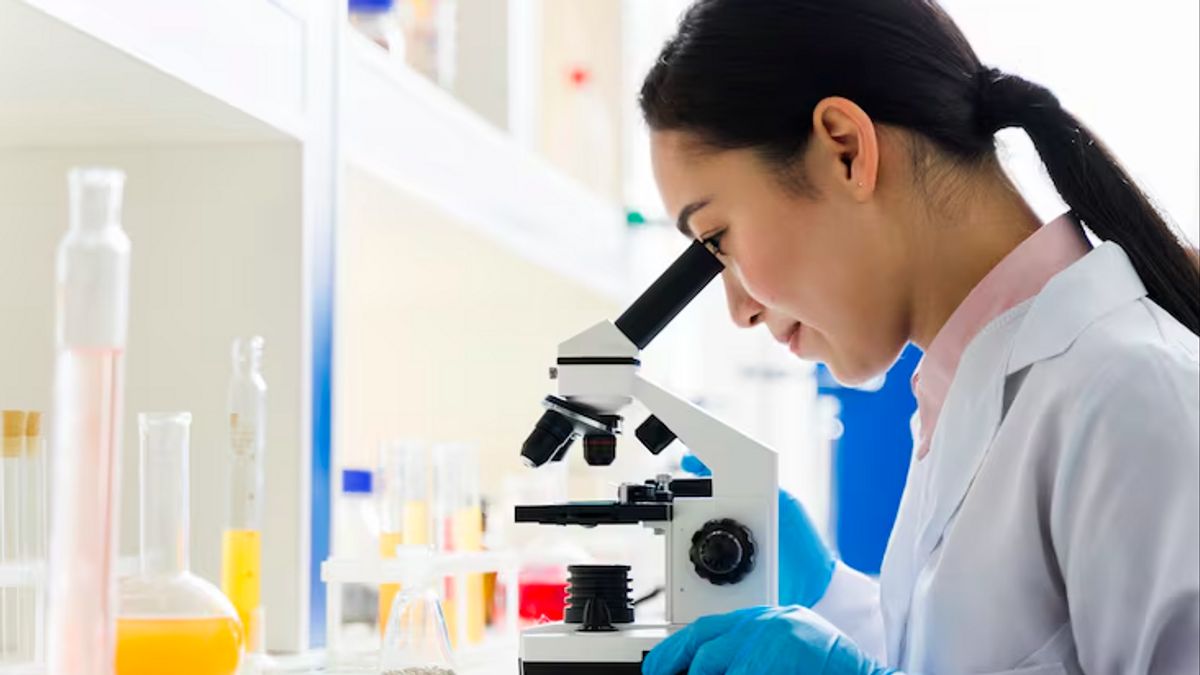


JAKARTA - More and more young researchers in Indonesia are starting to show their ability to produce relevant and impactful research. They are not only present as successors in science, but also as a "motor" of change that brings useful research results.
The stronger the research ecosystem, innovations born from laboratories are now starting to be directed towards real implementation in the health, technology, and industry sectors.
One of the moments that emphasized the development was the announcement of the three best studies at the 2025 Research and Technology Kalbe Science Awards (RKSA), which carried the theme Pentahelix Cooperation in Supporting Research Downstreaming.
Of the total 420 titles registered, three scientific works are considered the most ready to be developed towards the downstream stage. The innovation includes artificial intelligence-based diagnosis technology to functional beverage formulation for diabetics.
President Director of PT Kalbe Farma Tbk, Irawati Setiady, sees this success as a reflection of the great potential of Indonesian research.
"Indonesia has a lot of potential for science and technology innovation. Through RKSA, we bridge the synergy between industry and researchers as well as accelerate downstreaming so that research results are economically and socially beneficial," he said.
The 2025 RKSA also involves the Ministry of Higher Education, Science, and Technology (Kemendiktisaintek) as part of the policy support for the transformation of national research. This collaboration is in line with the Impacted Education and Technology Strategy, which places research as a lever of social and economic progress.
Chairman of the RKSA 2025 Jury, Prof. Dr. Amin Soebandrio, Ph.D, Sp.MK., emphasized that the quality of research is not only determined by academic power, but also readiness of regulations and potential implementation in the community.
"The potential success of innovation is influenced by its application and understanding of regulatory perspectives. The RKSA judging process is designed holistically by involving academics, government and industry. We will also monitor the research processes of the winners periodically," Amin said.
Although the development of research is quite promising, Prof. Amin reminded the importance of the principle of prudence, especially for natural research which is now increasingly popular in society.
He explained that the development of natural ingredients is divided into several approaches, ranging from traditional ingredients to the extraction of active compounds.
"Fans that have been used for hundreds of years, such as herbal medicine, are now being developed to be cleaner, healthier, and have guaranteed quality," he said.
SEE ALSO:
-
 | KESEHATAN SEKSUAL
Penelitian Jepang Ungkap Panjang Hidung Berkaitan dengan Ukuran Penis
26 November 2025, 01:25 -
 | KESEHATAN SEKSUAL
Studi Ungkap Pria yang Rutin Bercinta Mengalami Penurunan Risiko Sakit Jantung
03 November 2025, 22:25


This approach is known as herbal scintification, where the active content and benefits of a material are scientifically tested.
"In the past, the herbal medicines were made of leaves or roots mixed just like that, now research is being carried out to find out the active components that really provide benefits," he continued.
Natural ingredients-based research is now not only directed at drugs, but also functional food supplements and products such as effervescent tablets, herbal drinks, and nutrition preparations.
In addition to widely known medicinal plants, researchers have also begun to explore new sources that have never been used before. However, the research process must begin through the safety test and effectiveness stages.
"It must be proven first in animals whether it is useful and not toxic. If it is safe, it can be developed into an initial medicine, even though it is not an indexed drug yet," Amin explained.
One example is the development of Kombucha Rosella's ethervescent tablet, which was chosen as one of the best innovations of RKSA 2025.
The three selected studies are considered to have readiness for downstreaming and the potential for broad application in the health sector is as follows:
1. Achmad Himawan Hasanuddin University
He and his team researched the effectiveness of technology in the health sector by initiating AI-assisted Diagnostics of Atopic Dermatitis based on biomarkers and skin images.
2. Aulia Arif Iskandar Switzerland German University
AI-based portable 5-lead EKG devices for real-time cardiovascular screening.
3. Dr. Widiastuti Setyaningsih University Gadjah Mada
Downstream Kombucha's effervescent tablet Rosella antidiabetes with AI-NIR technology for quality control.
The English, Chinese, Japanese, Arabic, and French versions are automatically generated by the AI. So there may still be inaccuracies in translating, please always see Indonesian as our main language. (system supported by DigitalSiber.id)


