


JAKARTA - Debates about the safety of gallons of refills often appear in the community, especially related to the quality of drinking water and packaging durability.
But behind these concerns, experts assess the gallon to repeat it actually has an advantage, especially in terms of sustainability and impact on the environment.
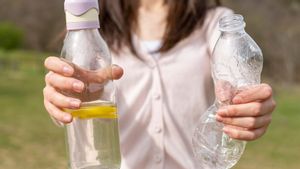
Lecturer and researcher at the Department of Food Science and Technology as well as the SEAFAST Center, Bogor Agricultural Institute (IPB), Nugraha Edhi Suyatma, confirmed that gallons to return are more environmentally friendly than disposable packaging.
"So from the environmental aspect, the packaging of gallons of Polycarbonate (PC) is superior to the gallon Polyethylene Terephtalate (PET). The packaging of gallons of PC has a longer repurpose than the gallon of PET," Nugraha said as quoted by ANTARA.
He added that the packaging of gallons in order to repeat does not add to the pile of waste, because the container can be reused so as to suppress the use of energy for the recycling process.
The statement was strengthened by the Head of the Makara University of Indonesia (DMUI) Sustainable Development Study Cluster, Bisuk Abraham Sisungkunon, who said the use of gallons to repeat was in line with the government's strategy to reduce waste through the principles of 5R: Reduce, Reuse, Recycle, Replace, and Replant.
According to data from the National Waste Management Information System (SIPSN) of the Ministry of Environment and Forestry in 2024, the national waste volume reaches 34.63 million tons per year, with around 9.9 million tons of which are in the form of plastic.
"Galon in order to repeat it can reduce single-use waste up to 316 tons annually," he said.
Bisuk explained that the current global trend leads to efforts to suppress the use of single-use plastics that have the potential to pollute the environment and accumulate in Final Disposal Sites (TPA). Indonesia itself targets a reduction in waste by 30 percent and waste management by 70 percent by 2025.
"Wearing gallons to help reduce plastic waste deposits which are currently still not handled in a sustainable manner. Garbage is often burned, buried, thrown into the water or thrown directly into the ground," he added.
SEE ALSO:
In addition, the use of gallons of refill also reduces dependence on virgin plastic to produce new gallons. Bisuk estimates that around 4,152 tons of virgin plastic can be saved thanks to the use of gallons for re-use.
Meanwhile, the Waste Zero Community highlighted the problem of Disposable Galon (GSP) which pollutes the waters north of Jakarta. This is considered to reflect the weak responsibility of producers in remanging waste in their product packaging.
The Zero Waste Community Coordinator, Wawan Some, emphasized that regulations clearly regulate producer obligations. Based on Law Number 18 of 2018 which was passed down to Minister of Environment and Forestry Regulation Number 75 of 2019, each producer is obliged to collect and recycle their packaging waste.
"So when someone then throws it away, the responsibility remains with the producers of their mineral water. In fact, I'm sure not everything can be recycled, not everything can be withdrawn with them even though their claim is large, it will make it easier to withdraw and recycle," said Wawan.
The English, Chinese, Japanese, Arabic, and French versions are automatically generated by the AI. So there may still be inaccuracies in translating, please always see Indonesian as our main language. (system supported by DigitalSiber.id)


