
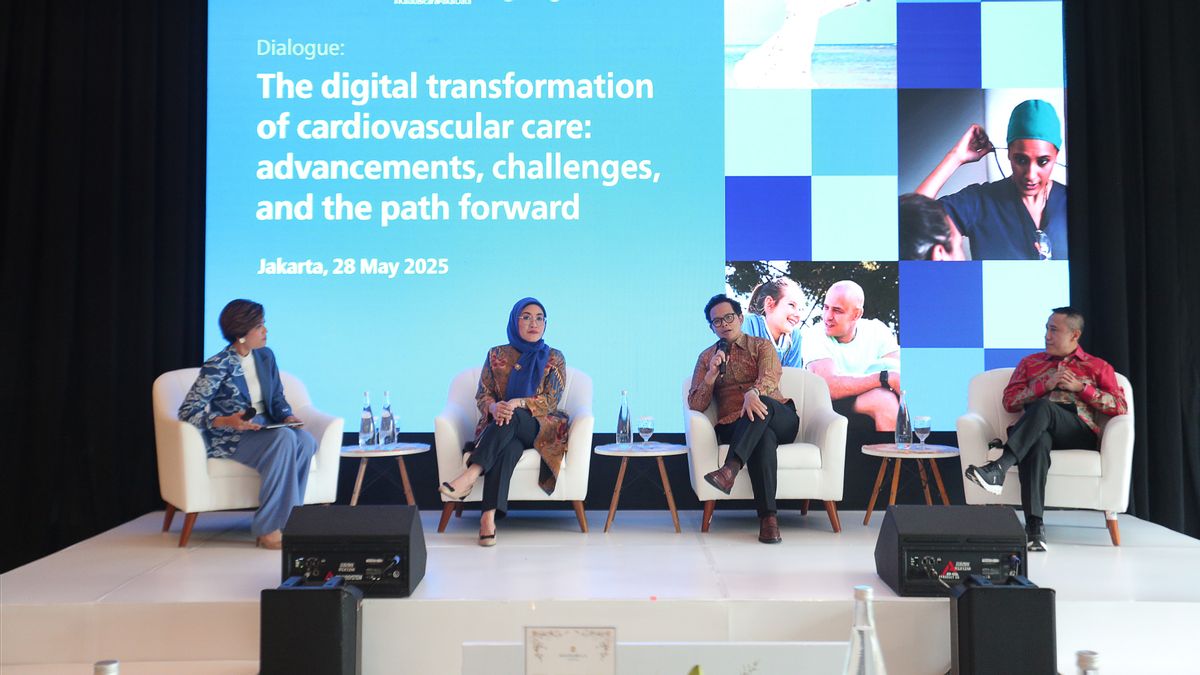


JAKARTA - The latest health technology, such as imaging, treatment, and artificial intelligence (AI)-based monitoring, is the key to providing better heart services amidst the limited number of cardiologists in Indonesia.
Royal Philips, global leader in the field of health technology, together with the Indonesian Heart Foundation (YJI) and the Association of Indonesian Private Hospitals (ARSSI), highlighted the importance of accelerating health service innovation as well as adopting advanced technologies such as imaging, treatment, and artificial intelligence-based monitoring (AI) as an urgent priority to overcome the increasing burden of cardiovascular disease in Indonesia.
In a dialogue entitled "Digital Transformation in Cardiovascular Care: Progress, Challenges, and Steps in the Future", the parties explained plans to use innovation and technology to provide better, faster, and more accessible cardiovascular services amid the limitations of health workers.
SEE ALSO:



Cardiovascular Disease Burden That Continues To Increase
Cardiovascular disease is a big challenge for the health system in Indonesia. About 650,000 people are diagnosed each year.
This disease is the main cause of death in the country. Heart disease also causes a health cost burden of Rp. 10.3 trillion or more than 700 million US dollars annually.
This condition is exacerbated by the limited number of heart specialists and uneven health facilities throughout Indonesia, which consists of more than 17,000 islands.
Currently there are only around 1,500 heart specialists throughout Indonesia. In addition, hospitals that have advanced heart services are only concentrated in big cities so that people in remote areas find it difficult to get adequate access to health.
"There are no cardiologists in certain areas in Indonesia and the incomplete diagnostic facilities for good heart disease have caused delays in diagnosis and treatment."
"As a result, patients come in a worse condition and are difficult to handle," said dr. BRM. Ario Soeryo Kuncoro, Sp.JP(K), FIHA, FASCC, Head of Medical Affairs of the Indonesian Heart Foundation (YJI) as well as cardiologist at the Heart Hospital and Harapan Kita Blood Vessel.
In addition to the limitations of medical personnel, health facilities in areas that have not developed are also often lacking in effective facilities to treat heart disease.
This systemic challenge creates a significant service gap and contributes to the increasing burden of disease nationally.
Patients With Heart Disease Are Getting Younger
Heart disease is now not only attacking the elderly. The more young Indonesians, even those aged 20'30, were diagnosed with this disease.
"Heart disease is now attacking youth groups who are in productive times."
"This greatly affects their lives and families because they have to adjust to manage this disease for life."
"Therefore, it is important for us to accelerate efforts to educate, prevent, as well as detect and treat early."
"The sooner it is recognized, the greater the chance to avoid complications and ease the burden on national health services," said dr. Ario.
Chairman of the Association of Indonesian Private Hospitals (ARSSI), drg. Iing Ichsan Hanafi, MARS., MH, also emphasized the same thing.
"The increasing number of young patients with heart disease is a warning to all hospitals."
"We must increase readiness, not only in treatment, but also in early detection and prevention."
"The focus of the service must shift towards a more proactive, fast, and patient-centered direction, for all age groups," he said.
Urgent Needs For Advanced Health Technology
All stakeholders agree that AI-based imaging, treatment, and monitoring, as well as data integration of cross-health facilities patients, are important solutions to bridge the service gap.
AI-based virtual technology also allows health service providers in remote areas to provide faster and more effective services.
Health service leaders have also planned the integration of this technology. According to the Philips Future Health Index 2024, as many as 74 percent of health service leaders in Indonesia plan to invest in AI's generating technology in the next three years, far above the global average of 56 percent.
"What really helps us work faster and more efficiently is when we have the right technology."
"This technology simplifies the workflow, speeds up the diagnosis process, and supports decision making."
"This means that patients can be diagnosed more quickly, treated early, and better yield opportunities also increase."
"Overall, hospitals can serve more patients, which is very important in areas with limited resources," said dr. Ario.
Furthermore, according to the Chairperson of ARSSI, the AI and digital technology can close the gap in heart services in Indonesia.
"By becoming a pioneer in digital transformation and investing in advanced health innovation and technology, private hospitals can continue to meet the needs of today's heart patients."
"In the future, at the same time support a more efficient health system," said drg. Iing.
Philips' Commitment To Providing Better Care For More People
Philips is working with healthcare providers to increase productivity and workflow efficiency across all service stages.
AI-based imaging solutions, such as heart ultrasonography, CT, and MRI help doctors detect early and accurate heart conditions, as well as speed up the diagnosis process.
Automatic measurements and real-time insight also simplify clinical work flow and increase confidence in diagnosis.
Integrated informatics platforms support the handling of complex heart cases by linking imaging data and cross-department clinical data.
The multidisciplinary team, starting from heart catheterization, ecocardiography, CT, to MRI, can access one patient's integrated appearance to track disease development and make decisions more quickly and precisely.
Digital tools such as remote monitoring and predictive analytics also empower health workers to manage chronic conditions proactively, reduce unnecessary hospital visits, and maintain patient involvement in their own health management.
"Indonesia's struggle against heart disease requires more than just medical personnel. We need innovation."
"With the limited number of heart specialists and disease burdens continuing to increase, we need a solution for health technology that can accelerate diagnosis and intervention."
"We are committed to building a stronger and more resilient health system. This is in line with our vision to provide better care for more people," said Astri Ramayanti Dharmawan, President Director of Philips Indonesia.
The stakeholders agree that the latest technology must be accompanied by a solid public-private partnership to accelerate the transformation of digital health in Indonesia.
This dialogue is a catalyst to encourage wider collaboration in building a more efficient and effective heart service model.
"Digital transformation is not only a matter of technology, but also how we work together to reimagine the way health services are provided."
"To have a real impact, this innovation must be accessible, can be applied on a wider scale, and built based on the needs of health workers and patients throughout Indonesia," said Astri.
The English, Chinese, Japanese, Arabic, and French versions are automatically generated by the AI. So there may still be inaccuracies in translating, please always see Indonesian as our main language. (system supported by DigitalSiber.id)


