
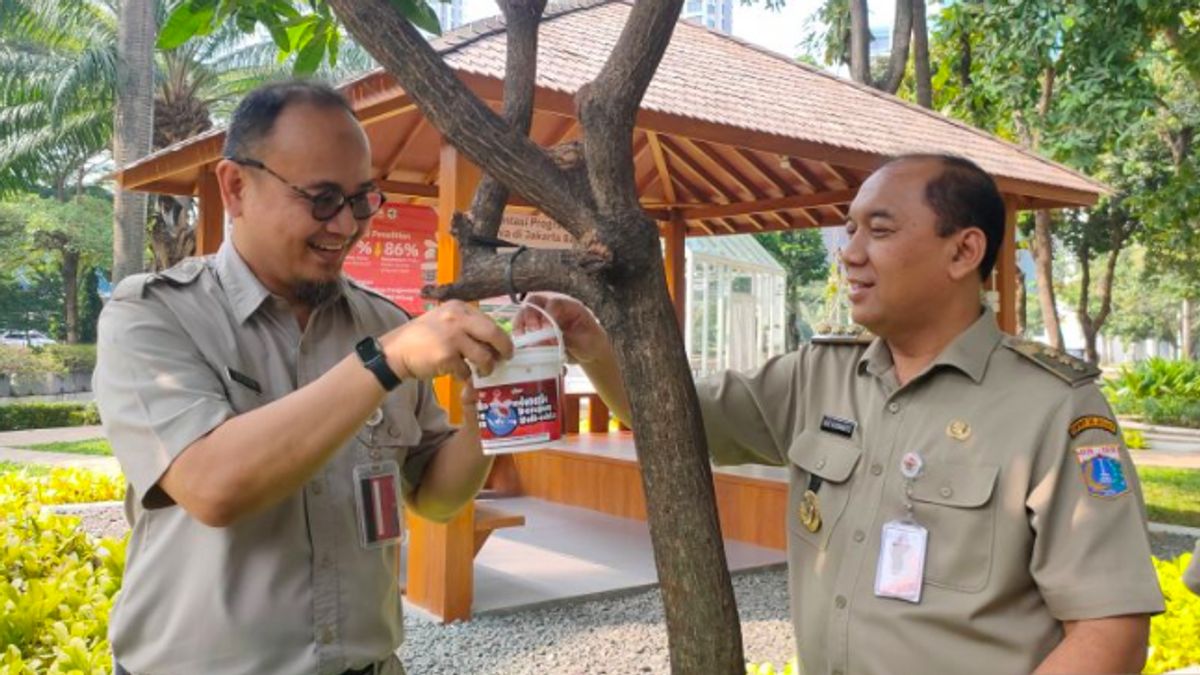


JAKARTA - The use of the Wolbachia mosquito is now starting to be applied as an innovative method to suppress the spread of Dengue Hemorrhagic Fever (DHF).
In West Jakarta, thousands of Aedes aegypti mosquito seeds that have been equipped with Wolbachia bacteria are placed at various points, including at the West Jakarta Mayor's office.
On Tuesday, the Mayor of West Jakarta, Uus Kuswanto, explained that the distribution of mosquito seeds was carried out simultaneously in two urban villages, namely South Kembangan starting from the mayor's office and Srengseng. "The seeds placed in the mayor's office are specifically for the South Kembangan Village. There are 13 laying locations each that have been handed over to foster parents," Uus told the media crew.
Uus added, with this implementation, a total of four villages in Kembangan District have become locations for the application of Wolbachia mosquito technology, after previously being implemented in North Kembangan and North Meruya.
SEE ALSO:
-
 | BERITA
Masih Pro Kontra, Pelepasan Jentik Aedes Aegypti Wolbachia Pencegah DBD di Bali Ditunda
17 November 2023, 16:56
He explained the reason for choosing Kembangan District as a priority location. "According to data from the Health Office, Kembangan District is one of the areas with the highest number of dengue cases in West Jakarta," said Uus.
Furthermore, Uus hopes that the spread of this Wolbachian mosquito can be an answer to public concerns regarding the effectiveness of this method. He also targets that after all regions in Kembangan District are covered, this program can be expanded to other sub-districts.
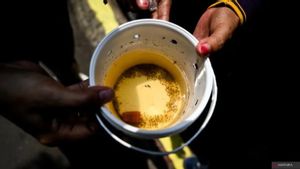
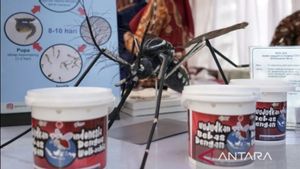
Meanwhile, the Head of the West Jakarta Health Sub-dept., Erizon Safari, said that each bucket contains 200 to 600 mosquito seeds containing Wolbachia. "As soon as they hatch and become adult mosquitoes, they will exit through special holes in buckets. When interacting with local mosquitoes and breeding, their descendants are no longer able to transmit the dengue virus," explained Erizon.
Each bucket is also supervised by "professive parents" who are tasked with monitoring the growth of mosquito seeds. "We carry out routine services every two weeks, including egg replacement. A large evaluation will be carried out after six months," he added.
Based on data from the West Jakarta Health Office, the number of dengue cases continued to increase throughout 2025. In January there were 186 cases, an increase to 211 cases in February, and reached 254 cases in March. As of April 10, an additional 53 new cases have been recorded.
The English, Chinese, Japanese, Arabic, and French versions are automatically generated by the AI. So there may still be inaccuracies in translating, please always see Indonesian as our main language. (system supported by DigitalSiber.id)
Popular


