
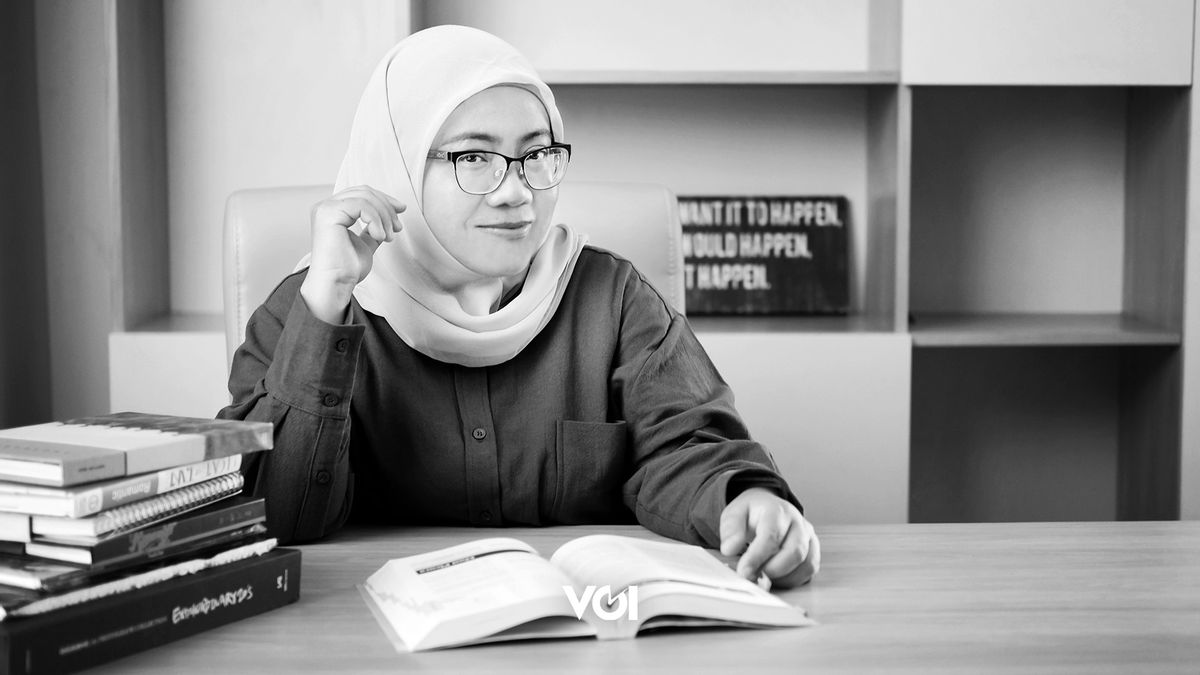


JAKARTA - Indonesia must return to its motto as a non-bloc country. The reason is, according to the analysis of International Relations Expert Binus University, Dr. Tia Mariatul Kibtiah, SAg, MSi, what has happened recently clearly shows Indonesia's bias on one of the blocs. If this is left, it is believed that it will complicate Indonesia's presence on the international stage.
***
The question of Indonesia as a non-bloc country is an old discourse since the era of President Soekarno. When the world was polarized between the Western Bloc led by the United States and the Eastern Bloc by the Soviet Union, Soekarno skillfully "surfed" between the two blocs. In fact, he led the southern countries to join the Non-Aligned Movement (NAM).
The movement then gave birth to the 1955 Asian-African Conference (KAA) in Bandung which was very legendary. The Indonesian Ministry of Culture has just commemorated the 71st anniversary of the KAA at the Savoy Homann Hotel, Bandung, Sunday, April 19, 2026.
In the era of Suharto, Habibie, Gus Dur, Megawati, SBY, to Jokowi, according to Tia Mariatul Kibtiah, even though Indonesia sometimes leans towards the United States (US), Indonesia's image as a non-bloc country is still maintained. However, he assessed that the situation is different during the current presidency of President Prabowo Subianto. "In the past, in the era of Suharto, we also leaned towards the US, but the cover as a non-bloc country is still visible. If now, it is no longer visible," he said.
Therefore, he suggested that Indonesia immediately return to the traditional pattern that has been carried out as a non-bloc country. "In the Middle East conflict, Indonesia offered itself to be a peacemaker the day after the US and Israel attacked Iran. How can it be accepted if Indonesia's position is considered to be more inclined to one side?" he said to Edy Suherli, Bambang Eros, and Irfan Meidianto when visiting the VOI office, Tanah Abang, Central Jakarta, April 14, 2026.
Pakistan has just initiated negotiations between the United States (US) and Iran, but ended in a stalemate. In your opinion, what is the main obstacle?
As an academic, I always advocate for peace. I had hoped there would be a meeting point, but in fact there was none. Without diminishing Pakistan's role, I actually hope that China or Russia will intervene as a mediator. Ideally, the US should be willing to accommodate Iran's wishes, not even close the door at all. If this pattern continues, an agreement will never be reached.
Iran actually only asked for 10 points, which I think is not too difficult: from the post-US-Israeli attack renovation budget, the lifting of economic sanctions, to the Strait of Hormuz and their proxy groups (Hezbollah, Hamas, and Houthi). The problem is, the US imposed 15 points of their own proposal. Finally? Deadlock.
One more thing, the delegation of these two countries is not equal. On the US side, there are J.D. Vance and Jared Kushner who I think don't understand the art of diplomacy. While Iran deploys heavy players such as Foreign Minister Abbas Araghchi and Speaker of Parliament Mohammad Bagher Ghalibaf.
At what point exactly is this deadlock most felt?
There are at least three crucial issues: uranium, the Strait of Hormuz, and Iranian proxies. The US insists on asking Iran to stop interfering in the affairs of other regions. The same is true of uranium; the US accuses Iran of wanting to make nuclear weapons, while Iran insists that it is for energy needs and the prosperity of the people. Even the IAEA has checked and stated that there is no formation of nuclear weapons there.
"I've been to Iran. Paying for electricity there is very cheap because they have the ability to process nuclear into electricity. This is what Israel and the US are afraid of. In the past, in the Obama era, there was a sense of trust. There was an agreement that guaranteed Iran would not make nuclear as long as economic sanctions were lifted. However, when Trump was in charge, the US unilaterally withdrew from the agreement.
The US was impressed with Iran's 10 conditions, but at the negotiating table it imposed 15 old proposals. Is this deliberately to corner Iran?
It seems that it is indeed a US tactic to just persuade Iran to return to the negotiating table. Iran is already at a point of great distrust of the US because it has been lied to many times. Imagine, while negotiations were underway in Switzerland, Israel actually attacked Iran with the blessing of the US.
"Why is the US now insisting on negotiating with Iran? Because their position is not good.
What is the indicator that the current US position is weak?
First, there are no US allies who want to fight Iran. Second, NATO is also reluctant to join. Third, Iran has a trump card in the form of the Strait of Hormuz as a bargaining position. Fourth, world public opinion is no longer pro-US. And finally, the US public itself urges their government to stop fighting because they feel this conflict has nothing to do with their national interests.
Pakistan, Egypt, and Turkey are often mentioned as potential mediators. Where is Pakistan's position among them?
If the choice is only those three countries, Pakistan is the most cooling. But again, China or Russia are still the best choice because they are respected by both sides. The problem is, do they want to? For the second round of negotiations, it seems difficult, because Iranian officials have expressed reluctance. The US needs a much greater effort if it wants to draw Iran back into dialogue.
President Prabowo had offered to be a mediator. Do you think Indonesia has that potential?
It is true, a day after the war broke out, President Prabowo offered himself. But honestly, this idea was even "laughed at" by the international public. Being a mediator requires power and influence on both sides. Our relationship with the US is very good, but what about Iran?
"In terms of culture, we may be close, but economically we are not. That makes one party hesitate. In a conflict of this magnitude, I think our leaders are better off silent. We must focus on national interests, especially energy security. One comment can be a dangerous blunder, especially if we seem to be too biased towards one side.
Some say our current leader is too "good boy" for the US. Your comment?
Yes, that is the image that is caught now. The image or image must be repackaged so that our "face" as a non-bloc country is again seen in the eyes of the world.
After the negotiations of Islamabad did not meet a point of convergence, the Strait of Hormuz was closed again. In the future, what will happen?
The US wants to return to the negotiating table, one of which is due to the Strait of Hormuz. Meanwhile, its allied countries can actually contact Iran directly. France, Spain, and the UK, all can pass through the Strait of Hormuz. Internationally, the Strait of Hormuz is Iranian territory; the US cannot just take it over. In the future, Iran will continue to defend this strait and only allow countries they allow to pass through.
Regarding the Strait of Hormuz, there are contradictory statements from Trump. At first he said he didn't need it, now it's just the opposite. How do you assess this?
In terms of supply, 80% of energy from the Strait of Hormuz flows to Asia and 20% to Europe, including for Indonesia. Indeed, America itself is not supplied with oil from there. Therefore, initially Trump said it was your business, we don't need it.
However, the US statement turned around after its allied countries were no longer in line. So, Trump changed his mind not because the US needed the oil, but because his friends were no longer giving support. The countries that were given ease by Iran became pro-Iran. Trump is afraid of losing his influence. As a result, world oil prices soared and hit the US economy. In fact, now there is an idea of impeachment in the US because of the suffocating fuel prices.
During the negotiations in Islamabad, Israel was not involved even though they were the main actors in the conflict. In the future, what will be the impact if this condition is repeated?
While negotiations were underway, Israel attacked southern Lebanon. This is what made Iran disappointed; every time there is a diplomatic effort, there is always an attack. It should be noted, Israel has no diplomatic relations with Iran, so it is impossible for these two countries to negotiate directly.
This Israel is smart "washing hands". When the US is cornered to attack Iran by land, Israel refuses to send troops. Israel wants Iran to disappear because it is considered to endanger their sovereignty, but they want the US to work. Israel will always try to make the US-Iran negotiations fail. As long as Donald Trump can't be firm against Israel, any negotiations will always end in a stalemate.
Donald Trump can't be firm because he's "driven" by Israel's interests?
It's not about steering or not, but whoever the US President will always stand by Israel. Only the level is different. If from the Democratic Party, it is usually more subtle (soft), for example Obama and Biden. Previously, when the IAEA said Iran did not make nuclear weapons, an agreement was reached. But if from the Republic, the style is harder, like Trump now.
Many observers associate this conflict with The Great Israel's ambitions. Is this plan getting closer to reality or is it buried by regional resistance?
The dream of The Great Israel is indeed there. The attack on South Lebanon is part of it - a vast area from the Nile River, Jordan, the Euphrates River, to parts of Saudi Arabia. The dream may be, but now facing Iran alone Israel is overwhelmed.
Even traditional allies of the US such as France, Germany, Spain, and the UK have begun to show disloyalty and have moved closer to China. Previously, during the Gulf War against Iraq, the US won easily because of the coalition's full support. Now facing Iran, the situation is different. Iran, whose weapons are far behind those of the US and Israel, has been able to survive. Their strategy is very clever.
Are the Arab countries aware that their territories are threatened by the annexation of The Great Israel's ambitions?
They tend to be pragmatic and see short-term gains. Bahrain and the UAE already have diplomatic relations with Israel. The ones who haven't are Qatar, Saudi Arabia, and Kuwait. After the relationship was opened, there were indeed economic benefits. They don't think long term, maybe they don't even believe in The Great Israel issue. Saudi Arabia itself had explored relations, but then backed down.
After the US and Israeli attacks were able to be quelled by Iran, did the dream of The Great Israel begin to waver?
The world is now witnessing that Israel is not as strong as it has been portrayed. High technology and advanced military equipment supported by the US can be penetrated. The image of "invincible" is now collapsing.
Does this mean that Iran's asymmetric warfare strategy is very effective?
Yes, they are aware of losing in conventional weaponry, so they play an asymmetric war. Strategic points are attacked with drones and missiles. With a certain pattern, expensive air defense systems such as Iron Dome, Arrow, and David's Sling can be penetrated by Iranian missiles and drones that cost much cheaper. Iran is also clever in attacking US company facilities in the Gulf countries to shake their economies.
This Persian nation is indeed tough. They are not afraid even though they are isolated from economic sanctions. Their IQ is high, they are good at developing technology in a tight situation. When the stock of weapons began to decrease after the war for more than a month, they played the Strait of Hormuz card. This blockade turned out to be very vital for world energy.
Now we see the US even as if "following the drum" of Iran, until it is involved in the Strait of Hormuz?
The US should have its own concept to conquer Iran, but it seems to have failed. Finally, they joined in blocking the outer Hormuz Strait.
The current US strategy is to kill the Iranian leader in the hope that his followers will surrender. But note, the leader they are targeting is senior, while the generation below him is out of sight. Trump said he would kill the Iranian leader in phases 1, 2, and so on. That's a big mistake. In Iran there is no such phase system. Their cadres are running very well.
Every year they select many candidates for Ayatollah. If one is killed, there are still many successors. Now Ali Khamenei's successor is Mojtaba. If he is also the target, a successor will emerge whose character is exactly the same. The candidates for Ayatollah are not only religious, but also scientists. In this case Trump is wrong again. Who is the informer? Their estimates are totally wrong.
So, the United States, which has been portrayed as a superpower, has also collapsed its credibility after attacking Iran?
Yes, the conditions on the ground can explain that. Do you want to say they won? Not really. This war actually humiliated the US as a superpower. In fact, Iran has been sanctioned for decades. The US wants to admit defeat even for prestige. Now, inviting Iran to the negotiating table again is difficult, because Iran has stopped being lied to.
I remind you, Indonesian leaders should not take sides in this conflict. Gus Dur used to join the Shimon Peres Foundation for Palestinian independence, but the public here could not accept that. Supporting a free Palestine is the basic pattern of this country which is in accordance with the opening of the 1945 Constitution. Our country is anti-colonial, that's clear. If there is an Indonesian leader who tries to run away from that pattern, his political career will be threatened.
Donald Trump is already under pressure from within and abroad. What can he do in this condition?
It's hard, because his alliance doesn't want to interfere and even turn to China. What he has to do is dampen Israel. Moreover, the majority of the US people themselves are actually pro-Iran. Iran's Foreign Minister, Abbas Araghchi, is very liked by the US people. When answering a CNN reporter's question, he looked calm but firm. His diplomatic language is calm but shaking. So, Trump has to stop this war because it is not good for his political career and the US. Now is the time to focus on the US people.
According to the CIA and FBI, Iran does not threaten the US. Therefore, it is useless to fight Iran. The question is, who is the whisperer so that Trump continues to fight? What is the "trump card" that the Zionists hold so that Trump listens once? There is no history of the US attacking Iran openly like this.
Did the Zionist lobby make Trump behave like that?
Besides the Zionist lobby, there could be one more trump card. If this is opened, it will destroy Trump's career.
Is it related to the Epstein Files?
It could be one of them. I also suspect that; the case resurfaced when the war was about to happen. The US should not have done this war because Iran is not dangerous. But what is being done now is as if they want to eliminate Iran from the region. Even though Iran is unlikely to disappear because it is a balance of power.
In this state of war in the Middle East, what is Indonesia's attitude so that national interests - such as Pertamina's tanker - can pass through the Strait of Hormuz?
"I see a difference in the foreign policy of the current government. In the past, from the era of Gus Dur, Habibie, Megawati, SBY, to Jokowi, we strengthened the region first. Now in the era of Prabowo it is reversed; bilateral first with distant countries, then to the region. As a result, our non-bloc attitude is not visible. In the past, in the era of Suharto, we were indeed leaning towards the US, but the cover as a non-bloc country was still visible. If now, it is no longer visible.
"In trade tariff negotiations, almost all of our positions are defeated. That's not called a negotiation, but it gives sovereignty to the US. That's very noticeable. Our presence in BOP (certain blocks) is also very striking. BOP is not urgent for Indonesia, so many are pushing to get out. Even though there have been many demands for the government to get out of BOP, the government is still going. How do I see it? Maybe it's still looking for ways so that if we get out of BOP, our trade tariffs won't be raised again.
"We should be brave like Malaysia. Break the trade agreement with the US and speak out strongly in defense of Iran which was attacked by the US and Israel. In terms of data, Malaysia's trade relations with the US are much larger than Malaysia with Iran. The ideology is also different; Malaysia is majority Sunni while Iran is Shiite. But Anwar Ibrahim can pack it all up nicely. We hope Indonesian leaders can be like that - prioritize the national interests and the Indonesian people.
So now Indonesia is leaning more to one side, not non-bloc anymore?
It is obvious, it is difficult to cover. Not to mention observers, even Indonesian people who are politically illiterate can read it. So far, our Foreign Minister - from Mr. Ali Alatas, Hasan Wirajuda, to Retno Marsudi - has had a good diplomacy. Their steps can be imitated. In my opinion, a strategic ministry such as Foreign Affairs should not be filled by people from political parties. It must be pure diplomats so that Indonesia looks elegant in international forums.
So our government can actually play a better role if it wants?
In the current situation, the EU countries alone can be pragmatic even though they are US allies. That's because they prioritize their own national interests and people. Why can't we be like that? In the future, we must "play beautifully" in the global political arena. Regional relations must be strengthened first, then bilateral with distant countries.
When working together to buy weapons or aircraft, there must be a bargaining position, for example, technology transfer or other benefits for the country. In theory, there must be national interests that are met. When all countries are busy taking care of their own people, we still look "facing" the US. Actually, it's good that the President visited Russia, but at the same time our Minister of Defense went to the Pentagon. Can't it be postponed first? Let the non-bloc image be built again. Currently, we are seen as serving the US, and this position is not good for the image of Indonesian politics in the eyes of the world.
Tia Mariatul Kibtiah: Tracing the Path of Peace from Tel Aviv to the Holy City of QomAs an expert in International Relations from Binus University which focuses on Middle East Studies, the experience of Dr. Tia Mariatul Kibtiah, SAg, MSi, MSi, visiting the two countries currently involved in the conflict is unique and full of lessons.
"Initially, my S1 was in education, but I was happy with journalism. I even took part in the Liputan6 host competition and won. However, the desire to become a host was hampered because at that time the hijab host was not common. Finally, I worked in one of the capital's print media," recalled the woman born in Karawang, June 2, 1978, the daughter of H. Abdul Hafidz and Hj. Pipih Alpinah.
Over time, Tia was interested in studying International Relations (IR). He continued his master's degree in the Middle East Political and International Relations (PHI) Program (2012), then completed a doctoral program in International Relations at Padjadjaran University, Bandung (2024).
In the midst of the heating up of the Middle East conflict, he is often a source of information in various media. "Understanding HI allows us to visit conflict countries and study state and non-state actors, such as Hezbollah in Lebanon, Hamas in Palestine, and Houthi in Yemen. In Indonesia, non-state actors are like NU or Muhammadiyah," he explained.
Even as an academic, he actively corresponded with his colleagues at Haifa University, Israel. "That's normal for academics. Through this friendship, I also sent a message that the Palestinians should not be attacked by the Israeli army," he said.
Experience Visiting Tel AvivIn 2015, Tia Mariatul Kibtiah had the opportunity to visit Tel Aviv at the invitation of Tel Aviv University. "The invitation was purely from the university, not the government. The participants were diverse, there were academics from the US to Iran. We focused on discussing finding solutions to the Middle East conflict without meeting the Israeli government," he explained.
From the discussion, Tia realized how complex the problem there was. "I understand why the conflict is so difficult to resolve. Because it is very complicated, it is normal that not many HI friends specialize in the Middle East; most of them choose Asian studies," he added.
Tia also noted that many Israeli academics of Jewish ethnicity actually do not like Zionism. "They protest the policies of the Israeli government and the genocide that took place in Gaza," he said.
While there, Tia also visited Haifa and Jerusalem. "In Jerusalem, I asked to be taken to the Al-Aqsa Mosque to pray Tahiyatul Masjid. I was accompanied by a Jewish academic friend," he said. He added that in the area, the holy sites of various religions such as the Wailing Wall (Jewish) and Bethlehem (Christian) are located close together.
Another interesting thing is that Indonesia is included in the Israeli education curriculum. "For them, Indonesia is important. So they know about us. When I say Israel is hated in Indonesia, they are not angry," he continued.
Tia also revealed a unique fact: many Israelis trust Muslims more than Christians in terms of consumption. "They prefer Palestinian restaurants because Jews and Muslims do not eat pork. In fact, Christians in Israel are often more discriminated against," he said.
Learning from IranThe opportunity to study in Isfahan, Iran, was taken advantage of by Tia Mariatul Kibtiah to learn about the culture and attitudes of the people there. One thing worth emulating, the Iranian people are very proud of domestic products. (Photo: Bambang Eros VOI, DI: Raga Granada VOI)
Tia's presence in Iran was in order to follow the Persian Language Study Program at Sahid Ashrafi Isfahan University (2012). In addition to Isfahan, he also visited Tehran and Qom.
"Isfahan is like Bandung, but without skyscrapers. Its typical Iranian architecture is very thick, the city is calm and beautiful. If Tehran is like Jakarta, a big metropolitan city full of tall buildings," he said.
The visit to Qom City also gave him a deep impression. "That's where the future Ayatollahs are trained and many Mullahs are born. The religious aura of Shiites is very strong there. Alhamdulillah, I was able to visit these three important cities in Iran," said Tia, who emphasized that he was not a Shiite but a Sunni.
Even though it has been embargoed by the US for decades, Iran has survived. Domestic production has become the main choice of its people. "They are very proud of their own products, so it's hard to find foreign products there. This is what we need to emulate. This pride is what makes them independent, even the weapons they make themselves," concluded Tia Mariatul Kibtiah.
"Israel wants Iran to disappear from the world because it is considered to endanger its sovereignty (sovereignty), but they ask the US to work. Israel will always try to make US and Iranian negotiations fail. As long as Donald Trump can't be firm with Israel, any negotiations will continue to end in a stalemate,"
Tia Mariatul Kibtiah
The English, Chinese, Japanese, Arabic, and French versions are automatically generated by the AI. So there may still be inaccuracies in translating, please always see Indonesian as our main language. (system supported by DigitalSiber.id)
Most Popular Tags
#Prabowo Subianto #donald trump #2026 World Cup #Febrie Adriansyah #8791Popular


