
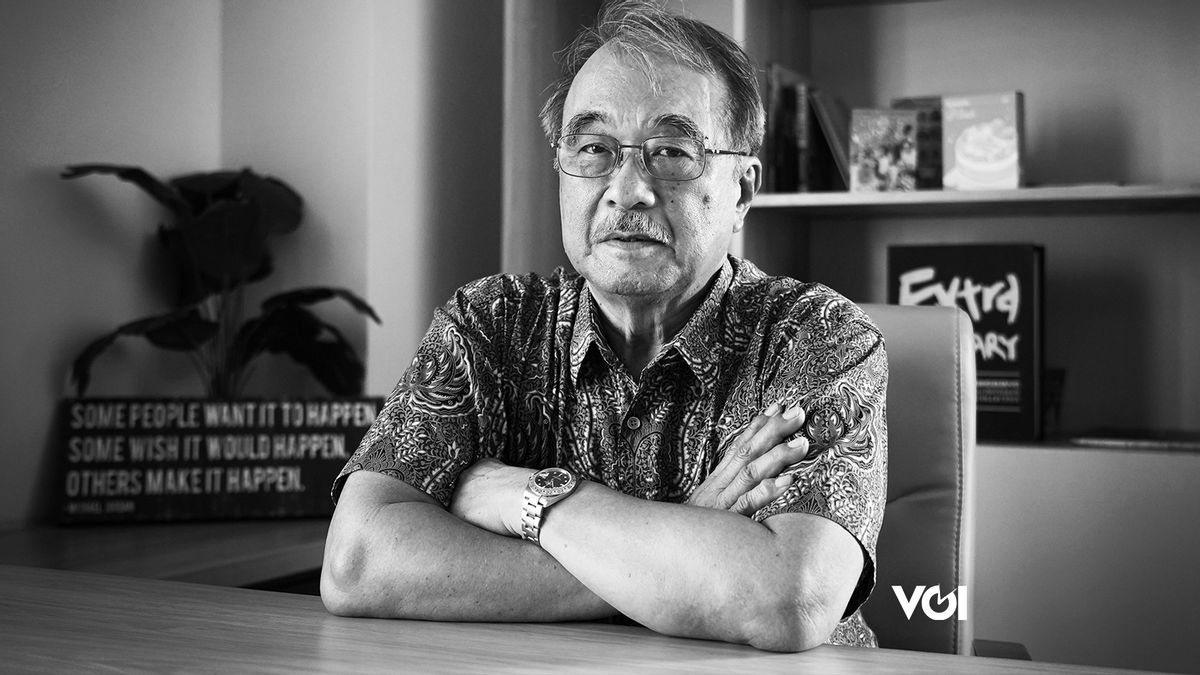


The labor-intensive industry, by its nature, absorbs a lot of labor. Therefore, said the Chairman of the Indonesian Association of Partnership (Aprisindo), Antonius Joenoes Supit, in difficult times like now, the textile, footwear, furniture, food and beverage, craft, and construction industries, can be a savior for many workers.
***
The reason is, there are so many workers who can be absorbed by this industry. Moreover, the manpower that can be absorbed does not require a high educational background. "The way to get our less fortunate brothers out of poverty is to provide jobs. This is where the role of the shoe, garment, furniture, and other industries can be a savior," he said.
Then what is the correlation of trade negotiations conducted between Indonesia and the United States through the signing of the ART (Agreement on Reciprocal Trade) with the garment and footwear industry? The volume of exports to America is large and this can keep factories producing.
The footwear industry, according to Anton, is not only labor-intensive, but also capital-intensive. It is appropriate for sectors like this to get more attention from the government because of its nature which is able to absorb a lot of labor.
"Actually, what we need is not complicated, the government just eliminates various business obstacles that exist in the field. If there is assistance in the form of other forms, please," he told Edy Suherli, Bambang Eros, and Irfan Meidianto when visiting the VOI office in Tanah Abang, Central Jakarta, February 20, 2026.
Starting this 2026, how do you map the position of the Indonesian footwear industry?
Talking about the shoe, garment, and other labor-intensive industries, our focus is on how to provide as many jobs as possible to the community. The reason is, our employment structure is 60% informal workers, only 40% formal workers. Formal workers have work ties, certainty of getting a salary at the end of the month, and other social security. Unlike informal workers, even though some of them also get social security. These people need certainty. In terms of education, the majority are graduates of elementary and junior high schools.
The way to get these less fortunate brothers out of poverty is to provide employment. This is where the role of the shoe, garment, furniture, and other industries can be a savior.
"We are not enough just to produce, we also need market access. After Donald Trump became president, all of this was disrupted because he reorganized the trade order. America is important in the footwear and garment sectors; its volume is around 10% of Indonesia's total exports there or around Rp200 billion. If added to footwear and others, it can reach 30%. Therefore, this sector is important if we talk about providing employment. Therefore, the tariff negotiations with the United States conducted by the Indonesian government are eagerly awaited.
The Indonesian government and America have signed the ART, how do you respond to it?
"It has indeed been signed, but that alone is not enough. So far, the trade between Indonesia and America is the one that has a surplus. That's why Trump "punished" by raising tariffs. The additional tariff is 32%, then the negotiations go down to 19%, and now the negotiations are again 0% for garments. I appreciate the negotiations that have been carried out.
"Does it mean that if we get 0% that we have won? How is the readiness of shoe entrepreneurs?
It is not certain whether we can take advantage of this or not. In the 70s, many entrepreneurs entered this cooperative sector. Many have fallen, now what is left is those who have been tested to face competition. This shoe industry is not only labor-intensive but also capital-intensive. It is a combination of two factories; there are those who make shoe soles and other components such as garments, both meet.
The potential market for shoes in the world is close to 4 billion dollars. The opportunity is still big. Vietnam can now export more than us. These shoes are not easy to move compared to garments. I see from the side of shoe entrepreneurs are ready because those who survive are those who have been tested. However, domestically there are non-tariff barriers, in fact this is also what Trump complained about.
So even though the opportunity is open, it is not automatic to achieve it. The ball is in the hands of the entrepreneur now, can he take advantage of this momentum?
The key is that we must improve the investment climate in the country. The most important thing is legal certainty; policies should not change. For example, what shoe entrepreneurs face about Amdal, it takes a long time to take care of it if you don't have a connection to officials. This must be resolved so that entrepreneurs can produce and absorb labor.
The government must also pay attention to the transformation of labor from informal workers to formal workers. To achieve this, investment is needed. BKPM standards 10 years ago, an investment of Rp. 1 trillion absorbed 4,000 workers. Now Rp. 1 trillion absorbs 1,200 workers. There is a decrease in labor absorption. To make people prosperous, yes, by providing jobs, not bansos; it is only a temporary cushion.
Should the government support investment so that it can create jobs, what do you think?
When the government passed the Cipta Kerja Law (Omnibus Law) some time ago, the number of job seekers at that time was 45 million people. Every year there are about 2-3 million new job seekers. Meanwhile, BPS said that the number of unemployed in Indonesia is 8 million, is this data true?
To be honest, I doubt it. If you refer to the data of 45 million job seekers, we need an investment of Rp. 40,000 trillion (assuming 1 trillion employing 1,200 people). This data and figure should be the handle of Bappenas or Menaker so that it can alleviate the 45 million job seekers. The government must find what investment commodities can absorb a lot of labor so that President Prabowo's economic growth target of 8% can be achieved. What is the prime mover, is it MBG (Free Nutritional Meal) or Red and White Cooperative or what.
"If we compare to other countries, what are they doing to absorb the many jobs?"
One of them is manufacturing. In the New Order era, our manufacturing once reached 27-30% of GDP. Now what I see in the media, it's only 18%. The drastic decline is because we have never been serious about dissecting investment changes.
In developed countries, Europe and America, the sector that was the pioneer was initially agriculture. After being strong, it switched to the manufacturing sector. After that, it only switched to the services sector (services). Have we reviewed this stage? This must be discussed and planned properly. The point is, the key to being able to compete globally is competitiveness. Our global competitiveness must be strong.
"Our shoe companies can compete with other countries, even though our export volume has decreased and is now losing to Vietnam in terms of export volume. The government's role is very helpful for our future as entrepreneurs.
What do you mean?
For example, the labor issue should not be politicized. If this is left alone, the workers themselves will lose. The decisions taken will shift from labor-intensive to mechanization, meaning that jobs will decrease. To be honest, I am sad every year with the UMR, now UMP. This is what is not understood, what is minimum wage. Minimum wage is a safety net, which is designed to be minimum. Can workers not be prosperous? Can, after a year of work, please negotiate with employers. If the employer does not want to, he can ask the government for help. If it is not effective, workers have the ultimate weapon: a strike. Not a demo. What is happening now is a demo every year. The ability of one company to another is not the same; if you are able, please raise 100%. The government must be wise, do not be swayed by the demo action. This is what we have to face in the future.
Remember, the strike is the right of the workers, but not to want to strike is also a right. Don't force, if you force it means breaking the law. Again, we ask for legal certainty from the law enforcement agencies of this country.
This shoe industry is not only labor-intensive but also capital-intensive, has the government given attention or assistance so that it can survive?
"Actually, what we want is not assistance. The important thing is that in running our business we are not hindered. That is what we complain the most. Thank God if there is assistance that can be given. For example in the Berikat Area, the import tax has been exempted; if it can also serve.
"Now this is a good momentum, our tariffs are more competitive in America, so goods from China cannot compete. In the long run, they relocate their industries, Indonesia can be an option. In Vietnam they lack labor, while in ours there is an excess. If we can't take this opportunity, there is no hope. The essence of Trump's trade war is that he wants jobs back to his country so he can employ his people. We are in front of our eyes.
"Now there are many factories that are relocating from around West Java and Banten to Central Java, even some are going abroad. Do you think this is prevented or how do you deal with it?"
"In my opinion, do we need them or not? If we don't need them, please let them go. But if we need it because many workers are absorbed, why not? Unless there is a replacement, business or manufacturing in other fields.
"In Indonesia today, with the UMP set for each region, in my opinion it is almost the same as in Vietnam or other countries. What needs to be encouraged is the scale of wages as in the civil service. There is a difference in working hours and wages. If the UMP is not implemented, the trade union must move to help its members fight for, negotiate with employers.
So what should the government do?
"The government must be firm and impartial. It does not lean towards employers or lean towards workers. The important thing is, if the normative obligation is not carried out by the employer, please be prosecuted; for example, the salary must be in accordance with the UMP. But if the demands of the workers are unreasonable, they should not be defended either.
Regarding workers who demonstrate every year to ask for a raise in UMP, what is the solution and the middle way according to you?
"I met the remuneration council in Japan twice. In Indonesia, it is tripartite (government, labor unions, and employers). In Japan, it is firm, if the economy improves, wage increases are inevitable. Therefore, we should not get used to using muscles, but using the brain. It should be negotiated to save the company. In this context, the government must be able to defend the interests of what must be saved.
Abroad, diligent employees can get a lot and those who are not diligent can get a little, does this also apply in Indonesia?
"Every company I am sure has a mechanism to provide appreciation to diligent and high-achieving employees. The previous era already had a vocational discourse, as Germany did. But this has not been realized, it is still a mere discourse.
Before President Prabowo to America, a number of businessmen were called to Hambalang. What is the president's hope for entrepreneurs?
I didn't go there, but according to my friends who came, entrepreneurs were asked to help overcome the investment climate. The President asked the Mensesneg to accommodate the complaints of entrepreneurs. The President and entrepreneurs have the same goal: building the Indonesian economy. Therefore, it needs synergy. If there are obstacles in the field that cannot be overcome, he said he could report to the Setneg or related ministries. If the President's political will can be implemented, I believe our economy will be helped.
"If this problem can be institutionalized, it's good. So every problem, the solution will be the same. So far, each entrepreneur has solved it in their own way; those who are close to officials are quickly finished. It can be called a task force or whatever, which does not need to be fat. The goal is for business to run smoothly; the task is to unblock. We are a big nation, no one is tied to each other. We have to synergize.
What do you hope for President Prabowo and his team that the footwear industry not only survives, but returns to being the pride of Indonesian exports?
"We are drafting a strategy and are being discussed with the Coordinating Minister for the Economy. We want the supporting industries to also develop in line with the main industries. If anyone wants to build, please this can be a priority and given protection. There are also certain industries that help the government's mission to address poverty, this is also please supported. The obstacles that have been in place so far please be removed, it does not need funds.
I still remember the words of Mr. Pang Lay Kim, the father of Bu Mari Pangestu, after he studied the success of East Asian nations such as Japan, Korea, Taiwan, and China. He said we must change the paradigm from "alert nation" to "trading nation".
"We have to see, is importing a sin? In China, they make it easier to import production materials, and as a result, they can export many times over. The point is that no country can meet its own needs. It must be distinguished between imports for production and consumption. In addition, the key is that good governance must be upheld.
Anton Joenoes Supit: Traveling Does Not Have to Be ExpensiveAnton Joenoes Supit's trips or travels do not need to be luxurious or expensive. (Photo by Karisa Aurelia Tukan - VOI, DI: Raga Granada - VOI)
Traveling is an activity that Anton Joenoes Supit does outside of his routine. For him, walking and visiting new places is a form of gratitude and enjoying the beauty of nature created by the Almighty. "For me, traveling doesn't have to be expensive; enjoying the beauty of God's creation is enough. After traveling, we can refresh ourselves," he said.
Anton's favorite place to travel is Europe and Japan. "I usually go to Amsterdam first, because there are many families living there. After that, I will explore various European countries. I usually drive myself when I travel, because I have an international driving license," said Anton, who is very helped by digital maps that can be accessed via mobile phone.
There is one activity that not many people do, but he did it while in Vienna, Austria. Anton likes to visit the graves of classical song composers at the Vienna Central Cemetery (Zentralfriedhof), especially in the Musicians' Ehrenhain (Area of Honor for Musicians).
"There Ludwig van Beethoven, Franz Schubert, Johannes Brahms, Johann Strauss I & II (Father and Son), and others are buried. In short, they all gather there. Only Mozart is not buried there," he explained.
If Mozart, continued Anton, he was in another cemetery. "Why is he different himself? The information I got, when he died in a difficult state and had a dangerous disease. In the end he was buried where he died on the same day. Well, that night it rained heavily, the mound of his grave was level with the ground. Because people can't find the exact location of the burial, it was just a guess; at one point a proper tomb was built, there was a wax statue and an angel," he said.
Natural Tourism and Typical CulinaryThe natural beauty in Europe with the beautiful countryside made Anton even more amazed by the Creator. "The nature is beautiful; there are mountains with eternal snow and beautiful and green countryside. So there's no need to go to a fancy place, that's enough for me to be grateful," he said.
But for traveling, it's not always driving. There are times when Anton combines his journey between airplanes and cars. "From Holland I took a plane to Italy, then rented a car there and traveled to the cities in Italy. The same goes for Spain, landing in Madrid or Barcelona, then renting a car," he said.
One experience while stopping in Naples; in the city there is one famous pizza seller. Anton is eager to taste the delicacy of the typical dish, even though the queue is long. "Because I'm not a culinary expert, the obsession to get and taste the pizza makes me excited. The long queue is also just endured, hehe," he said.
He did the same thing in other places, such as when he went to Semarang. "Semarang is famous for its lumpia. I am also obsessed with finding the best lumpia there, even though it is crowded and I have to queue again. That's the adventure to taste a dish," said Anton, who has reduced his food intake even though he is not forbidden.
Mature Travel PlanAnton is one of the people who are orderly and have a mature plan when traveling. "For example, I'm from Bandung; the morning before I get to my destination, I will stop by Purwakarta to eat maranggi satay. After I'm full, I'll continue my journey. In the afternoon, I'll stop by Cirebon for empal gentong lunch and other typical foods," he said.
The journey from one point to the next for Anton is a journey that will be remembered in the future. "For people, maybe it's normal. But for me, it's something to enjoy and be grateful for. Thank God for giving me happiness even if it doesn't have to be luxurious or expensive," he said.
Here he could see God's justice on his people. "So God is fair to his people. People who are what they are can be happy without having to go on vacation with luxurious facilities. Eating on the side of the road, queuing to buy food is something unique. And when we can get food after passing a long queue, it feels so happy," he explained.
With this interview, Anton also feels happy. "Because I have motivation, hopefully what is discussed can be useful for others. Changing the situation for the better, that's the hope," he said.
"The way to get our less fortunate brothers out of poverty is to provide employment. This is where the role of the shoe, garment, furniture, and other industries can be a savior,"
Anton Joenoes Supit
The English, Chinese, Japanese, Arabic, and French versions are automatically generated by the AI. So there may still be inaccuracies in translating, please always see Indonesian as our main language. (system supported by DigitalSiber.id)
Most Popular Tags
#Prabowo Subianto #donald trump #2026 World Cup #Febrie Adriansyah #8791Popular


