
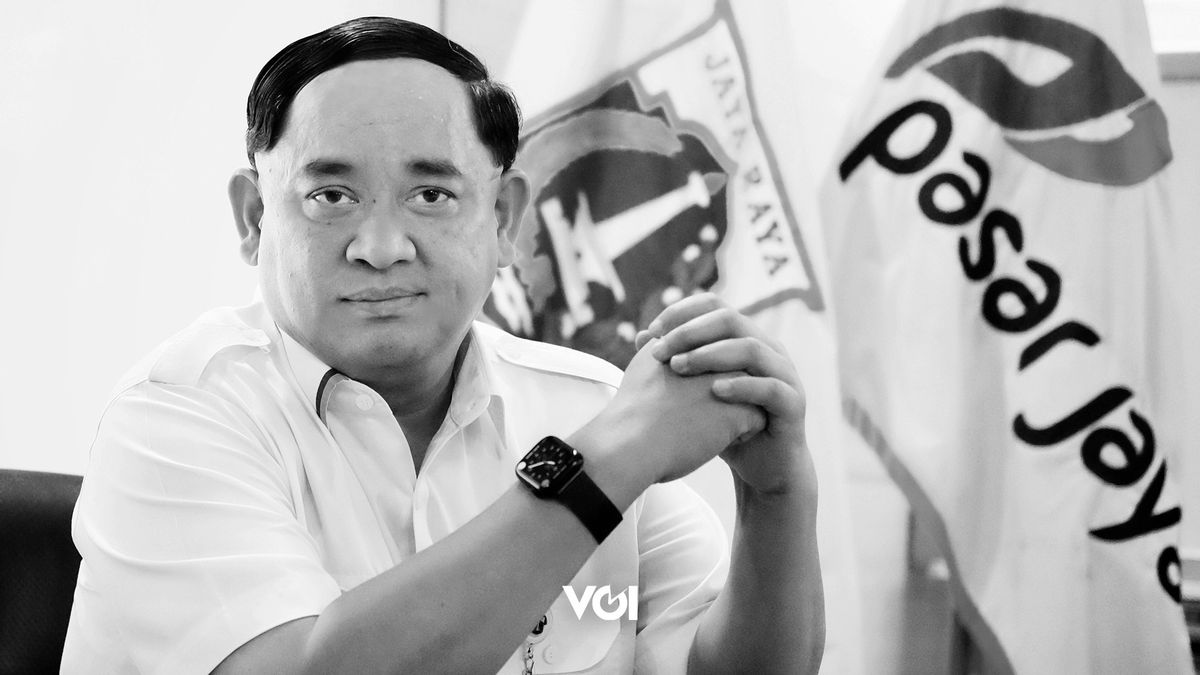


So far, waste is still a problem in various places. According to the President Director of Perumda Pasar Jaya, Agus Himawan, every day the waste in the Pasar Jaya environment throughout Jakarta reaches 500 tons. This amount is equivalent to 7-8% of all Jakarta's waste. That is why, his party will try to independently process the waste produced.
**
Pasar Jaya's efforts to process waste independently are not only aimed at reducing the burden of the Final Disposal Site (TPA), but can also produce new products that are useful. "Of the 500 tons of waste from all of Pasar Jaya, almost 95% is organic waste. In accordance with the directions of the Governor, we are preparing a self-sufficient waste processing center," he said.
The first step will be built at the Kramat Jati Central Market, East Jakarta, because this market contributes the most waste. "Kramat Jati Central Market produces 40% of our market waste. This is in the process, hopefully in 2026 it can be realized. The output of waste management is in the form of liquid fertilizer and organic fertilizer that can help urban farming in Jakarta," he said while adding that after that a self-sufficient waste processing will be made in various other areas of Jakarta.
To realize this self-sufficient waste processing, Pasar Jaya will involve traders by sorting out the waste produced. "To the public, we ask for help and support to improve the market. This is a joint task, not just us. Come on traders and the public, help us together to improve this market," he told Edy Suherli, Bambang Eros, and Irfan Meidianto from VOI who met him recently at the Pasar Jaya State Owned Enterprise Office, Cikini, Central Jakarta.
How many traditional markets in Jakarta will be revitalized?
"We support the Jakarta Provincial Government's program to improve existing infrastructure, especially markets. This is to welcome Jakarta as a global city. It has been 8-10 years since there has been a massive renovation of market buildings in Jakarta. In revitalization, we use three schemes.
Internal fund use: In 2023-2024, almost 67 markets will be carried out with external painting of the facade, parking lot improvements, paving, concrete, toilet repairs, and others. Regional Capital Participation Scheme (PMD): This is done for 30 markets. During the pandemic, it was stalled, thank God it was all completed. Synergy Partnership Scheme: It can be with BUMN, sister company, or private.What are you doing so that after the revitalization of the rental price does not burden traders?
"We apply existing regulations. When setting the price of the kiosks, we use an independent Public Appraisal Service Office (KJPP). Before it is implemented, there is a socialization first. The markets that have been completed include Duta Mas Market, Jembatan Besi Market, and Serdang Market. In the future, what will be revitalized is the Pramuka Market and the Kramat Jati Mother Market.
If there are still street vendors on the market page, how do you discipline them?
"We always coordinate with local authorities when we will carry out the order. Of course we do not evict traders, but rather arrange for the quality of the environment to improve. We do this in Kramat Jati Market, Palmerah Market, and Sunday Market. Furthermore, in markets that also have many PKL, the order will be carried out. We give them the opportunity to trade in the los that are in the market.
"If we see in Tanah Abang Market, the PKL who have been disciplined come again. What can be done?
To handle the Tanah Abang Market, we have coordinated with regional authorities, local city governments, and the government of the traders because there is a Tasikmalaya trader community there. The public is usually familiar with the "Tasik Market" which operates every Monday and Thursday.
"We have already submitted, please enter and trade in markets managed by Perumda Pasar Jaya. We also provide convenience with the term "3+3", which means the first three months are free, if you haven't got any results, add another three months, after that you only pay according to the applicable tariff. Another alternative, we will revitalize Pasar Tanah Abang Block G so that they can trade there. We will make branding like "Pusat Bordir Tasikmalaya" or something like that so that buyers are interested.
So, who does the selling place of the Tasik Market traders belong to now?
"I don't know who the land belongs to, whether it belongs to government agencies, private companies, or individuals. If the concept we offer in Block G is realized, it will reduce the chaos in Tanah Abang Market.
How is Pasar Jaya ready to compete with private modern retail that looks more neat and orderly?
The market that has been revitalized in concept is a clean, modern, and environmentally friendly market. For example, Jati Rawasari Market; not only a place to trade, there are also badminton sports facilities. There are 19 more markets that will have sports facilities, namely 11 badminton courts and 8 futsal courts. Following will be built also padel courts, because now it's a trend.
Even for the Jati Rawasari Market, the electricity needs come from solar energy through solar panels on the roof of the building. There is also independent waste processing; we have socialized to traders to sort waste.
What are the other advantages of Jati Rawasari Market?
Of course, this market is also disability-friendly. There are not many markets that make it easier for our disabled brothers. Another thing, there is a lactation room for nursing mothers. Other facilities such as parking are arranged neatly, neatly, and safely. Like most modern shopping centers, we also provide a food court to pamper visitors.
In the future, all markets under the auspices of Perumda Pasar Jaya will be built like that; modern, clean, complete facilities, and environmentally friendly. For ornaments, we use local wisdom typical of Betawi on the exterior of the facade.
Roof besides installing solar panels, what is it used for?
"Jakarta has limited land. In some markets, we have made the top a greenhouse. We plant various plants, such as vegetables, flowers, and fruit. This has been done at Mayestik Market, Perumnas Klender Market, and will follow other markets.
In addition, we are also optimizing the upper part of the market as a residence (mixed-use). So there are other functions as residences, such as in the Manggarai Grass Market. The concept used is TOD (Transit Oriented Development), so it is directly connected to existing public transportation facilities; TransJakarta, Jaklingko, and then LRT.
"Apart from the Manggarai Rumput Market, where else will this TOD concept be built?
There are several more markets that will be built like this: Senen Market Block 6, Palmerah Market, Grogol Market, and Cempaka Putih Market. This concept is expected to help provide housing in Jakarta. The scheme used is SKBG (Building Ownership Certificate). This concession is 60 years, bankable (can be mortgaged), can be taken over, and can be inherited.
With this concept, are you sure you can compete with the private market?
Oh yes, God willing, it can. The trader is an asset and we must help, especially those who are UMKM. They can encourage an increase in economic growth. With the synergy between Perumda Pasar Jaya and traders, the market in Jakarta will be better, cleaner, and more modern.
How to minimize criminal acts in markets such as pickpocketing, theft, scalping, and others?
"The effort we are doing is to minimize transactions in the form of cash. So, we encourage the use of QRIS. In the digitalization of this market, we work together with BI, OJK, as well as banks that have been in the market. To be interesting, we hold a market competition where traders and buyers use the most digital transactions.
Another effort is to tidy up PKL so that they can continue to sell, but in places that are already available. This will reduce the chaos that exists. We also add security personnel and increase coordination with related authorities in their respective regions.
"After revitalization, prices usually go up, what do you do so that traders can still sell and pay rent?"
We do not arbitrarily set tariffs. However, the continuation of the traders selling it is also our concern. The price setting is based on an appraisal from an independent appraisal service office. For example, at Pramuka Market, we lowered the price by almost 60% of the appraisal value. This means that we are trying to help traders.
How is the waste management management at Pasar Jaya?
There are 153 markets under Perumda Pasar Jaya, of which 146 are active. The daily waste production from all markets is around 500 tons. It contributes 7-8% of Jakarta's total waste, which amounts to 8,000 tons per day.
"Of these 500 tons, almost 95% are organic waste. In accordance with the Governor's instructions, we are preparing a self-sufficient waste processing center. The first one will be built at the Kramat Jati Central Market because it produces 40% of our market waste. This is in the process, hopefully in 2026 it can be realized. The output of waste management is in the form of liquid fertilizer and organic fertilizer that can help urban farming in Jakarta. If many of these waste processing plants are built, we can reduce the burden of existing landfills while producing new products.
Besides the Kramat Jati Central Market, where else will this self-processing waste facility be built?
"We divide the market in Jakarta into 14 areas. The second self-processing waste center will be built in West Jakarta. We are in the stage of exploration with partners. After that, it will follow the market in other areas.
Regarding the digitization of payments, how is the development in the markets owned by Pasar Jaya?
"We are working together with BI and OJK; the target is that by the end of 2025 it can reach 40 markets. Payments from buyers to traders, and from traders to Pasar Jaya in the future will be recommended cashless. This is effective to reduce leakage.
Does the market that serves to supply basic necessities to the community help stabilize prices?
Our Tupoksi is managing market properties, then acting, and retail. This helps control regional inflation along with sister companies in the food sector under the Jakarta Provincial Government: Food Station and Dharma Jaya. We distribute subsidized food and help other food security.
"We also have Jakmart, a small retail store that contains basic necessities. Currently, there are 105 outlets throughout Jakarta. We also help open retail such as IstiqlalMart. There is also JakGrosir; there are 4 in the Jakarta area (Pasar Kramat Jati, Kedoya, Koja, and Thousand Islands).
What are the anticipations for the market fire?
"We insure the market building. Then, we also secure the 24-hour market. In all markets, APAR (Light Fire Extinguishing Equipment) must be present. And of course we coordinate with the Jakarta Fire Service (Damkar). We also routinely conduct fire simulations with the Damkar. With all the efforts of anticipation, hopefully if a fire occurs it can be immediately overcome.
Has the modernization of the market so far met the Jakarta Provincial Government's target?
We have only been in office for two years, from 2022 to the present. The data on the number of markets with good conditions is increasing. Almost 80 markets we have improved and the conditions have changed. What we are doing is for the convenience of the people of Jakarta in particular, and all residents who use markets in Jakarta in general.
Not long ago, Governor Pramono Anung visited Blok M, it turned out that the price of the kiosks sold was different from the existing list. What can be done so that cases like this do not happen again?
"The case did not happen in the Perumda Pasar Jaya environment, but I agree that it can be a lesson so that it does not happen in our place. We have strict rules; traders who rent kiosks in Pasar Jaya cannot rent it again to other parties. There is a Perda and a lease agreement. The penalty is firm if it is violated.
What about the regeneration of traders? Sometimes the children of traders do not want to be successors.
"We provide training to traders about financial literacy. To the heirs or children of traders, we give them space and opportunity to continue their parents' business. But it all depends on the respective heirs.
What are your expectations of traders and the community as market users so that the market remains good and functional?
For us, traders are a very valuable asset. Without them, the traditional market would not be possible. To the team, I emphasize to "pick up the ball" if there is a problem. Then what we need to present is also a very large arrears from traders. We provide installment relief; hopefully this can help and the market continues to operate.
To the public, we ask for help and support to improve the market. This is a joint task, not just us. Come on traders and the community, help us both fix this market.
Agus Himawan: Between Culinary and SportsWhen he is not performing routine activities as President Director of Perumda Pasar Jaya, Agus Himawan has a hobby of walking and culinary tourism. It turns out that these two activities can be done in parallel. Sometimes he does it with his family, other times with friends at the office.
"My hobby is walking and culinary. Sometimes the two go hand in hand. It means that after walking, I immediately go to culinary, hehehe," said the man who was born in Cilacap, Central Java, June 15, 1968.
For culinary, he can do it with colleagues or family. "Basically, if there is good food in any corner, we will taste it. I am not picky, ranging from UMKM dishes in a stall to a restaurant," he said.
When asked what food he liked the most, it turned out to be food from the city of Palembang. "I really like pempek. Because it's delicious, a combination of savory fish flavor with a sauce that tastes 'many'; spicy, salty, sour, and a little sweet. If you eat pempek, you can be kalap," said Iwan who has almost tried all variants of pempek, ranging from lenjer, submarines, adaan, lenggang, and others.
If you are a culinary tourist, the counterweight is sports. "Excess food intake after culinary tourism must be balanced with exercise. What I do is morning walk, either alone or with my family. Usually I walk for an hour. That's pretty sweaty," said Iwan, who is usually accompanied by his beloved wife.
Attention for FamiliesMonday to Friday, Agus Himawan will focus on office affairs. Meanwhile, weekends are a time to be with family. "Usually we walk together while enjoying culinary tourism," he said.
Of his three children, two have completed their studies and are working. The youngest is still studying at a university in Jakarta. Morning is Iwan's and his family's favorite time to gather. "After gathering together, the children can do their personal activities," said Iwan, who asked his children to temporarily store their gadgets while gathering with their families.
Iwan and his wife give their children freedom to be active as long as they are responsible. "I always emphasize to my children to be responsible for their activities. Don't do things that are prohibited by religion," said the man who completed his S1 from the Indonesian Christian University (1992).
Since his children are in elementary and secondary schools, Iwan has instilled the understanding to arrange the future. Because the future is a personal responsibility, it cannot depend on others including parents themselves. "So I teach them to design their future independently. We as parents direct," he explained.
And last but not least, when doing something must be balanced. "Don't just study or work, balance it with exercise and enough rest. So live a healthy and positive life," said Agus, who completed a Master of Science from Dr. Moestopo University (2015).
Not only to his son, Agus Himawan also advised all children wherever they are to always study. "My message to my children and all children is to study, study, and study. This world is getting more developed and advanced, we will be left behind if we don't study. In the future, the competition is not only from within the country, but also from other countries that are expanding into Indonesia. Now it's globalization," he explained.
"In the future, all markets under the auspices of Perumda Pasar Jaya will be built modern, clean, complete facilities, and environmentally friendly. And for market ornaments, we use local wisdom typical of Betawi for the exterior of the facade,"
Agus Himawan
The English, Chinese, Japanese, Arabic, and French versions are automatically generated by the AI. So there may still be inaccuracies in translating, please always see Indonesian as our main language. (system supported by DigitalSiber.id)


