
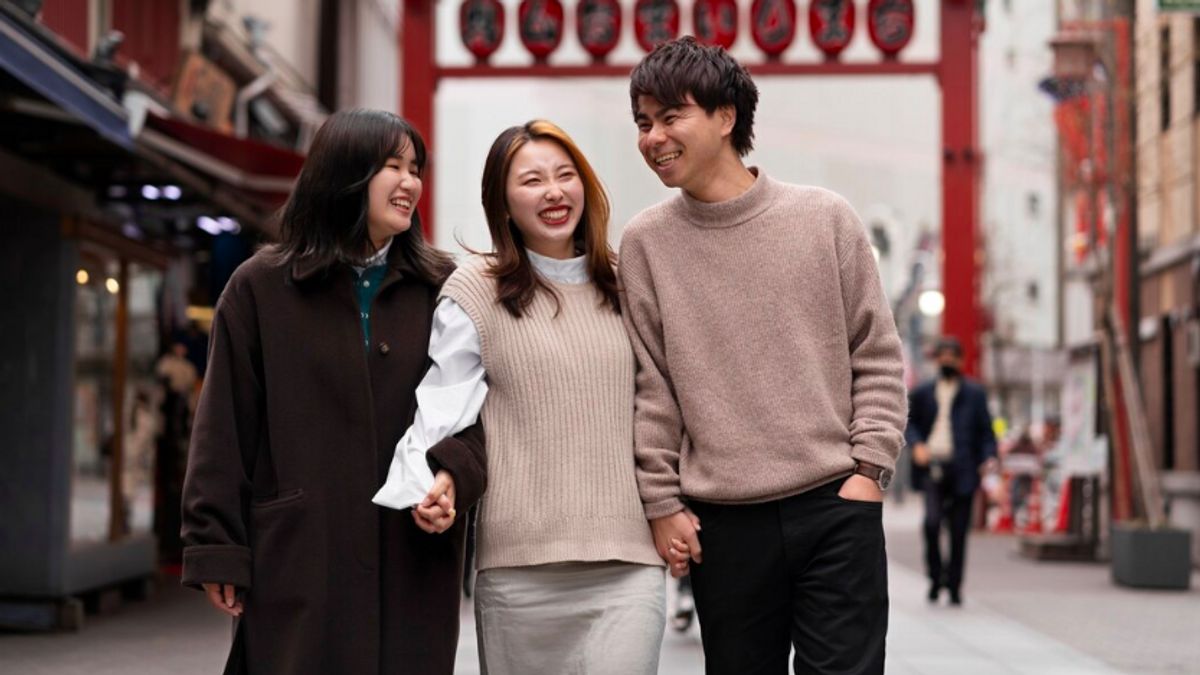


JAKARTA - Have you ever been curious, why do many Koreans look fresh even though the weather is hot? It rarely looks too sweaty, let alone until the smell of the body. Apparently, there is a scientific secret behind this and everything is related to genetics.
Some studies say 80-95% of East Asians have abnormalities in the ABCC11 gene, which is directly related to the smell of the body in the armpits. This means that their bodies do not emit an acid smell like the majority of other people when sweating in hot weather.
"The body odor is much lighter and much less common. So we can take longer without having to wear a body odor cover," said Dr. Madalyn Nguyen, a dermatologist from Oregon who is also of East Asian descent, quoted from the NBC News page.
Due to the hot weather, the topic of body odor has become widely discussed. A dermatologist, Heather Kornmehl, had uploaded a video on Instagram earlier this month. He explained that the possibility of having a odor armpit was determined by genetic factors. The video is viral and viewed more than 4 million times.
Meanwhile, a TikTok video from dermatologist Dr. Daniel Sugai also provoked laughter from the audience when he shared the moment of asking questions with friends in East Asia about his favorite deodorant. However, he did not get the answer.
Dr. Nguyen explained that body odors usually come from the aporrine sweat glands, which are in the armpits andGAps. In people who do not have an ABCC11 gene mutation, this gland transports fat (lipid) compounds into sweat.
Bacteria on the skin then break this lipid and produce a body odor. But in the person who had a gene mutation earlier, this process did not occur.
"The fat carrier doesn't work. So we don't have lipids that enter sweat or ear droppings," explained Nguyen.
He added that the ABCC11 gene did not work, nor was it related to dry ear droppings.
"So, if there is less lipid, automatically the body odor is also less and the ears tend to have dry dirt," he explained.
SEE ALSO:



Although this mutation is common among East Asians, only about 3% of Europeans and Africans have these mutations, according to a 2010 study in the Journal of Investigative Dermatology. Among East Asia, Koreans have the highest number, followed by Chinese, Vietnamese, and others.
"I'm not talking about modern East Asia. I'm talking about East Asia from tens of thousands of years ago, including Southeast Asia," said Nguyen.
"This mutation can also be found in Native Americans, because their ancestors used to migrate from East Asia. So many Americans also have this malfunctioning gene," he added.
There is no definite explanation as to why this mutation is common in East Asians. However, a 2010 study called the possibility of the people of East Asia in the past having stronger hygiene and hygienic traditions, people who don't smell body may be preferred as a couple. Finally, the number of people with this mutation increased from generation to generation.
"We evolve by adapting to the environment. Scandinavians have a much brighter skin than those living near the equator, because in the tropics, the body needs more melanin to protect the skin," said Nguyen.
"But that doesn't mean people with this mutation can just not take a shower. They still remove substances from the aporrin glands, especially when stressed, because these glands are also triggered by a compound called katekolamin," he continued.
Dr. Nguyen said medically, body odor is actually not unhealthy. But for those who want to reduce it, he does not recommend deodoration, because it only adds to the smell above the existing body odor.
"It's better to use soap that contains benzoyl peroxide in the armpits," he suggested.
"Shut it up for one to two minutes before rinsing. This will reduce the number of bacteria in the skin that break lipids in sweat," he continued.
He also suggested using anti-pespiration at night in dry armpits.
"That way, the substance can enter the sweat gland, not be carried away by the sweat that has come out first." he explained.
The English, Chinese, Japanese, Arabic, and French versions are automatically generated by the AI. So there may still be inaccuracies in translating, please always see Indonesian as our main language. (system supported by DigitalSiber.id)


