

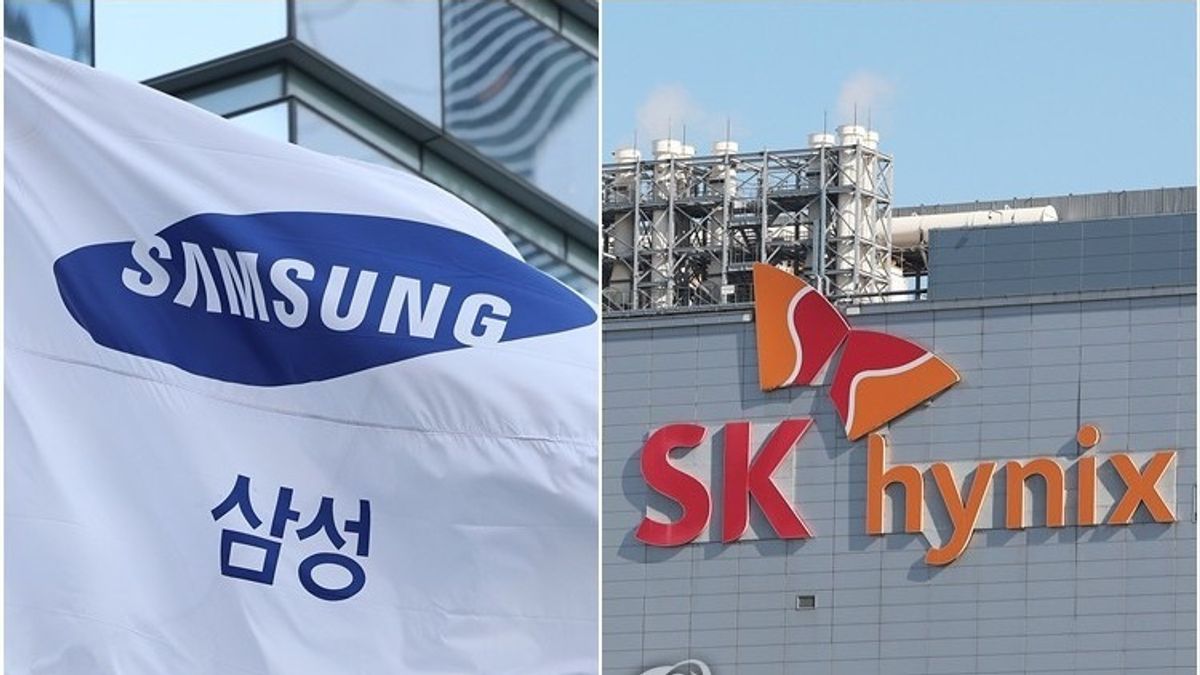


JAKARTA - Foreign investors have sold shares of two South Korean chip giants, Samsung Electronics and SK hynix. The value is more than 10 trillion won or about US$6.6 billion in just a week.
Data from Korea Exchange and Yonhap Infomax, as reported by Yonhap, quoted on Monday, May 25, showed that the sell-off occurred throughout the week which began on May 18. Foreign investors sold a net of SK hynix shares worth 5.33 trillion won and Samsung Electronics 5.26 trillion won.
The two stocks accounted for 73 percent of the total net foreign sales in the South Korean stock market. In total, it reached 14.45 trillion won in the period.
The pressure has not stopped. Foreign investors have recorded net sales for 12 consecutive trading sessions since May 7.
In the 12 sessions, foreigners sold SK hynix shares worth 19.53 trillion won and Samsung Electronics 18.87 trillion won. The two combined reached 82.9 percent of the total net foreign sales of 46.34 trillion won.
The direction of foreign funds is interesting to observe in the Asian market. Global money seems to be coming out of Korean semiconductor stocks that have risen sharply, then entering sectors that are considered still have room for greater increases.
Last week, shares of Hyundai Mobis, Hyundai Motor, LG Electronics, and Samsung Electro-Mechanics were also sold off by foreign investors.
However, foreign funds have not completely left the Korean market. They turned to robotics stocks and energy storage systems (ESS). ESS is a system for storing electrical energy, usually related to batteries and energy supply for industry.
On the main KOSPI index, foreign investors bought a net of Doosan Robotics shares worth 370 billion won and Samsung SDI 148.9 billion won.
On the KOSDAQ exchange, foreigners recorded net purchases of 1.29 trillion won. The purchase included Fadu shares worth 155.6 billion won. Fadu is a fabless company, that is, a company that designs chips, but does not produce them itself. It focuses on storage systems for artificial intelligence or AI data centers.
Foreigners also bought Seojin System shares worth 128 billion won. The company produces ESS and telecommunications equipment.
The shift in funding comes as global markets place great hopes on robotics and ESS. Demand from physical AI and AI data centers is one of the driving forces.
Analysts assess that foreign selling reflects portfolio restructuring, not panic. Korean semiconductor stocks have risen sharply. When the proportion is too large in the portfolio, some investors choose to realize profits and look for other stocks that are not too expensive.
"Foreign investors seem to be responding with selling because the share of Korean semiconductor stocks in their portfolios has increased sharply due to the price surge," said Kang Jin-hyuk, an analyst at Shinhan Securities, quoted by Yonhap.
According to Kang, the funds were shifted to other stocks whose profits improved, but the stock prices were still relatively low.
In other words, foreign investors have not exited the big AI theme. They just reduced the burden on chip stocks, then glanced at robotics and energy storage which are still considered to hold opportunities.
The English, Chinese, Japanese, Arabic, and French versions are automatically generated by the AI. So there may still be inaccuracies in translating, please always see Indonesian as our main language. (system supported by DigitalSiber.id)
Most Popular Tags
#Prabowo Subianto #donald trump #firearm #8791 #giias 2026Popular


