

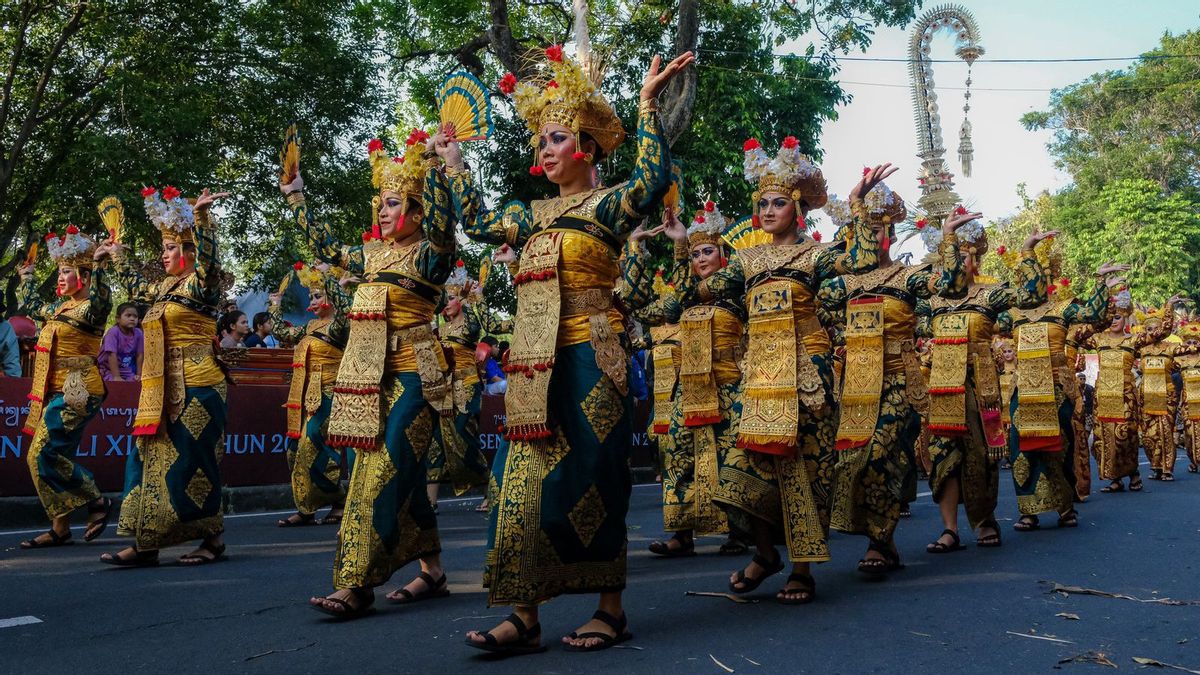


JAKARTA - The Bali Arts Festival (PKB) 2026 has begun to receive international attention after reports on the largest annual cultural festival in Bali were distributed through the Associated Press (AP News) and USA Today networks amid increasing global discussions on tourism, cultural preservation, and destination sustainability.
In the report, PKB is not only positioned as an annual cultural agenda, but also as a symbol of how Bali strives to maintain its cultural identity in the midst of modern tourism pressures and global change.
The 48th PKB is scheduled to take place from June 13 to July 11, 2026 at the Bali Cultural Park, Denpasar.
This festival will involve around 20,000 artists from more than 673 art groups throughout Bali, as well as the participation of a number of countries such as Japan, India, South Korea, East Timor, Hong Kong, and the United States.
The international spotlight on PKB came as many of the world's tourist destinations began to face a similar challenge: how to preserve local identity and traditional culture amid the growth of the mass tourism industry.
Former journalist and Bali academic Agus Dei assessed that cultural festivals such as PKB now have a much greater meaning than just entertainment or tourism promotion.
"Cultural festivals like this remind us that Bali is not only a tourist destination, but also a living cultural and environmental ecosystem," said Agus Dei.
According to him, Bali's biggest challenge today is not only to attract more tourists, but to ensure that tourism growth does not damage the cultural and environmental foundations that have long been Bali's main strength in the eyes of the world.
"The biggest question for Bali is not just the number of tourists, but how that growth does not weaken the cultural and environmental identity that makes Bali unique," he said.
In the international report, PKB is also referred to as "a small miniature of Bali" because it brings together the diversity of art, traditions, costumes, and cultural identities from various regions on the Island of the Gods in one common space.
For international readers, especially in Europe and Western countries, the discussion on PKB is considered relevant because more and more global tourist destinations are facing debates about overtourism, environmental pressures, and the preservation of local identity.
Bali itself in recent years continues to face various challenges ranging from waste problems, infrastructure pressures, tourist area density, to environmental sustainability issues amid a surge in international tourist visits.
But amid these various pressures, PKB is still seen as one of the most powerful symbols of the Balinese cultural identity that still survives in the era of modernization and global tourism.
The English, Chinese, Japanese, Arabic, and French versions are automatically generated by the AI. So there may still be inaccuracies in translating, please always see Indonesian as our main language. (system supported by DigitalSiber.id)
Most Popular Tags
#Prabowo Subianto #donald trump #Febrie Adriansyah #8791 #giias 2026Popular


