

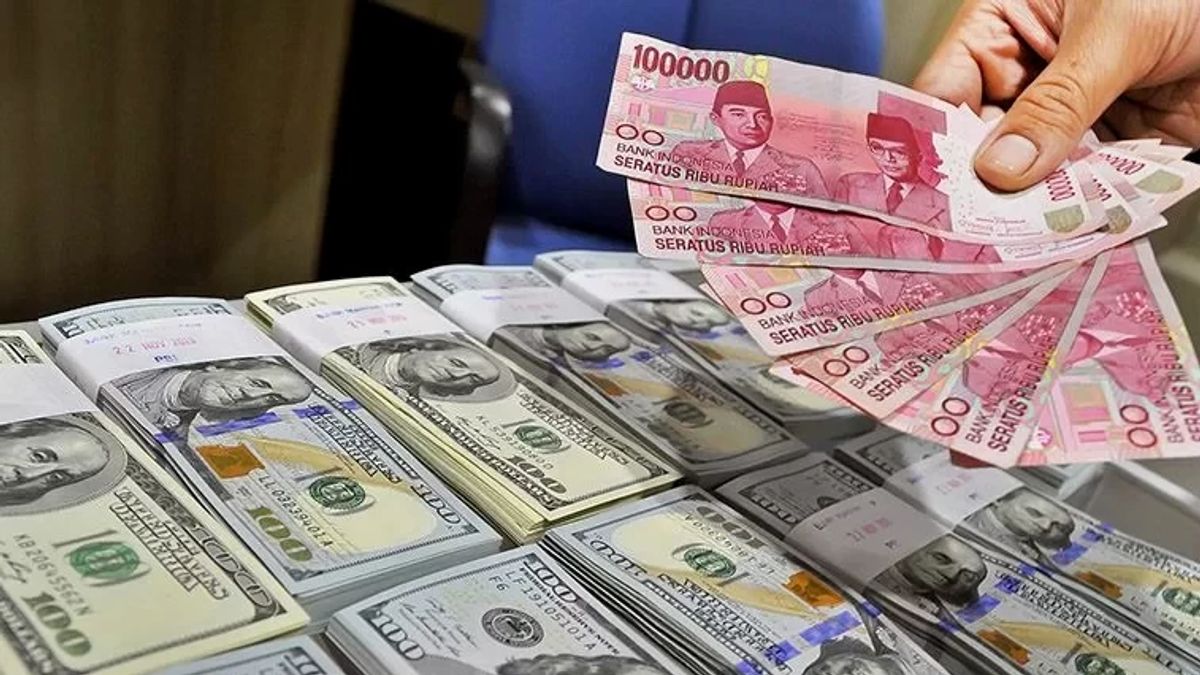


MAKASSAR - Bank Indonesia (BI) has confirmed that the plan to reduce the threshold for the obligation to submit underlying cash transactions for the purchase of foreign exchange (foreign exchange) from 50,000 US dollars to 25,000 US dollars in June 2026 is not a new policy.
Meanwhile, a similar step was implemented in 2015 when the global financial market experienced turmoil due to the taper tantrum.
Director of the Financial Market Deepening Department of Bi, Ruth A. Cussoy Intama explained, BI had previously lowered the limit of the obligation to deliver underlying from 100 thousand US dollars to 50 thousand US dollars since April 1, 2026.
This policy is carried out as an effort to strengthen the stability of the rupiah by suppressing the demand for foreign exchange purchases that are not supported by real needs.
Furthermore, in June 2026, BI again lowered the threshold to 25 thousand US dollars to narrow the space for speculative transactions in the market.
According to Ruth, the policy which started to be implemented in April has proven effective in suppressing dollar purchase transactions without underlying.
"Because when we lowered (the threshold for the purchase of foreign exchange cash against the rupiah) from 100 thousand US dollars to 50 thousand US dollars, the effectiveness was already visible from around 78 million US dollars or 76 (US dollars), it was reduced to an average of only 62 million US dollars per day. 62 million US dollars x 20 days can be Rp1 billion," he said in a Journalist Training, Friday, May 22.
He said the downward trend showed that the policy of restricting transactions without supporting documents was quite effective in reducing the need for speculative dollar purchases.
Ruth also revealed that a similar policy had been implemented in August 2015 when the turmoil of the taper tantrum triggered pressure in the financial market and at that time, BI assessed that the reduction of the threshold was able to help maintain the stability of the rupiah in the midst of external pressures.
"In August 2015 (it was lowered) because of this taper tantrum, we lowered it like that. Well, it looks like that. So even though the trend may still be rising (rupee), there are certain points that we can assure are effective as we are lowering now (foreign exchange purchase limit)," he said.
"The adjustment of the underlying liability limit is aimed at supporting the stability of the rupiah exchange rate, maintaining domestic foreign exchange supply, and strengthening foreign exchange liquidity management in the financial market," he continued.
In its implementation, he said that BI provided a transition period so that banks could adjust the system and mechanism for verifying customer documents.
The underlying documents in question include invoices, import-export documents, and proof of payment for education abroad.
Ruth emphasized that the policy was not to limit people from buying foreign exchange, but to suppress speculative transactions in the spot market.
He added that the public and business actors were still allowed to buy foreign exchange in large quantities as long as they had documents that showed real needs.
"Buy as much as you want, so once again, the message is that we do not limit the purchase of foreign exchange. Want US dollars, want non-US dollars, but please if you want to buy it must have an underlying. So it's not a speculation. That's an important message that we need to emphasize why we're lowering it again," he said.
He explained that speculation in the midst of fluctuating global market conditions has the potential to weaken the rupiah so that BI wants to ensure that dollar purchase transactions are based on economic needs, not to seek short-term profits due to market turmoil.
"If you want, please mothers who have children abroad who really need (foreign exchange), please, please. Businesses that require (foreign exchange) for the economy, please, but don't just because of speculation that's the message," he said.
According to him, based on BI data, more than 90 percent of domestic foreign exchange transactions actually have underlying, so the threshold reduction is carried out to minimize the transaction space without clear economic needs.
Ruth added that people who need foreign exchange for education, travel, and business activities can still carry out transactions as usual as long as they are accompanied by valid supporting documents.
The English, Chinese, Japanese, Arabic, and French versions are automatically generated by the AI. So there may still be inaccuracies in translating, please always see Indonesian as our main language. (system supported by DigitalSiber.id)
Most Popular Tags
#Prabowo Subianto #donald trump #Febrie Adriansyah #8791 #giias 2026Popular


