

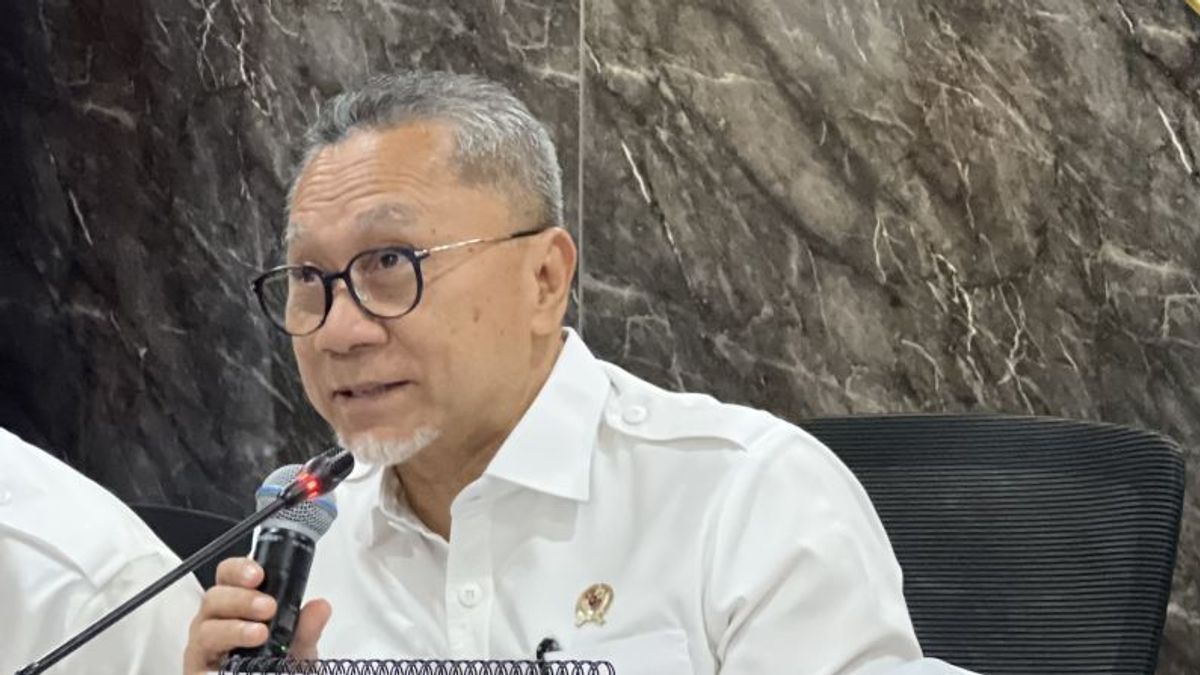


JAKARTA - Coordinating Minister for Food and Agriculture Zulkifli Hasan said he would process waste piles at the final disposal site (TPA) into fuel oil (BBM) with BRIN, the Ministry of Higher Education, Science, and Technology (Kemdiktisaintek), and the TNI.
"Previously, waste was converted into electricity, now we are working together (waste into fuel) with the TNI, the technology is from BRIN and the Ministry of Education," said Zulhas, a nickname for Zulkifli Hasan, quoted by ANTARA, Tuesday, May 19.
Zulhas said that processing waste into fuel is part of a major transformation of waste management. Previously, he said, the government focused on processing waste into electricity.
Now, the government is encouraging waste piles to become fuel with a pyrolysis scheme or the process of decomposing organic materials through high temperature heating. Zulhas revealed that there were six locations targeted for the waste to fuel project.
"There are six (locations). There are in Bantargebang, there are in Bandung, there are in Bali," said Zulhas.
Zulhas explained that the difference between the two projects lies in the type of waste. For the Waste to Energy (PSEL) project, the government will use new waste.
Meanwhile, for the waste to fuel project, the government will use the waste that has piled up.
"We already have mountains of garbage, as high as a 16-story building. Like in Bantargebang. That's what we use pyrolysis. The high piles of garbage will be processed into fuel," said Zulhas.
Through his presentation, Zulhas said that the projected waste pile in 2029 is estimated at 146,780 tons per day. Furthermore, in his presentation there are five options for waste processing technology. As much as 12.4 percent of the total waste is processed with organic processing at the source of waste.
Then, 19.8 percent was processed by TPS-3R (Reduce, Reuse, Recycle) at the parent landfill; 25.3 percent of the total waste was processed by TPST RDF (Integrated Waste Processing - Refuse Derived Fuel).
Furthermore, 20 percent is processed with pyrolysis technology; and 22.5 percent of the total waste is processed in the PSEL project.
"Garbage is no longer a burden, but a source of energy and part of the national energy independence," said Zulhas.
The English, Chinese, Japanese, Arabic, and French versions are automatically generated by the AI. So there may still be inaccuracies in translating, please always see Indonesian as our main language. (system supported by DigitalSiber.id)


