

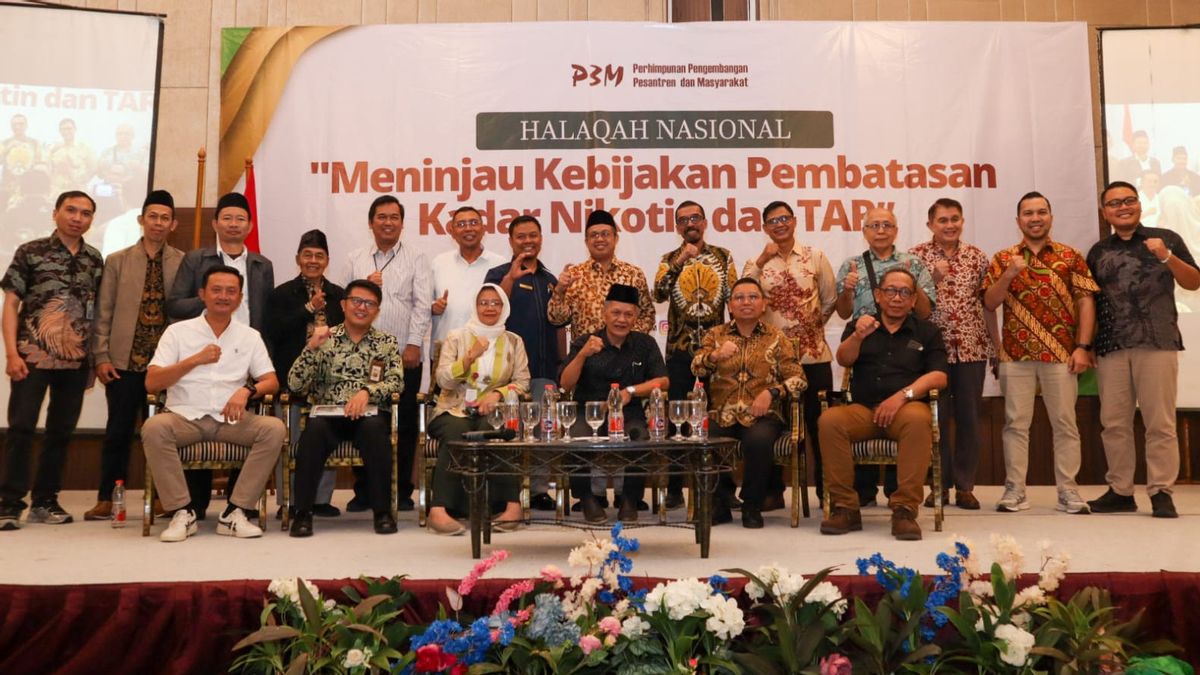


JAKARTA - The discussion of the derivative rules of Government Regulation (PP) Number 28 of 2024 concerning Health continues to attract attention. This regulation which regulates the restriction of nicotine and tar levels is considered potentially hitting the national tobacco ecosystem from upstream to downstream if it is imposed without a realistic transition period.
These concerns emerged in the National Halaqah: Reviewing the Policy on Limiting Nicotine and Tar Levels, which was held by the Association for the Development of Pesantren and Society (P3M) in Jakarta.
"About 90 percent of our tobacco naturally has nicotine levels between 2 and 8 milligrams. Imposing global standards without considering the reality of local varieties and the transition period is the same as closing the door to the absorption of people's tobacco and threatening the breath of the economy of millions of farmer families," said Wisnu Brata from the Indonesian Tobacco Farmers Association (APTI).
Bridging Public Health and Farmers' Economic Sovereignty
P3M emphasized that this halaqah forum was held not to reject the national health vision launched by the government. Instead, this agenda is a forum to find a fair middle ground between public health protection and the sustainability of the small people's economy.
For millions of farmers, from the slopes of Mount Temanggung to the remote corners of West Nusa Tenggara (NTB), tobacco is not just a common trading commodity. Tobacco is a life-sustaining instrument that can survive in dry land, even during long dry seasons.
Policies that tend to imitate the rules of European countries without considering the ability to adapt to local varieties are feared to trigger economic shocks. The impact not only hits tobacco farmers, but also weakens the national kretek industry which absorbs almost 140 thousand tons of local cloves every year. The collapse of this ecosystem is predicted to significantly increase the poverty rate in the production center areas.
View from the Health Regulation Side
Despite vigorously advocating for the fate of farmers, this National Halaqah still provides space for a health perspective.
Present at the forum, dr. Nancy Dian Anggreni, M.Epid (representative of the Ministry of Health) and dr. Benget Saragih, M.Epid (Ministry of Health). Both emphasized that strengthening national health resilience through regulations on the maximum levels of nicotine and tar is a mandate from PP No. 28 of 2024 to reduce the burden of non-communicable diseases (NCDs).
Responding to this, P3M believes that public health and farmer welfare should not be positioned as two poles that destroy each other. Both must go hand in hand.
The Threat of Illegal Cigarettes and 3 Strategic Solutions for the Government
One of the crucial impacts that was reminded in this forum is the potential for the proliferation of illegal cigarette products. When regulations on the legal industry become too strict and unrealistic for local farmers and producers, the empty space will be filled by illegal products that do not pay taxes and are out of control. This condition will actually weaken the effectiveness of the health control goal itself.
To anticipate the adverse impacts, experts and representatives of farmers in the National Halaqah proposed three strategic policy instruments to the government:
1. Phased Regulation (Phased Regulation): The implementation of nicotine and tar limits gradually through a clear roadmap, and provide adequate adaptation time by considering the reality of Indonesian tobacco. 2. Regulatory Transition Period (Regulatory Transition Period): Provide sufficient transition time for farmers and business actors to adjust from upstream to downstream. 3. Regulatory Sandbox: Provide limited adjustment space for the industry to gradually comply, in order to minimize the potential for adverse socio-economic impacts.25 Years of Commitment of P3M to Protect the Interests of the People
P3M, which has been assisting tobacco farmers for more than 25 years, emphasized that farmers' economic sovereignty is part of the public welfare that must be protected.
The recommendations from the national halaqah will later be officially submitted to the Government - especially the Coordinating Ministry for Human Development and Culture (Kemenko PMK), the Ministry of Health (Kemenkes), and BPOM. This step is expected to be a constructive input in the preparation of derivative regulations of the Health Law, so that the state is not only present to protect the health of its citizens, but also ensure that no farmers lose their livelihoods due to hasty regulations.
The English, Chinese, Japanese, Arabic, and French versions are automatically generated by the AI. So there may still be inaccuracies in translating, please always see Indonesian as our main language. (system supported by DigitalSiber.id)
Popular


