

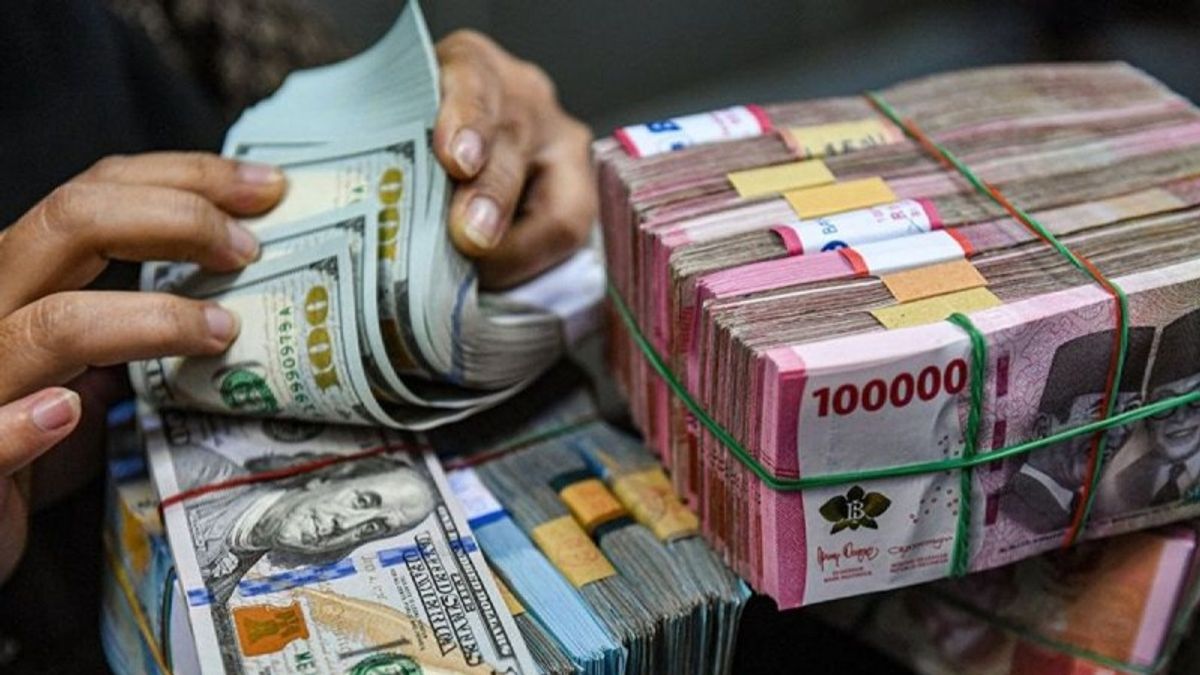


JAKARTA - Bank Indonesia (BI) has confirmed that it continues to strengthen synergies with the government to maintain the stability of the rupiah exchange rate amid global dynamics pressures triggered by the Middle East conflict and the rise in US interest rates.
BI Communication Department Executive Director Ramdan Denny Prakoso said coordination between BI and the government, including through the Financial System Stability Committee (KSSK), continues to be carried out to strengthen the national economic conditions and maintain the rupiah stable and tend to strengthen.
"The details will certainly be asked later. But with the KSSK platform, of course, there is synergy to continue to strengthen the Indonesian economic condition, including to make how the rupiah is stable and strong, it has been discussed," he told the media, Wednesday, May 13.
He explained that the weakening of the rupiah that occurred since the end of February 2026 was not only experienced by Indonesia, but also the majority of other emerging market currencies due to global pressures.
"That the weakening of the rupiah exchange rate and also a number of countries, after the start of the Middle East conflict. At the end of February 2026, the exchange rate movements in various countries were greatly influenced by global dynamics, especially the Middle East conflict which resulted in rising oil prices," he explained.
According to Ramdan, the Middle East conflict has pushed the world oil price spike by more than 40 percent since the end of February 2026, and the rise in the yield of US Treasury 10-year bonds approaching 4.5 percent also strengthened the US dollar index so as to suppress the currencies of various countries.
He said that due to global dynamics, a number of other currencies also experienced weakening, including the Philippine peso, Thai baht, Indian rupee, South Korean won, to the South African and Chilean currencies.
On the domestic side, Ramdan said the demand for the US dollar also increased in line with the season of repatriation of dividends, foreign debt payments, and foreign exchange needs for the implementation of the hajj pilgrimage.
"BI is very aware of this condition, so BI continues to strengthen what is called the seven steps of Bank Indonesia in making the rupiah stable and tends to strengthen. So the Governor (BI Perry Warjiyo) said, we still believe that with the steps taken, the rupiah will be stable and tend to strengthen," he said.
However, he conveyed that BI believes that Indonesia's economic fundamentals remain strong compared to many other countries, and this is reflected in the continued economic growth, stable inflation, and prudent management of foreign debt.
Ramdan emphasized that BI continues to strengthen the rupiah stabilization strategy through the seven strategic steps that have been previously conveyed, and in its implementation, BI will continue to be present in the domestic and international markets to maintain the stability of the rupiah movement.
"Bank Indonesia will continue to be in the market, both the domestic market and the foreign market, so once the Jakarta market closes, we are standby in the European market. We are then standby in the American market to maintain how the movement of the rupiah exchange rate is affected by non-deliverable forward (NDF) transactions that are still stable. "he said.
He added that BI is optimistic that the synergy between the central bank, the government, and related ministries and agencies will be able to maintain the stability of the rupiah and encourage the strengthening of the exchange rate in the future.
"Of course we believe that with the synergy of BI, the Ministry, and the Institution, it will be able to make the rupiah stable and also strengthen itself because there is no reason for the rupiah not to strengthen, not to be stable," he said.
Ramdan also invited all elements of society to jointly maintain the stability of the national economy through collaboration and synergy in the midst of ongoing global challenges.
Previously, Minister of Finance Purbaya Yudhi Sadewa stated that the government would start supporting BI's steps to reduce pressure on the rupiah from tomorrow, and this support was carried out through intervention in the bond market.
"We will start helping (BI) tomorrow, maybe (the government) will enter the bond market," he told the media, Tuesday, May 12.
Purbaya explained that this step was carried out through the utilization of the Bond Stabilization Fund (BSF) which will be activated on a number of domestic financial instruments.
"By entering the bond market, that is the Bond Stabilization Fund, but not all funds. We activate the instruments we have here. Tomorrow it starts," said Purbaya.
He explained that this step was taken through the Bond Stabilization Fund (BSF) scheme which will be optimized on a number of domestic financial instruments.
According to him, the mechanism will start tomorrow by utilizing the instruments that the government has.
Purbaya assessed that intervention in the bond market was important to ensure that yields did not soar too high, and if yields increased sharply, foreign investors holding domestic bonds could potentially experience capital losses so that they chose to withdraw their funds from Indonesia.
"We help BI a little if we can. We intervene in the bond market so that the yield does not rise too high. If the yield rises too high, what does it mean? Foreigners who hold bonds here have capital losses, they will leave," he said.
Therefore, Purbaya said the Ministry of Finance is trying to maintain the attractiveness of the bond market so that foreign investors remain and even return.
The English, Chinese, Japanese, Arabic, and French versions are automatically generated by the AI. So there may still be inaccuracies in translating, please always see Indonesian as our main language. (system supported by DigitalSiber.id)


