

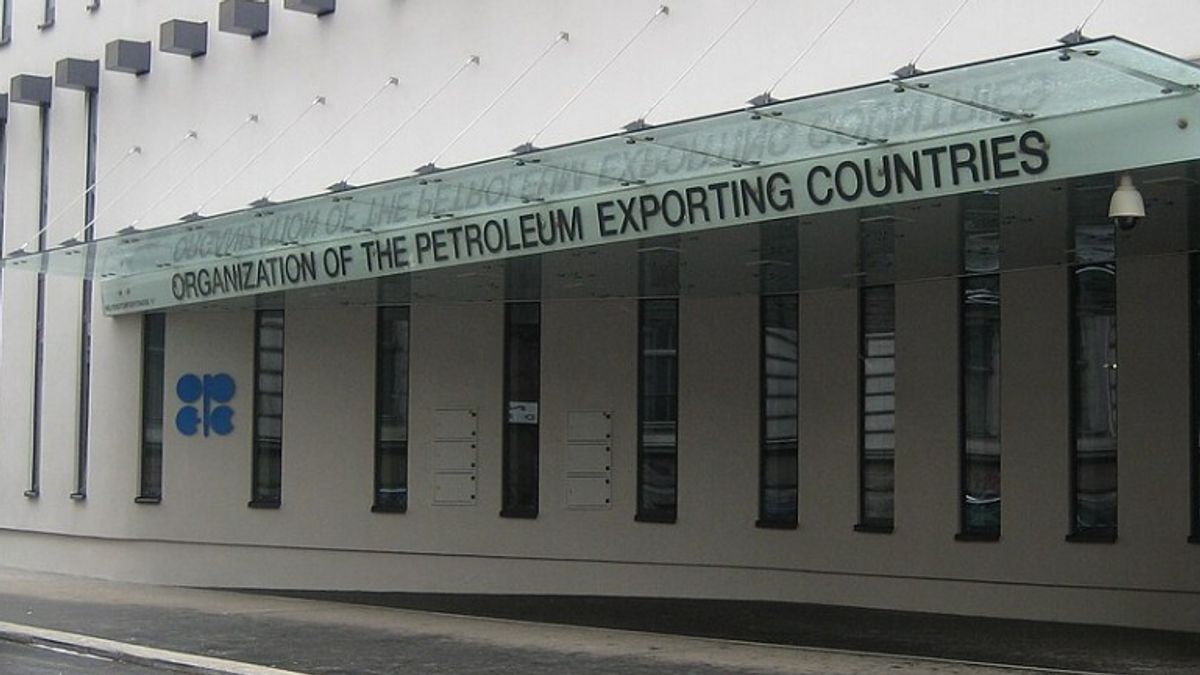


JAKARTA - World oil prices fell after the United Arab Emirates (UAE) announced it would leave OPEC. The decision is of concern to the market because the UAE is a major producer in the oil cartel.
The Independent, quoted Wednesday, April 29, reported that Brent prices for June delivery fell 0.5 percent to $110.71 per barrel in early trading on Wednesday. Brent for July delivery weakened 0.6 percent to $103.74 per barrel.
U.S. benchmark crude was down 0.6 percent at $99.32 a barrel.
The exit of the UAE from OPEC is scheduled to take effect on Friday. OPEC has contributed about 40 percent of global oil production. The UAE is one of the important producers in it.
In recent years, the UAE has often rejected OPEC production quotas because it wants to sell more oil to the world market.
"The exit of the UAE will increase oil production," ING Bank analysts Warren Patterson and Ewa Manthey wrote in a research note, Wednesday, quoted by The Independent.
According to ING, the UAE is increasingly frustrated because its production is limited by the OPEC quota. The quota makes the country's production far below its true potential.
However, the short-term impact on oil prices has not been determined solely by the departure of the UAE. The market is still waiting for developments in the Iran war and the fate of the Strait of Hormuz.
Before the war, about a fifth of the world's oil passed through the route. Now the Strait of Hormuz is still largely closed. US-Iranian negotiations to end the war have also not moved much.
Iran has offered to reopen the Strait of Hormuz if the United States lifts a blockade on its ports. However, the US has so far appeared to reject a deal that does not include Iran's nuclear program.
In the stock market, Asian exchanges were mostly stronger despite Wall Street's weakness. South Korea's Kospi rose 0.3 percent, Hong Kong's Hang Seng gained 1.4 percent, and Shanghai Composite rose 0.3 percent. Meanwhile, Australia's S&P/ASX 200 fell 0.3 percent.
Investors are also waiting for the Federal Reserve's interest rate decision. On Wall Street, the S&P 500 fell 0.5 percent, the Dow Jones fell 0.1 percent, and the Nasdaq fell 0.9 percent.
Artificial intelligence-related technology stocks also pressured the market. Broadcom fell 4.4 percent, Nvidia weakened 1.6 percent, and Micron Technology fell 3.9 percent.
The exit of the UAE from OPEC is of concern to the market because it can reduce OPEC's ability to regulate oil supplies. However, for now, the direction of prices is still very dependent on the Iran war and the reopening of the Strait of Hormuz.
The English, Chinese, Japanese, Arabic, and French versions are automatically generated by the AI. So there may still be inaccuracies in translating, please always see Indonesian as our main language. (system supported by DigitalSiber.id)


