
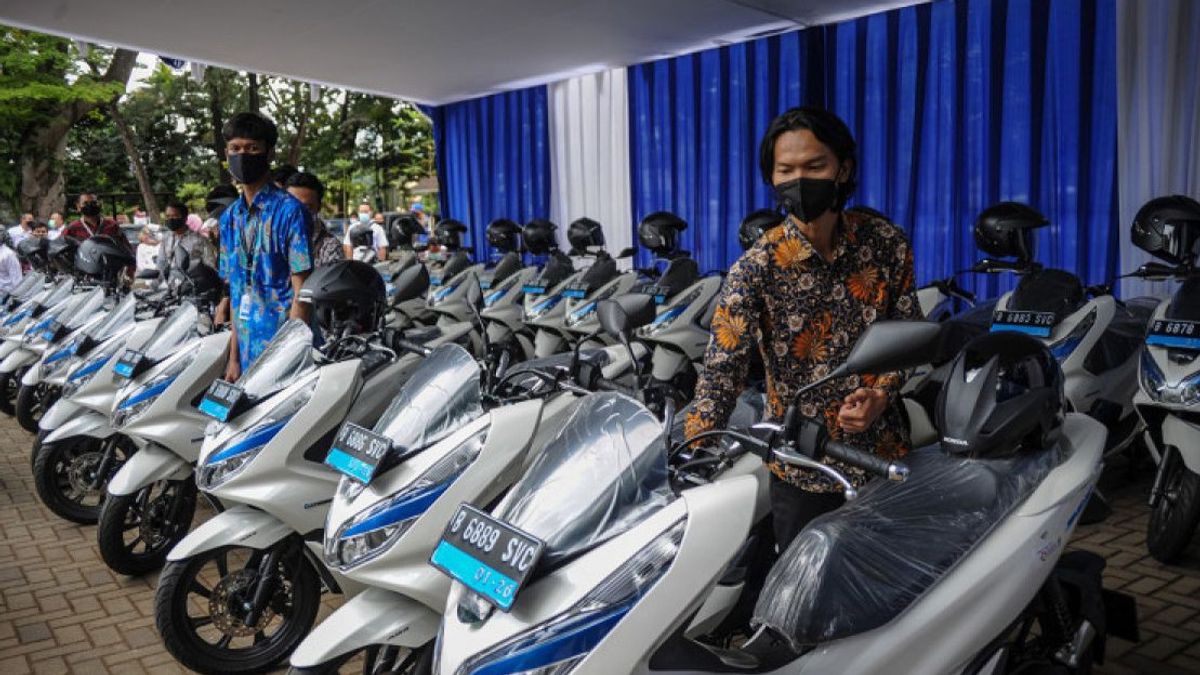


JAKARTA - The Indonesian Electric Motorcycle Industry Association (AISMOLI) expressed full support for the vision of the President of the Republic of Indonesia in making vehicle electrification a pillar of national energy resilience, especially in the midst of the threat of an energy crisis. As part of the growing electric vehicle industry ecosystem, AISMOLI presents a clear message: the industry is ready, investment has entered, and the market is growing, all that is needed now is a policy/regulation that speaks in unison.
The emergence of several policy instruments simultaneously, including those recently such as Permendagri 11/2026 and Circular Letter 900.1.13.1/3764/SJ of the Minister of Home Affairs, has raised various questions from consumers, business actors, and investors regarding the direction of electric vehicle policies in the future. AISMOLI hopes that the Government will be more careful in issuing policies given the high level of economic sensitivity, and transparent and balanced communication is the key for all parties to move forward with full confidence.
"Good policies are not enough, but must be in line and reach the field with the same interpretation. Policy certainty is a costly commodity and is needed for industries to invest, produce, and serve the community sincerely," said AISMOLI Chairman, Budi Setiyadi, in a statement, Friday, April 24.
Momentum that is Built Together and Must be Taken Care of TogetherIndonesia's electric vehicle ecosystem has recorded a progress that should be celebrated together. Thanks to the consistency of the incentive policy implemented by the Government, US$ 2.73 billion of investment has entered the sector in the last three years (2023-2025), from global investors such as BYD, Chery Automobile, Mitsubishi Motors, XPENG, and GAC AION (INDEF/FDI Market, 2025). The market share of electric vehicles grew from 1.09 percent in 2022 to 12.93 percent in 2025, and domestic production commitments continue to increase in line with the running incentive framework.
In the two-wheel segment itself, the segment that is most directly felt by the majority of the Indonesian people, this growth carries a deeper meaning. With more than 150 million motorcycles operating throughout the archipelago, the transition to two-wheeled electric vehicles is the fastest and most inclusive way to reduce national dependence on subsidized fuels, while improving air quality in urban areas.
INDEF in 2025 said that the electrification of 10 percent of the passenger vehicle fleet saves Rp12.3 trillion in fuel subsidies per year, more than twice the savings of the WFH policy one day per week. Acceleration of the adoption of electric vehicles is a fiscal policy, not just an environmental policy.
Fiscal Burden of Fuel: A Context That Cannot Be IgnoredThe relevance of this transition is increasingly urgent when viewed from a fiscal perspective. The burden of national fuel subsidies and compensation reached IDR 322 trillion in 2022, with Pertalite, the main fuel for two-wheeled vehicles, as the largest component. The INDEF study projects that in a scenario of oil prices of 100 US dollars per barrel due to geopolitical pressure, the fiscal burden of Pertalite can jump up to 380 percent from normal conditions. Electrification is not a luxury option, it is an increasingly urgent fiscal protection.
On the other hand, concerns that electric vehicle incentives burden the country need to be straightened with data. INDEF notes that the forgone revenue from electric vehicle tax incentives is only IDR 30.4 trillion per year, an amount that is 90 percent lower than the difference in the burden of fuel subsidies that have been successfully saved by IDR 296.9 trillion. Supporting vehicle electrification is a fiscal decision that benefits the country in the long run.
Regulatory Alignment Is in the Interest of All PartiesAISMOLI understands that every regulation issued by the Government has a legitimate purpose and good intentions. However, when several instruments run simultaneously without clear lines of coordination, the impact is felt in a tangible way by three groups at once. First, consumers who want to switch to electric vehicles need certainty of long-term operating costs before making a significant purchase decision.
Second, investors and manufacturers who have committed to domestic production plans need stable regulatory projections for at least the next three to five years. And third, Regional Governments that want to contribute to the national electrification target need guidance that is consistent with the HKPD Law so that they can design appropriate incentive policies in their regions.
AISMOLI specifically encourages that Permendagri 11/2026 be reviewed and harmonized with Law No. 1 of 2022 concerning HKPD, which explicitly exempts battery-based electric vehicles (KBL BB) from tax objects. This alignment is not about who is right, it is about ensuring that all policy instruments are pushing in the same direction.
Clean Air is a Public Right, Not a Policy BonusBeyond fiscal calculations, there is a dimension that often escapes policy discussions, namely public health. WHO (World Health Organization, 2024) notes that ambient air pollution causes around 7 million premature deaths per year globally. In Indonesia, high-density two-wheeled vehicles in urban areas are one of the largest contributors to emissions at the street level. WRI Indonesia (2023) notes that the transportation sector accounts for around 23 percent of GHG emissions in urban areas.
The acceleration of the adoption of electric vehicles, especially two-wheelers that reach the majority of the population, is a direct investment in the health of millions of city residents. This cost does not appear on the fiscal balance sheet, but is felt by everyone who lives in the city.
Three Steps AISMOLI ProposesFirst, the most urgent initial step is to align Permendagri 11/2026 with the HKPD Law and the applicable electric vehicle incentive framework. Ambiguities at the regional level cannot be allowed to linger, every day without clarity is a day where consumers delay purchasing decisions and investors hold off on commitments.
Second, clarity on the ground can only be maintained if there is a permanent coordination architecture at the central level. AISMOLI encourages the establishment of a regular cross-ministerial and agency coordination forum, with a specific mandate to review the impact of regulations on the EV ecosystem before the instrument is issued, not afterwards.
This forum needs to be supported by one official and verified EV policy communication channel, so that consumers, investors, and local governments have one reference source that can be held, not a collection of conflicting statements. This can be facilitated by considering the Energy Transition Acceleration Task Force that has been formed by the President.
Third, all of the above steps will be stronger, and implemented faster, if the industry associations are actively involved in every stage of policy formulation and evaluation. Not as a formality of consultation, but as implementation partners who bring field data and bear real responsibility for the ecosystem that is being built together.
"Indonesia has everything it needs to become a leader in the transition to electric vehicles in Southeast Asia: the largest market, rich mineral resources, and a ready industry. All that is left is to ensure that every policy is pushing in the same direction. AISMOLI is ready to sit down with the Government to realize it," explained Budi.
AISMOLI believes that the Government and the electric vehicle industry have interests that are fundamentally aligned, namely reducing the dependence on imported fuels, strengthening the domestic manufacturing industry, and making Indonesia a player that is taken into account in the global electric vehicle supply chain.
"We are here as a constructive partner, and we are ready to sit down whenever," concluded Budi.
The English, Chinese, Japanese, Arabic, and French versions are automatically generated by the AI. So there may still be inaccuracies in translating, please always see Indonesian as our main language. (system supported by DigitalSiber.id)
Most Popular Tags
#Prabowo Subianto #donald trump #Febrie Adriansyah #8791 #giias 2026Popular


