
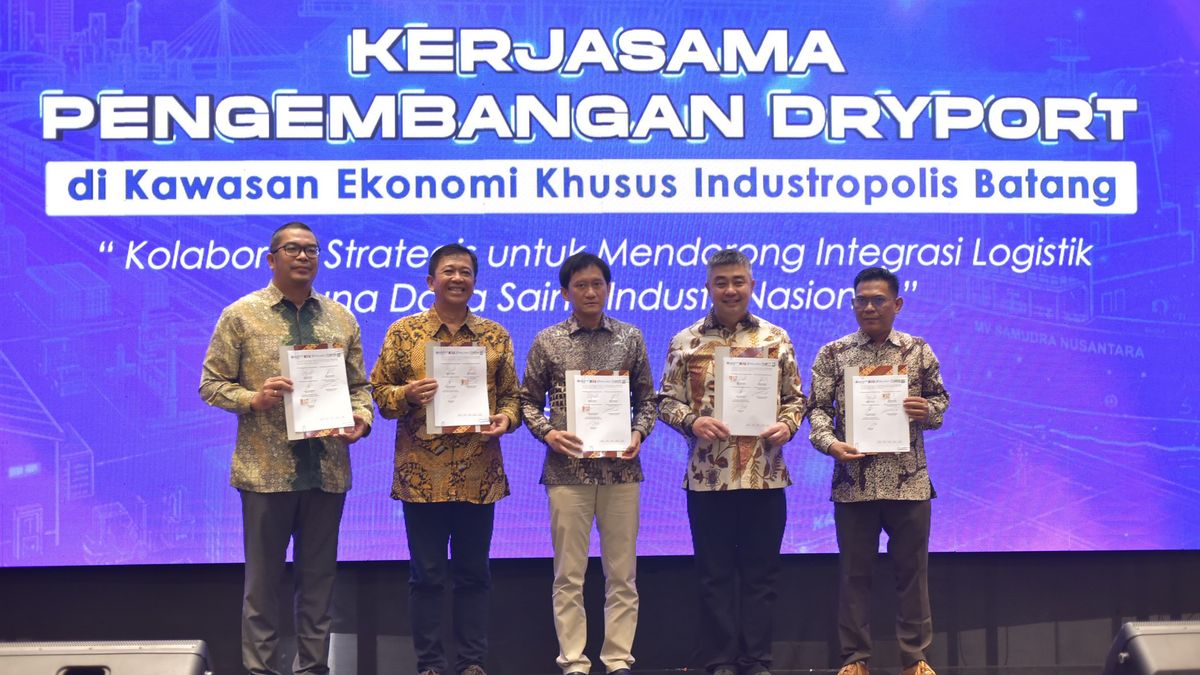


JAKARTA - PT Kawasan Industri Terpadu Batang (KEK Industropolis Batang), part of the BUMN Holding Danareksa, confirmed its strategic steps in strengthening the national industrial ecosystem through the signing of a Memorandum of Understanding (MoU) for the development of a rail-based Dryport in the Special Economic Zone (KEK) Industropolis Batang. This cooperation involves PT Kereta Api Indonesia (Persero), PT Pelabuhan Indonesia (Persero), PT Sarana Pembangunan Jawa Tengah (Perseroda), and Perumda Aneka Usaha Kabupaten Batang, and was carried out at the Ballroom of the KEK Industropolis Batang Management Building.
This activity was also attended by the Deputy for Business and Digital Economy Coordination of the Coordinating Ministry for Economic Affairs of the Republic of Indonesia, Ali Murtopo Simbolon, representatives of the Coordinating Ministry for Infrastructure and Regional Development, the Ministry of Transportation, and the Ministry of Public Works, as well as the ranks of the heads of SOEs and local governments, including the President Director of PT Kereta Api Indonesia (Persero), President Director of PT Pelabuhan Indonesia (Persero), President Director of PT Kawasan Industri Terpadu Batang, President Director of PT Sarana Pembangunan Jawa Tengah, Regent of Batang, and President Director of PT Danareksa (Persero).
This initiative is a strong signal of the acceleration of the transformation of the Batang Industropolis SEZ as a strategic node of the national industry and logistics. In line with its designation as a Special Economic Zone (SEZ) with a focus on the distribution and logistics sector, the development of this rail-based dryport reinforces the role of the region in building an integrated logistics ecosystem.
In the midst of increasing needs for supply chain efficiency and industrial area connectivity, this facility is designed as a logistics backbone that integrates industrial areas with seaport networks and land distribution more effectively and sustainably.
Dryport Industropolis Batang will serve as an import-export gateway for tenants as well as a regional logistics consolidation center that can significantly reduce distribution costs and travel time. With direct connectivity to the railway and port ecosystem, this facility is expected to reduce dependence on road-based transportation, while encouraging a more efficient and competitive national logistics system.
Developed on an area of about 30 hectares, this dryport is designed to have an initial capacity of up to 600,000-650,000 TEUs per year and has the potential to increase to 1,000,000 TEUs as the area and market demand grow.
The presence of this facility will be one of the most strategic ground logistics nodes in Indonesia, strengthening connectivity between industrial areas in Central Java with national main ports and global trade networks.
The development of this dryport is not stand-alone, but is part of a cross-sectoral collaborative approach that integrates the strengths of SOEs, local governments, and industrial area managers. The synergy between the railway, port, and area development sectors is an important foundation in building an integrated and highly competitive logistics ecosystem.
Deputy for Business Coordination and Digital Economy of the Coordinating Ministry for Economic Affairs of the Republic of Indonesia, Ali Murtopo Simbolon, emphasized that the development of this dryport is in line with the government's agenda in strengthening the national logistics system.
"Strengthening rail-based connectivity and integration with ports is the key to reducing national logistics costs. Initiatives such as those in Industropolis Batang are concrete examples of how collaboration can provide real solutions for Indonesia's economic efficiency and competitiveness," he said.
President Director of PT Kereta Api Indonesia (Persero), Bobby Rasyidin, said that rail-based connectivity would be a game changer in the logistics distribution system.
"KAI is ready to fully support the development of this dryport by providing a reliable, efficient, and sustainable rail-based freight network and services. The integration between the industrial area and the railway network will provide significant added value for industrial players," he said.
He also added that the groundbreaking process for the development of the dryport is targeted to begin in June 2026 as part of accelerating the implementation of this project.
In terms of ports, the President Director of PT Pelabuhan Indonesia (Persero), Achmad Muchtasyar, assessed that the presence of dryports would strengthen the national port ecosystem.
"Dryport Industropolis Batang will be an extension of port services that allow logistics processes to be carried out closer to industrial areas. This will increase efficiency, speed up the flow of goods, and strengthen connectivity with the global port network," he said.
Meanwhile, the Regent of Batang, M. Faiz Kurniawan, emphasized the strategic impact of this project for the region.
"The development of this dryport not only increases the attractiveness of investment in Batang, but also opens up new economic opportunities for the community. We are optimistic that the presence of this logistics infrastructure will provide a significant multiplier effect for regional economic growth," he said.
The President Director of KEK Industropolis Batang, Ngurah Wirawan, emphasized that the development of the dryport is an integral part of the region's major strategy.
"We see the need for an integrated logistics system as a key factor in attracting quality investment. With the presence of the dryport, KEK Industropolis Batang not only becomes an industrial area, but also an integrated logistics center that is ready to compete globally," he said.
More than just infrastructure, this project reinforces the positioning of KEK Industropolis Batang as an area that not only focuses on the development of manufacturing industries, but also as an integrated logistics center that is able to support large-scale investment needs. With the projection of significant tenant growth, the existence of a dryport is a crucial element in ensuring the smooth flow of goods from the industrial area to the domestic and international markets.
This development will be implemented in stages, starting from the finalization of the concept and feasibility study in 2026, followed by the construction of infrastructure and system integration in the period 2027 to 2028, to the operational and expansion phase according to market needs. This step shows a long-term commitment in building a strong and sustainable logistics foundation.
With the full support of the government and strategic partners, KEK Industropolis Batang continues to move to strengthen its position as a leading investment destination that is ready to respond to the challenges and opportunities of the future industry, while making a real contribution to strengthening the national logistics structure.
The English, Chinese, Japanese, Arabic, and French versions are automatically generated by the AI. So there may still be inaccuracies in translating, please always see Indonesian as our main language. (system supported by DigitalSiber.id)


