



JAKARTA - The finance ministers of the G7 countries agreed to work to maintain global economic stability amid uncertainty due to the war between the United States and Israel against Iran.
In a Kyodo News report quoted on Thursday, April 16, Japanese Finance Minister Satsuki Katayama said the surge in energy prices and global supply chain disruptions were the main concerns at the meeting. According to Katayama, many central banks are currently inclined to choose a wait-and-see attitude before taking new steps in monetary policy.
Katayama also admitted that it was still difficult to determine whether the fragile ceasefire that had lasted for more than a month would actually lead to a lasting peace. However, the Japanese Minister of Finance said, there was a common understanding among the participants that the situation must be calmed down, including by ensuring freedom of navigation in the Strait of Hormuz.
He said US Treasury Secretary Scott Bessent did not attend the meeting due to scheduling conflicts. Katayama added that the separate non-G7 document initiated by the UK basically reflected the views of many participants.
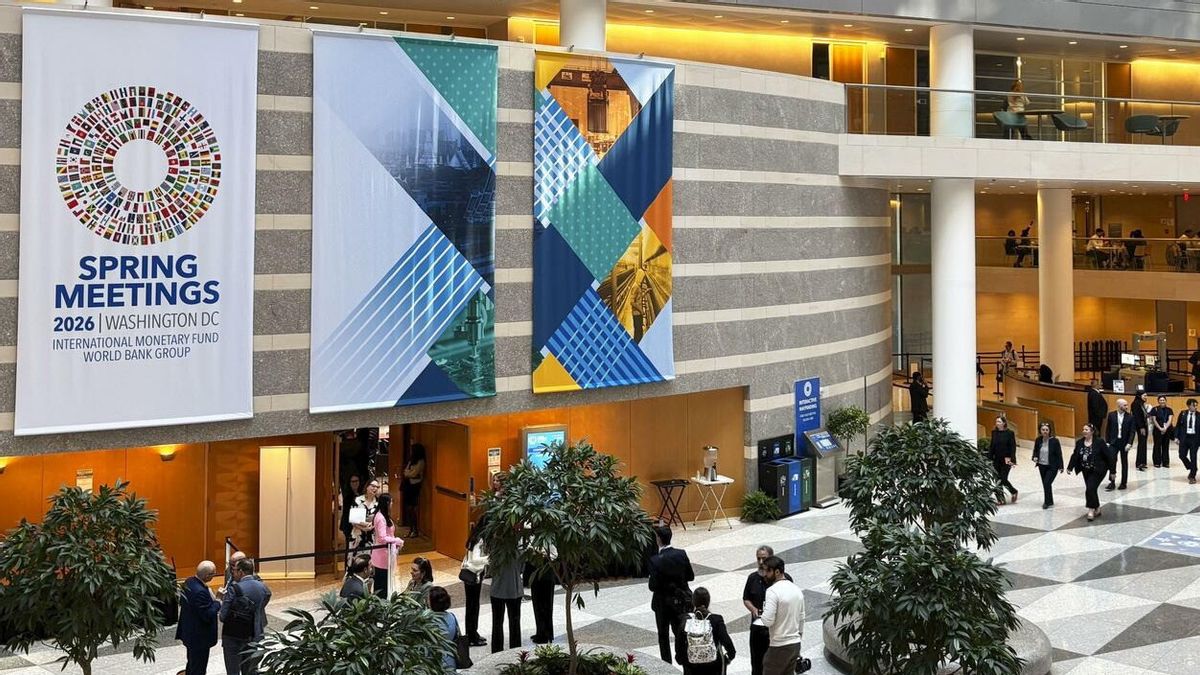
The meeting of the G7 finance ministers and central bankers, which lasted about two hours in Washington, United States, was held on the sidelines of the IMF and World Bank spring meetings. Even so, the forum, which includes Britain, Canada, France, Germany, Italy, Japan, the United States, and the European Union, did not issue a joint communique.
In a document that also involves the United Kingdom, the finance ministers of Australia, Japan, Sweden, the Netherlands, Finland, Spain, Norway, Ireland, Poland, and New Zealand stated that even if the conflict eventually finds a more permanent solution, the impact on economic growth, inflation, and markets will still be felt.
They also committed to promoting cooperation and integration to support regional and global stability. According to Kyodo News, this war also shows the growing gap between the United States and Europe.
The world is indeed welcoming a two-week ceasefire agreement between the US and Iran reached last week. However, the war has not really ended. The Strait of Hormuz, an important sea route for global trade off the coast of southern Iran, is still largely closed to ship traffic.
Katayama said that in addition to the Iran issue, G7 participants also discussed support for Ukraine as well as cooperation on securing critical minerals that are important for high technology industries and national security.
Before the G7 meeting, Katayama first met Bessent. In a social media post, he said the two agreed to strengthen communication regarding the exchange rate. He also said Bessent gave a "very interesting" explanation about the Iranian situation.
Katayama added that he had explained to Bessent about Japan's procurement of crude oil from the US as well as Tokyo's financial support package for Asian countries amid the energy crisis. The package worth US$10 billion announced by Prime Minister Sanae Takaichi on Wednesday is aimed at strengthening the energy supply chain in Asia, including through loans for the procurement of crude oil and oil products.
Later, Katayama also revealed that Bessent was looking forward to visiting Japan before accompanying President Donald Trump on a trip to China in mid-May. When asked about the information he had obtained from Bessent regarding Iran, Katayama did not elaborate, but hinted that the talks were related to the Trump administration's views on the possibility of easing the war and the issue of sanctions.
The English, Chinese, Japanese, Arabic, and French versions are automatically generated by the AI. So there may still be inaccuracies in translating, please always see Indonesian as our main language. (system supported by DigitalSiber.id)


