

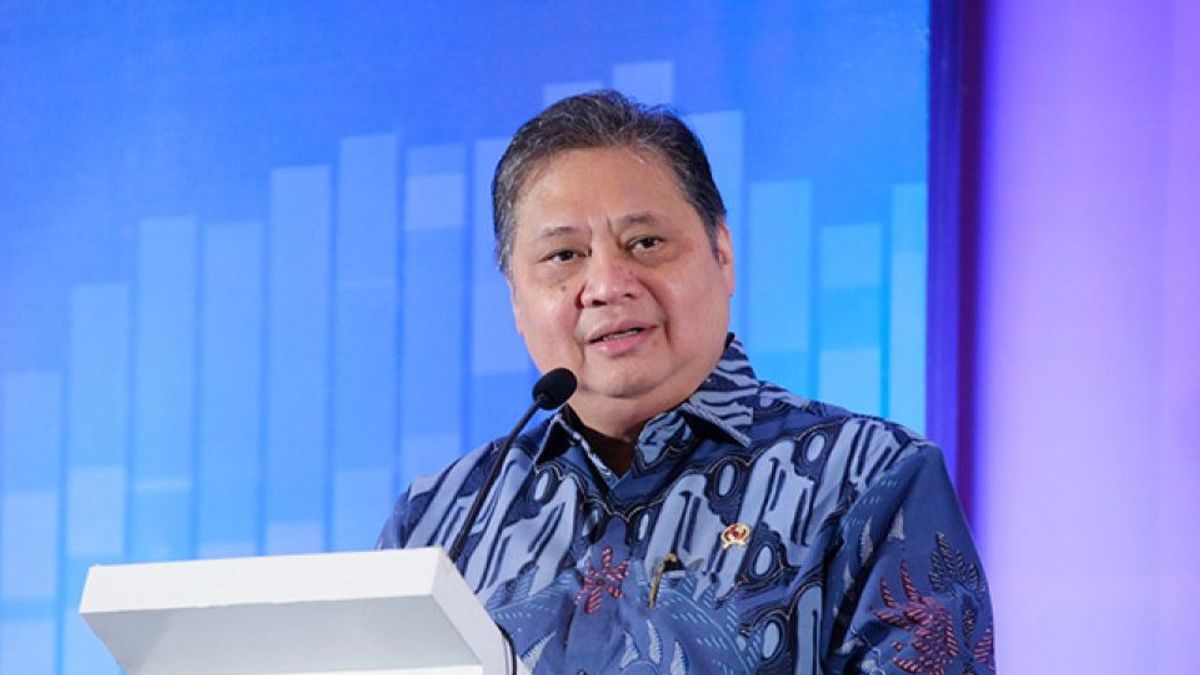


JAKARTA - Coordinating Minister for Economic Affairs Airlangga Hartarto, emphasized that Indonesia's economy entering the second quarter of 2026 is in a strong condition, supported by controlled inflation, trade surplus for 70 consecutive months, and high consumer confidence.
In a Focus Group Discussion (FGD) on the Indonesia-United States Trade Agreement (ART) at the Senate Hall of Gadjah Mada University, Airlangga said that the financial sector continued to show solid performance, reflected by the growth of bank deposits and credit expansion which took place stably.
"Our poverty rate has dropped to 8.25 percent. Our Gini ratio has dropped, our unemployment has also dropped. And the creation of jobs throughout 2025 is 2.71 million new workers," he said in a statement Wednesday, April 15.
On the other hand, Indonesia continues to strengthen global economic diplomacy during the presidency of President Prabowo Subianto through various agreements and strategic partnerships, where Indonesia actively participates in a number of international forums such as RCEP, BRICS, G20, OECD, ASEAN, and CPTPP, as well as expanding bilateral cooperation with various partner countries.
In addition, at the same time, tariff negotiations with the United States also open up opportunities for increased exports of labor-intensive industries and job creation.
The government also continues to strengthen bilateral economic cooperation between Indonesia and various partner countries and a number of agreements have been successfully concluded, including with Japan, Pakistan, Palestine, Chile, Australia, Mozambique, Korea, Iran, Peru, Canada, and Tunisia.
Meanwhile, a number of other negotiations are still ongoing, including with MERCOSUR, Gulf countries, as well as Pakistan, Bangladesh, Sri Lanka, Morocco, Turkiye, and Uzbekistan, all of which show commitment to completing the process in the near future.
The trade relationship with the United States is also in the spotlight, given that the country is the largest contributor to the trade surplus and one of Indonesia's main export destinations, especially for manufacturing products such as palm oil, electronics, textiles, shoes, and furniture.
"Then with America. Why is America important? Because in fact the highest positive trade balance is with America. America imports Indonesian manufactured products. Palm oil, electronics, shoes, textiles, furniture, and others. That is what distinguishes America from other countries," said Airlangga.
Furthermore, the Government noted significant progress in trade negotiations with the United States from April 2025 to early 2026, including a reduction in tariffs on a number of commodities from 32 percent to around 19 percent, as well as the opportunity for tariff exemptions for 1,819 specific products.
This policy is expected to strengthen the labor-intensive industry which absorbs around 5 million workers, as well as encourage cooperation in strategic sectors such as food, energy, industry, and technology, as well as encourage strengthening cooperation in the fields of digital economy, economic security, and the completion of non-tariff barriers.
Furthermore, Airlangga emphasized that Indonesia's strategic position at the global level also strengthens bargaining power in various international negotiations.
He added that Indonesia has high credibility and is often a priority partner in global dialogue, including with the United States which recorded a trade surplus of around 20 billion US dollars with Indonesia.
"Well, this may make it easier for us to complete all negotiations. If Indonesia is not high profile, Indonesia is not a priority. With America, for example, Indonesia is actually positive in the trade balance with America 20 billion US dollars, but Indonesia remains a priority," said Airlangga.
Regarding the legal dynamics in the United States, Airlangga explained that the US Supreme Court's ruling did not cancel the trade agreement with Indonesia because the treaty clauses had fulfilled the legal process in each country.
However, he said that with the US Supreme Court ruling, the US government currently needs additional legal grounds beyond Article 122 of the US Trade Act, so it launched a Section 301 Investigation related to alleged dumping and other issues, focusing on excess capacity and forced labor, in which Indonesia is also included in the investigation process.
However, the Indonesian Government has prepared an official response that will be submitted on April 15, 2026, with a follow-up process in the form of consultations with the USTR on May 12, 2026.
Airlangga also conveyed that the entire negotiation process of The Agreement on Reciprocal Trade (ART) with the United States was always carried out through intensive communication with various stakeholders.
He added that the Government has also consistently conveyed the progress of each stage of the negotiations to the public through the mass media, as a form of transparency and accountability in the Indonesia-United States ART process.
Airlangga emphasized that various priority programs of the government of President Prabowo Subianto, such as the free nutritious meal program and the strengthening of the red and white cooperatives, were designed to improve people's welfare, maintain the stability of the prices of basic necessities, and encourage inclusive economic growth.
The English, Chinese, Japanese, Arabic, and French versions are automatically generated by the AI. So there may still be inaccuracies in translating, please always see Indonesian as our main language. (system supported by DigitalSiber.id)


