

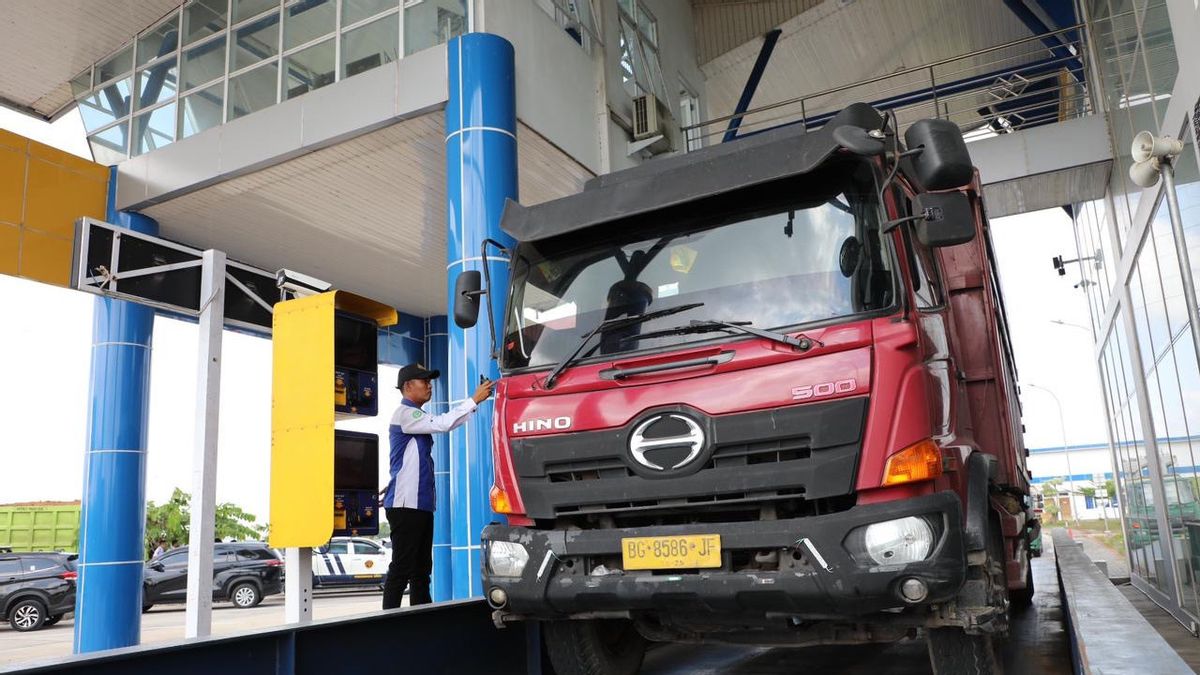


JAKARTA - The Ministry of Transportation continues to strengthen the handling of over-dimension over-load (ODOL) vehicles, which until now is still a problem in the logistics transportation sector. One of the steps taken is to tighten supervision based on digital technology.
Director General of Land Transportation Aan Suhanan emphasized the importance of comprehensive digital transformation in the supervision of logistics transportation, so that it is faster and more effective in detecting ODOL violations.
"Currently, supervision is still partial and conventional, our personnel are limited and must supervise so many over-load over-dimension vehicles. This means that we need to carry out technology-based supervision and data digitally because manual is no longer possible, we will maximize the use of data that exists in other ministries and institutions," said Aan in an official statement, Monday, April 13.
According to Aan, the Ministry of Transportation is currently encouraging cross-ministry and agency data integration to strengthen supervision. This transformation involves a number of parties such as the National Police Traffic Directorate, the Ministry of Public Works, the Toll Road Business Agency (BUJT), and other related ministries.
Digital surveillance utilizes technologies such as ETLE cameras and Weigh in Motion (WIM) scales to detect violations more quickly and accurately, as well as supporting the law enforcement process.
Furthermore, Aan emphasized that this system is also aimed at changing the pattern of accountability in ODOL violations, which until now tend to be only charged to drivers.
"So far, if there is a violation, the driver is often the scapegoat, even though there are owners of goods or vehicle owners who if they are aware of safety should not load that much. With the system we are building now, not only the driver, but also the operator or entrepreneur will be held responsible," said Aan.
In addition, digitalization of supervision is believed to be able to reduce the practice of illegal levies (pungli) which are still found in the field. The minimal direct interaction between officers and drivers is considered to be able to close the gap in illegal negotiations.
"Regarding the pungli, we do not turn a blind eye, it is still happening and we are firm against the violation, there are those who we have demoted who no longer work on the weighing bridge. We also see this as a challenge to continue to supervise our personnel so that they do not do pungli, so with digital systems such as CCTV or ETLE will close the room for drivers to bargain with officers so that they close the room for pungli," he said.
The Ministry of Transportation is currently also carrying out a transition period towards the implementation of the Zero ODOL policy through socialization to driver associations and freight transport business actors. This step is taken to reduce resistance while ensuring the readiness of all parties to the new surveillance system.
"With the orchestration led by the Ministry of Infrastructure and the same commitment from all ministries and institutions, I am optimistic that 2027 Zero Over Dimension Over Load can be achieved," he said.
"Let's end tolerance for over-dimension and over-load vehicles, as well as traffic accidents because there is nothing more important than human safety, one life is too much," Aan continued.
The English, Chinese, Japanese, Arabic, and French versions are automatically generated by the AI. So there may still be inaccuracies in translating, please always see Indonesian as our main language. (system supported by DigitalSiber.id)
Most Popular Tags
#Prabowo Subianto #donald trump #firearm #8791 #giias 2026Popular


