
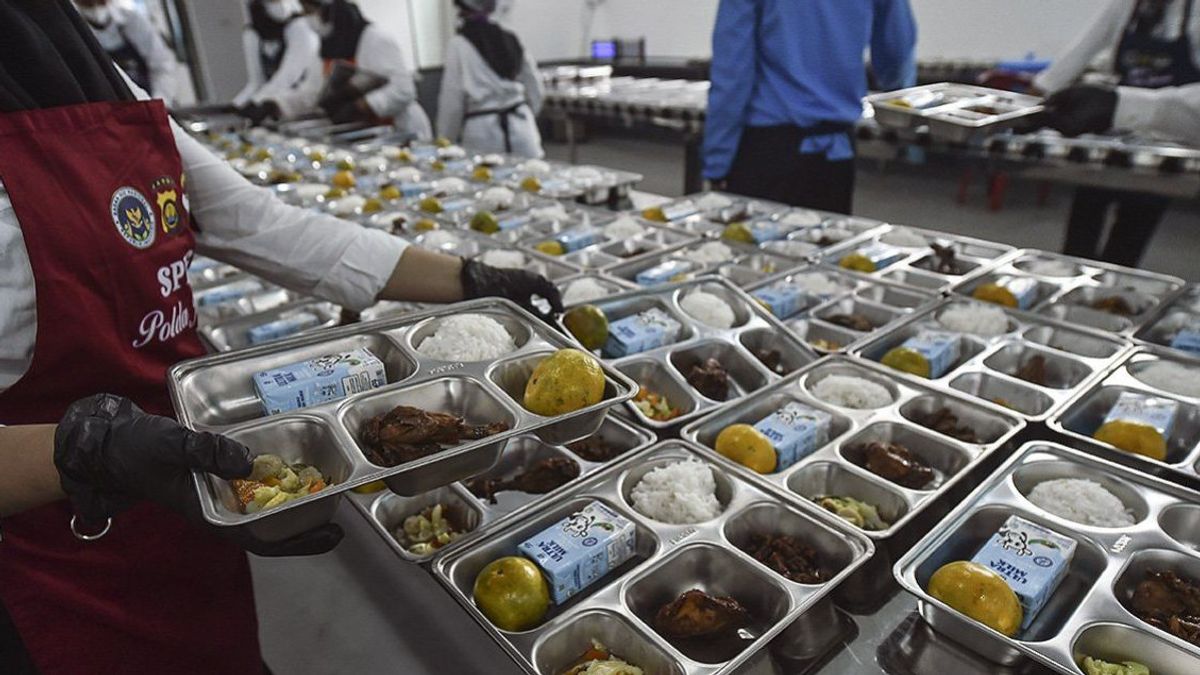


JAKARTA - The Free Nutritious Meal (MBG) program is not just a social policy for distributing food. In the eyes of the Indonesian Chamber of Commerce and Industry (KADIN), this is a new engine of economic growth that is changing the business landscape in the region.
Executive Director of the Indonesian Chamber of Commerce and Industry Institute, Mulya Amri, emphasized that MBG has provided a positive effect on the economy in the real sector today.
"Before the MBG program started, our chicken and egg stocks were in excess. Now it is actually a shortage, so that the price of eggs is more expensive. We are spurring more production," he explained in a written statement, Saturday, April 11.
According to him, this is an opportunity for chicken farmers and vegetable farmers in the area, because this program is a real economic blessing for them. Therefore, Mulya sends a strong message to regional entrepreneurs to transform.
Benedictus Dalupe, a layer chicken breeder, Kadi Pada, Tambolaka City, West Sumba, is one of the faces of local entrepreneurs who started their business when the MBG program was running to witness how the economy in the area has transformed since the MBG.
"We are one of the suppliers of raw materials for eggs for SPPG or MBG kitchens in Tambolaka City, West Sumba. We are currently in the development phase so we can only supply one kitchen regularly. So far we have supplied about 20-25 eggs, ranging from around 3,000 more. We send about three times a week regularly. Usually on Sunday, Tuesday, and Thursday. Currently, our regular ability is only able to supply one SPPG, there are other SPPGs that ask but because of our limited stock we prioritize one SPPG only," said Benedictus.
In fact, Benedictus explained that 95 percent of the need for eggs in West Sumba, both for household consumption, industry, and retail, is still met by farmers from Java Island. After the MBG, there was an interest from local entrepreneurs or farmers in West Sumba to develop a layer chicken farm.
This is in line with Mulya's statement and invitation which encourages local entrepreneurs to take advantage of this opportunity.
"Come on, regional entrepreneurs, make a pivot. If you used to focus on construction, now take the opportunity in the food, health, and agriculture industries," urged Mulya.
Mulya also clarified that the state budget funds allocated for the MBG program are mostly for food and volunteer operations, not for the construction of kitchen infrastructure. This is where entrepreneurs come in.
"If you build a kitchen, you have to use all government funds, it's definitely a tekor. The capital for one kitchen can be Rp. 1.5 billion to Rp. 3 billion. So, entrepreneurs who build their kitchens, recruit people, and manage the network to produce food," he said.
Currently, from the target of around 30,000 government kitchens, around 20,000 units have been built and operating. Mulya encourages entrepreneurs in areas that have not joined to immediately take advantage of the remaining one-third of the target, especially in the 3T (Leading, Outer, Lagging) areas.
Public Perception of the MBG ProgramMulya is aware of the skewed view, especially from the middle class who consider this program unnecessary for the government to interfere with. However, he emphasized the difference in reality in the field.
"There are many misconceptions about us as the middle class. We assume these children have already eaten. In fact, many are not given to eat," said Mulya.
Several studies reinforce Mulya's statement. LabSosio-LPPSP FISIP UI, for example, which conducted research related to the MBG program, explained that the parents of the students surveyed generally gave a very positive assessment of this program. The presence of MBG is considered very helpful in alleviating the economic burden of the family and saving the children's pocket money. For parents who are busy working in the morning, this program is a practical solution that ensures their children are not hungry and still have access to nutritious food at school.
"Almost half of the students, 48.5 percent of students, admitted that they rarely or never ate breakfast before going to school. So 85.8 percent of students always spend the MBG food served," said Dr. Hari Nugroho, MA, Chairman of LabSosio-LPPSP FISIP UI. In line with this, the Research Institute Of Socio-Economic Development (RISED) recently also conducted a study related to MBG which has an impact on household spending and beneficiary children.
"As many as 81 percent of parents from vulnerable households stated that they support the sustainability of MBG. Interestingly, this support is not only about saving money, but more on the sense of security and certainty that their children have access to nutritious food while at school," said RISED Researcher, M. Fajar Rakhmadi.
In line with the findings of RISED, the Political Indicator also announced the results of a similar survey, namely, 12.2 percent of the public were very satisfied with MBG, and 60.6 percent of the public were quite satisfied with the MBG program.
Government intervention in providing nutritious food does have a direct impact on the concentration of learning and the quality of knowledge that students absorb. This is the main foundation for creating superior human resources in the future.
Mulya Amri, again emphasized "This program is a long-term investment. Even though the benefits of new human resources (HR) quality will be felt in the next 5 to 15 years," he concluded.
The English, Chinese, Japanese, Arabic, and French versions are automatically generated by the AI. So there may still be inaccuracies in translating, please always see Indonesian as our main language. (system supported by DigitalSiber.id)
Most Popular Tags
#Prabowo Subianto #donald trump #Febrie Adriansyah #8791 #giias 2026Popular


