

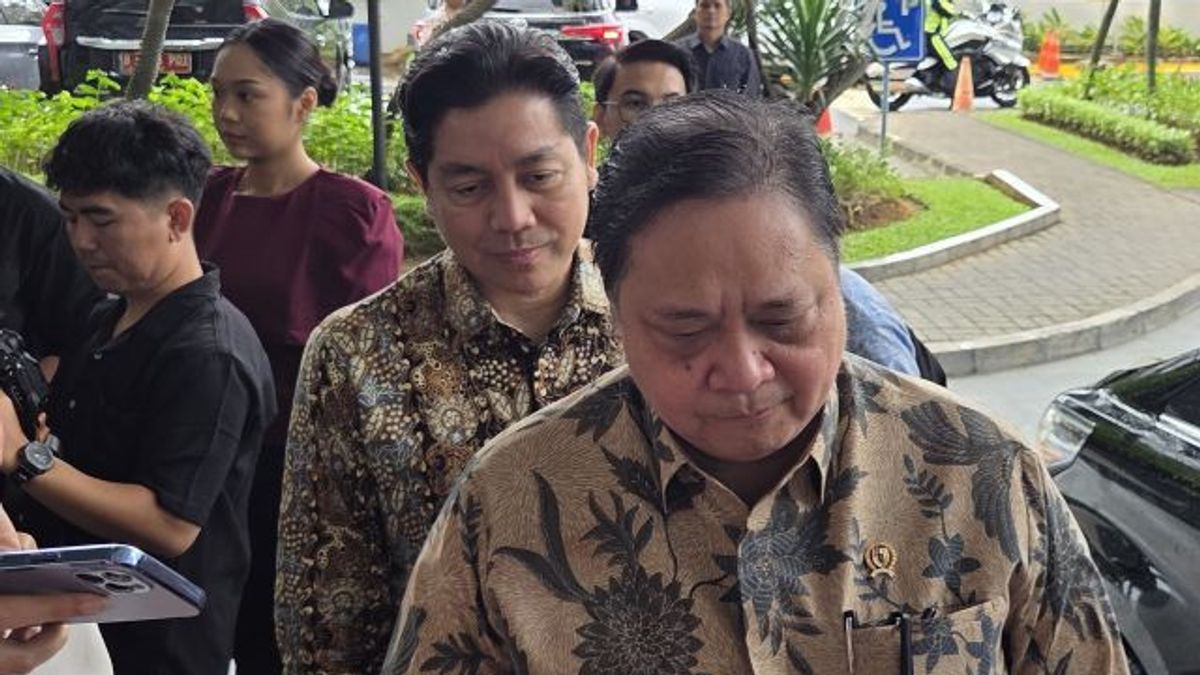


JAKARTA - Coordinating Minister for Economic Affairs Airlangga Hartarto said that the government would soon announce a work from home or work from home (WFH) policy as a step to reduce fuel consumption.
He explained that the policy was planned to be implemented one day a week for state civil servants, including civil servants and PPPK, and will be an appeal for workers in the private sector.
"Soon, before April," he told the media at the Ministry of Finance's office, Friday, March 27.
However, Airlangga has not given a definite date regarding the announcement because he still has to report the plan to President Prabowo Subianto at the Presidential Palace.
He emphasized that the decision regarding the WFH policy is likely to be announced in the near future.
"This week," he said.
Previously, the government had decided to immediately implement the work from home (WFH) policy 1 day a week, namely every Friday.
This policy was prepared as a precautionary measure against the rise in world oil prices triggered by tensions in the Middle East region.
Minister of Finance Purbaya Yudhi Sadewa revealed the reason for choosing Friday as one of the options for implementing WFH because the working hours were relatively shorter.
"Friday is the shortest working hours. So the loss to productivity is considered the smallest," said Purbaya at the Ministry of Finance's office, Jakarta, Wednesday, March 25.
According to him, the WFH policy will be officially announced by Coordinating Minister for the Economy Airlangga Hartarto and applies to state civil servants (ASN) in the central and regional governments. Furthermore, it can be expanded to private employees.
The main objective of this policy is to suppress fuel consumption, given the uncertainty of the global situation, while Indonesia's energy reserves are estimated to only last for about 25-26 days.
However, Purbaya emphasized that the impact of this policy can not only be seen from the perspective of energy savings.
"If WFH reduces the burden of employee travel, then household consumption can increase. Business activities continue, and tax revenue also has the potential to increase," he said.
Purbaya added that if the WFH policy actually encouraged the economy to grow faster than expected, then it would be beneficial.
"If the economy slows down, business goes up quickly, consumption goes up, my taxes go up. That is actually beneficial," he said.
He emphasized that the government did not see the WFH policy from only one side.
The approach used is the general equilibrium approach, which takes into account the impact of policies on the overall movement of the economy, not just energy savings.
The English, Chinese, Japanese, Arabic, and French versions are automatically generated by the AI. So there may still be inaccuracies in translating, please always see Indonesian as our main language. (system supported by DigitalSiber.id)


