

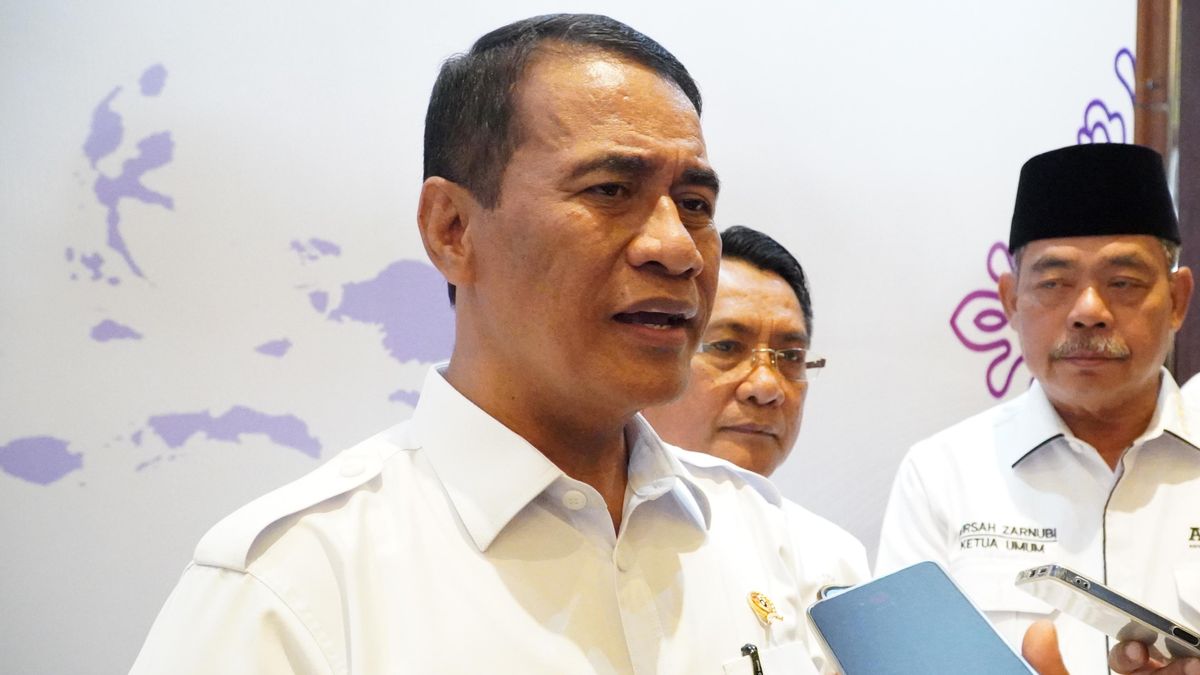


JAKARTA - The certainty that Indonesia will not open the tap of consumer rice imports throughout 2026 was reiterated by the Head of the National Food Agency (Bapanas) who is also the Minister of Agriculture, Andi Amran Sulaiman.
The affirmation was conveyed after filling in the National Working Meeting of the Association of Regional Governments of All Indonesia (Apkasi) in Batam, Riau Islands, Monday, January 19.
"We must not import rice, we are self-sufficient. Our stock is abundant. This is the rice (production) of the country. Tell them, (we) must love red and white. Convey red and white love. This is because we want food sovereignty," said Amran in an official statement, Monday, January 19.
According to Amran, the decision not to import rice is a form of the state's bias towards domestic farmers and the foundation for food sovereignty.
"Imports must not be. Please do not play with the fate of the people. There are 115 million rice farmers. It is time to kill small people. Our president has announced that we are self-sufficient. This is the supreme commander who has declared Indonesia to be self-sufficient," he said.
The government's belief in eliminating rice imports is strongly supported by the projection of the national rice balance. Data from the Rice Food Balance Update 6 January 2026 estimates that the total annual consumption needs are in the range of 31.1 million tons. Meanwhile, this year's rice production is estimated to reach 34.76 million tons, enough to meet domestic consumption.
The production surplus is strengthened by the carry-over stock of the previous year which reached 12.4 million tons, becoming the initial stock entering 2026. With this calculation, Indonesia is projected to still have 16.1 million tons of national rice stock by the end of the year.
This policy is also contained in the National Commodity Balance 2026 which was passed at the end of December 2025. The government officially abolished the import of general consumption rice and industrial raw rice which is usually used for industrial-scale food processing.
The raw materials in question include broken rice and glutinous rice with a grain integrity level of less than 15 percent. With the absence of import quotas, the government encourages industry players to rely on local broken rice and broken glutinous rice.
Responding to the fluctuation in rice prices in the market, Amran explained that the dynamics were more due to distribution cost factors, not a lack of supply.
"That's the price (of rice) because of distribution. But the current price, not rice contributing to inflation. I repeat, not rice contributing to inflation, which is usually the highest contributor to inflation. Toh has risen, yes. But now we, our stock is a lot," he said.
Data from the Central Statistics Agency (BPS) shows that the movement of rice inflation in 2025 is much more controlled. The peak of rice inflation last year only reached 1.35 percent in July, far below the spike in September 2023 (5.61 percent) and February 2024 (5.32 percent).
Monthly rice inflation was also closed with good performance in December 2025 at the level of 0.18 percent, with an annual average of 0.30 percent lower than 2023 (1.34 percent) and 2022 (0.51 percent).
With abundant stocks, adequate production, and no significant inflationary pressure, the government declared 2026 as a milestone for the consolidation of national food self-sufficiency.
The English, Chinese, Japanese, Arabic, and French versions are automatically generated by the AI. So there may still be inaccuracies in translating, please always see Indonesian as our main language. (system supported by DigitalSiber.id)
Most Popular Tags
#Prabowo Subianto #donald trump #Febrie Adriansyah #8791 #giias 2026Popular


