

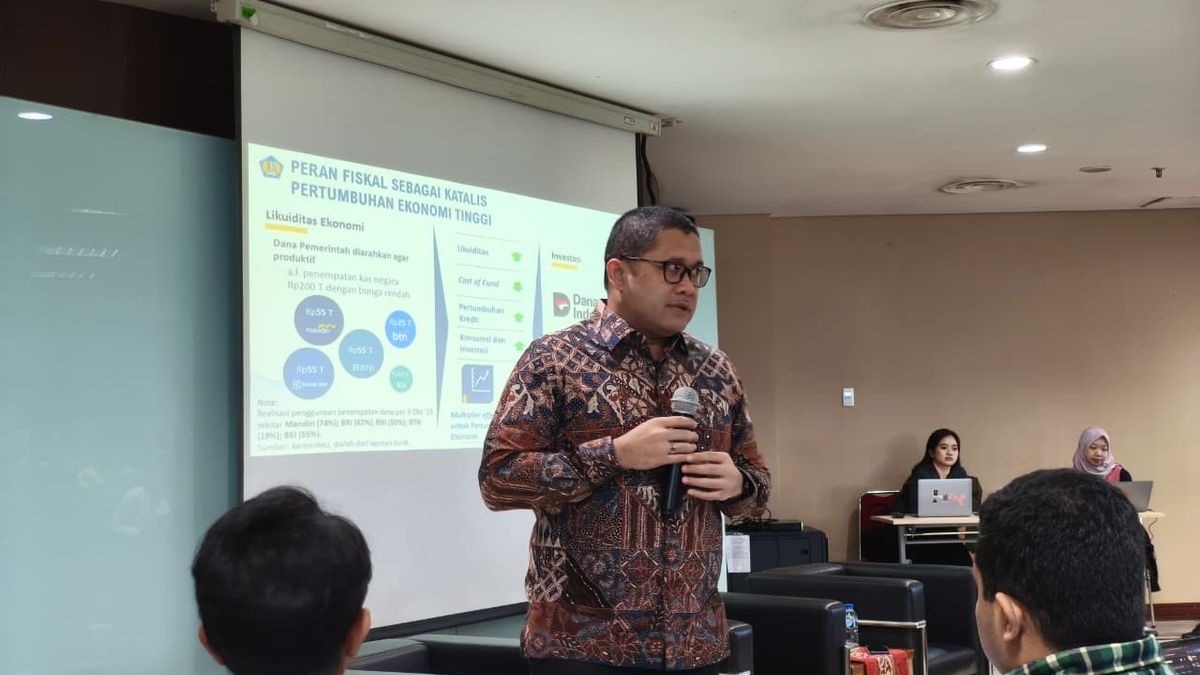


JAKARTA - The Ministry of Finance through the Director General of Economic and Fiscal Strategy (SEF) Febrio Kacaribu revealed that it would evaluate the policy on coal VAT restitution.
"This is definitely every year we see and will definitely evaluate yes. The restitution according to existing laws and regulations is clearly the right of the WP," said Febrio, Tuesday, December 23.
He added that the Ministry of Finance would only evaluate the restitution application and not remove the existing policy.
Febrio also cited an example when his party discussed the exit tax on coal. In recent years since the enactment of the Job Creation Law, the BK coal institution has had quite a heavy consequence in terms of taxes.
"The consequence for the tax side is quite heavy. That there is still a real tax, there is a PBB, there is a real VAT. But because there is a restitution, it makes the tax revenue relatively limited," he continued.
He also said that his party had discussed with the House of Representatives of the Republic of Indonesia which invited the Ministry of Finance to approve the coal export duty but the Ministry of Finance must ensure an increase in terms of state revenue.
"Now this is what we evaluate the policy. Then we discuss with the DPR also say please approve BK coal, then the direction is to ensure that the country's revenue increases. Well that's what we are preparing," he said.
Previously, Minister of Finance Purbaya Yudhi Sadewa confirmed that the application of exit duties for coal commodities will begin to be implemented in 2026.
The government's planned export tariff ranges from 1 percent to 5 percent.
According to Purbaya, the reason behind the policy is that there has been fiscal inequality, where coal companies that reap huge profits actually receive facilities that burden the state budget, including restitution facilities, so the government wants to impose an exit tax so that state revenues remain stable.
He assessed that when coal prices fell, exporters filed many tax refunds, but when prices rose, there were no exit duties to be paid so that it indirectly felt like a subsidy from the government.
"So it's strange. These are rich people, exports are fortunately many, I subsidize it indirectly. So that's actually the main philosophy behind this regulation (coal export tax)," he said in a working meeting with Commission XI of the Indonesian House of Representatives, Monday, December 8.
The former LPS boss added that the change in the status of coal from non-taxable goods to taxable goods makes companies entitled to apply for Value Added Tax (VAT) refunds.
"So when the 2020 Job Creation Law was implemented, it strengthened the status of coal from non-taxable goods to taxable goods, as a result the coal industry can request a VAT refund to the government," said Purbaya.
The English, Chinese, Japanese, Arabic, and French versions are automatically generated by the AI. So there may still be inaccuracies in translating, please always see Indonesian as our main language. (system supported by DigitalSiber.id)
Most Popular Tags
#Prabowo Subianto #donald trump #2026 World Cup #Febrie Adriansyah #8791Popular


