
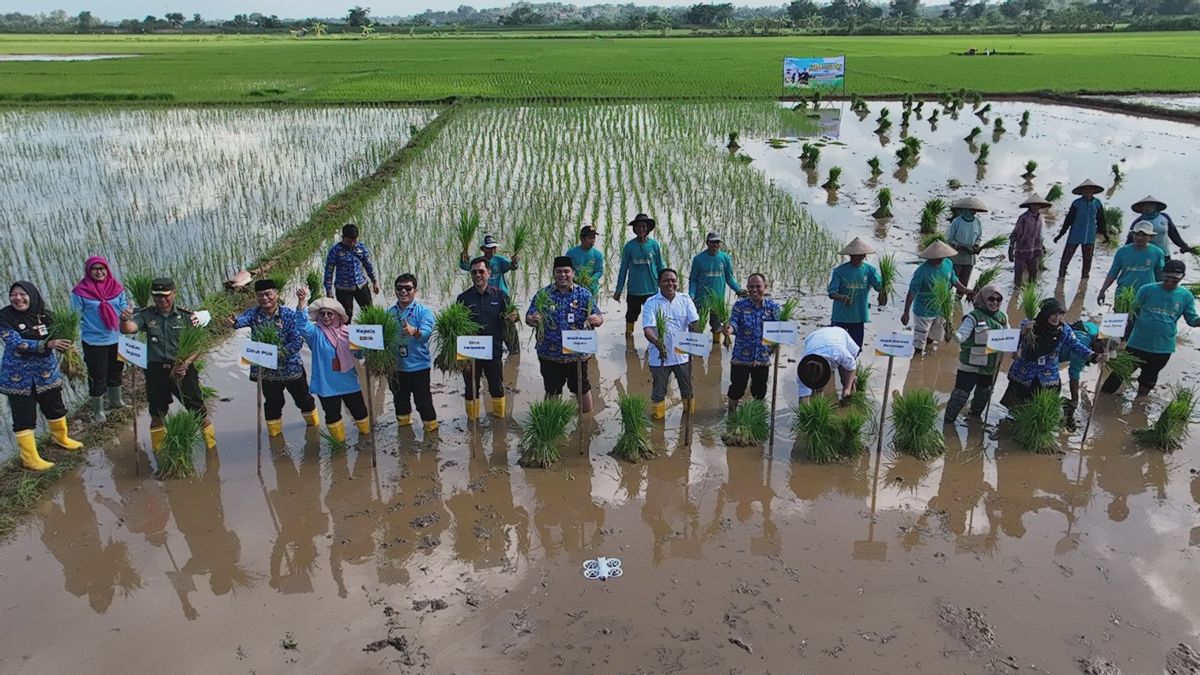


JAKARTA - PT Perusahaan Gas Negara Tbk (PGN) together with the National Research and Innovation Agency (BRIN) strengthen support for the national food security program through the development of biosaline rice cultivation in the coastal area of Jepara Regency. This initiative is part of the strategy for disaster mitigation and post-disaster recovery due to the intrusion of seawater and climate change which has lowered the productivity of coastal agricultural land for years.
As is known, the coastal areas of northern Java, including Jepara and the North Coast area of Central Java, face serious challenges in the form of increased soil salinity due to seawater intrusion and flash floods. This condition causes conventional rice varieties to fail to grow, triggering the conversion of land into fallow land, and reducing farmers' income since repeated crop failures have occurred.
In response to this challenge, PGN together with BRIN and the Regional Government (Pemda) through the PGN CSR program encourages the use of biosaline rice varieties as part of the national food security strategy as well as efforts to mitigate the impact of climate change and environmental disasters in coastal areas. This initiative was introduced in the Farm Field Day (FFD) of Innovation Innovation of Energy Technology Supporting Food Security held in Jepara Regency, Wednesday, December 17.
Through the CSR Program, PGN provides comprehensive support ranging from the provision of seeds and fertilizers, cultivation assistance to post-harvest, as well as capacity building for farmers. This program is carried out through multi-stakeholder collaboration between PGN, BRIN, local governments, farmer groups, and is supported by the TNI-Polri in land preparation.
The Deputy Regent of Jepara, Muhammad Ibnu Hajar, assessed that this program was in line with the direction of the central government's policy in strengthening national food security, especially in areas affected by climate change.
"We appreciate the synergy between PGN and BRIN in supporting the main program of the President of the Republic of Indonesia related to food security. We hope that this program can improve the economy of farmers and communities, as well as present integrated solutions, including energy solutions through plastic waste management," said Ibnu Hajar.
PGN Finance Director, Catur Dermawan, emphasized that support for the biosaline rice program is part of PGN's contribution to supporting government priority programs, especially food security and the economic recovery of coastal communities.
"PGN considers food security as the foundation of national resilience. This biosaline rice program is not only oriented towards harvest results, but also towards the recovery of land productivity affected by sea water intrusion. Through collaboration with BRIN and the Regional Government, we want to ensure that coastal land is again economically valuable and farmers obtain sustainable sources of livelihood," said Catur.
In Jepara Regency, Catur added, this program was initiated by planting 400 kilograms of biosaline rice seeds on an area of 5 hectares and is now being developed to 20 hectares. This development continues the success of implementation in the northern coastal area of Semarang, which currently has reached 100 hectares of planting land. From this area, the harvest of biosaline rice produces 116.95 tons of harvested dry rice (GKP) with an average productivity of 5.85 Tons/Hectare.
"This productivity data shows that coastal land that has not been cultivated has great potential if supported by the right technology. This is what we continue to encourage through the collaboration of PGN, BRIN, and the Regional Government," he said.
In terms of disaster research and mitigation, BRIN places the development of biosaline rice as part of a technology strategy to optimize land affected by environmental disasters, especially in coastal areas and salinity-prone areas. Director of Regional Research and Innovation Facilitation and Monitoring at BRIN, Wiwiek Joelijani, emphasized that biosaline agricultural research is not only aimed at increasing production, but also as a mitigation and post-disaster recovery step.
"To ensure sustainability, the production of biosaline rice is not only directed as a consumption commodity, but also developed for seed production, to encourage local seed independence and strengthen the innovation-based agricultural ecosystem. We have also prepared various Appropriate Technology as part of disaster mitigation and post-recovery, so that people can quickly recover and adapt," explained Wiwiek.
According to Wiwiek, this approach is an example of research downstream that is oriented towards real solutions in the field, where technological innovation does not stop at variety development, but is integrated with assistance, land management, and capacity building for the community.
In addition to the agricultural sector, PGN also introduced the Petasol innovation, a technology for processing low-value plastic waste into fuel oil (BBM). This technology was previously developed to support environmentally friendly tourist destinations in Karimunjawa and is now introduced as part of an integrated approach between food security, environmental management, and sustainable energy transition.
"In the future, PGN together with BRIN and the Regional Government plans to replicate this collaboration model in other coastal areas in Central Java. One of them is the development plan in Batang Regency in 2026 with a wider scale, as part of efforts to strengthen national food security, environmental disaster mitigation, and sustainable grassroots economy," concluded Catur.
The English, Chinese, Japanese, Arabic, and French versions are automatically generated by the AI. So there may still be inaccuracies in translating, please always see Indonesian as our main language. (system supported by DigitalSiber.id)


