

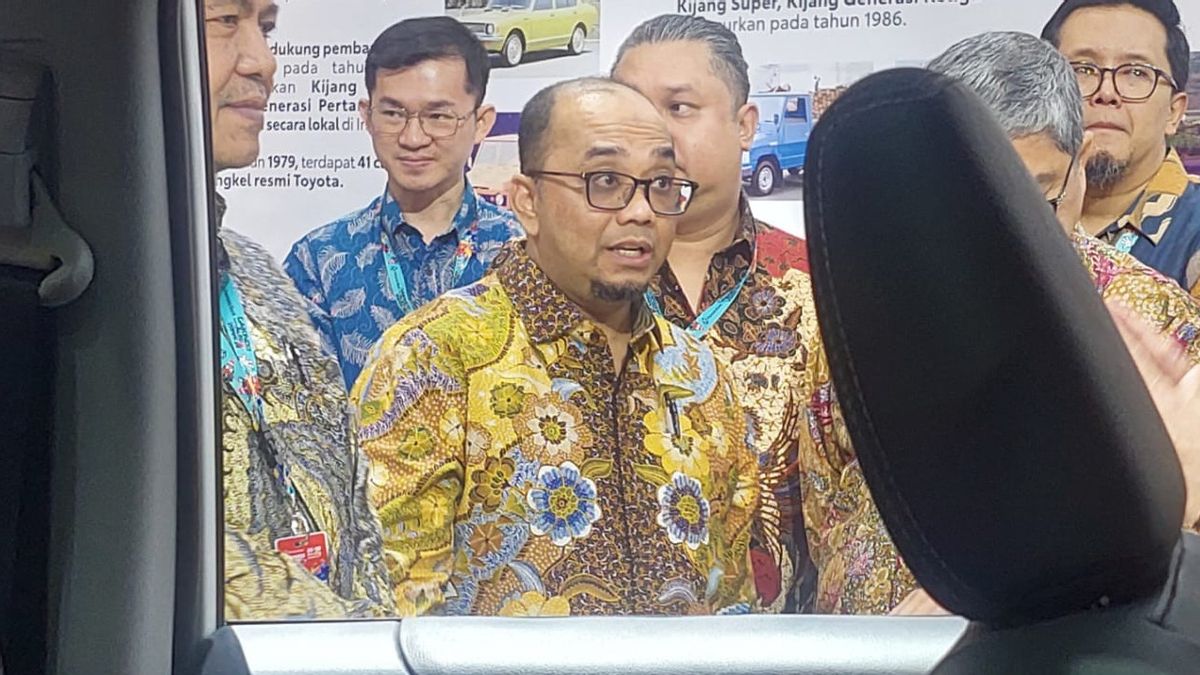


JAKARTA - The national automotive industry recorded a more stable performance towards the end of 2025. The Gaikindo Jakarta Auto Week (GJAW) 2025 exhibition is considered to be an important momentum in maintaining the growth rhythm of this sector, especially in terms of vehicle production and exports.
The Director General of Metal, Machinery, Transportation Equipment and Electronics (Dijern ILMATE) of the Ministry of Industry, Setia Diarta, said that GJAW 2025 acts as a strategic forum for introducing automotive products while strengthening industrial competitiveness.
"The 2025 GJAW exhibition is one of the important efforts in promoting domestic automotive products which is expected to spur the growth of the national automotive industry, especially towards the end of 2025," said Setia at the opening of GJAW 2025, Friday, November 21.
He explained that the automotive sub-sector is still one of the backbones of the manufacturing industry. The contribution to the national Gross Domestic Product (GDP) was recorded at 1.28 percent in the third quarter of 2025.
In terms of capacity, currently there are 39 four-wheeled vehicle manufacturers with a total production capacity of 2.39 million units per year. For two and three-wheeled vehicles, there are 82 manufacturers with a combined production capacity of 11.2 million units per year.
Throughout January to September 2025, the production of four-wheeled vehicles was recorded at around 850 thousand units. Of these, exports in the form of CBU (Completely Built-Up) reached around 380 thousand units.
"Almost 45 percent of four-wheel production is absorbed by foreign markets, showing Indonesia's position remains strategic as a global production base in the midst of increasingly fierce competition," he said.
Similar performance is also seen in the two- and three-wheel segments. Production during the same period reached 5.25 million units, while CBU exports were recorded at 410 thousand units.
Setia also highlighted the ratio of vehicle ownership or Car Ownership Ratio (COR). Based on OICA data in 2024, it was recorded that 99 vehicles per 1,000 population were recorded, although they were still lower than neighboring countries.
SEE ALSO:
-
 | OLAHRAGA
Valencia Ajukan Gugatan terhadap Netflix atas Film Dokumenter Vinicius
07 Oktober 2025, 09:24


This figure is still lower than Malaysia, Thailand, and Singapore. This shows that the growth space is still wide open," he said.
On the other hand, the development of electric vehicles is also a concern. The total investment that has entered for the development of electric buses, electric cars, and two- and three-wheeled electric vehicles has reached IDR 5.7 trillion.
The current production capacity of electric buses reaches 4,100 units per year. Meanwhile, the production capacity of electric cars reaches 110,660 units per year with an investment of around IDR 4.23 trillion.
For two- and three-wheel electric vehicles, the production capacity reaches 2.51 million units per year with an investment value of around IDR 1.157 trillion. Through the implementation of GJAW 2025, the government and industry players are expected to continue to strengthen the automotive ecosystem.
The English, Chinese, Japanese, Arabic, and French versions are automatically generated by the AI. So there may still be inaccuracies in translating, please always see Indonesian as our main language. (system supported by DigitalSiber.id)
Most Popular Tags
#Prabowo Subianto #donald trump #Febrie Adriansyah #8791 #giias 2026Popular


