

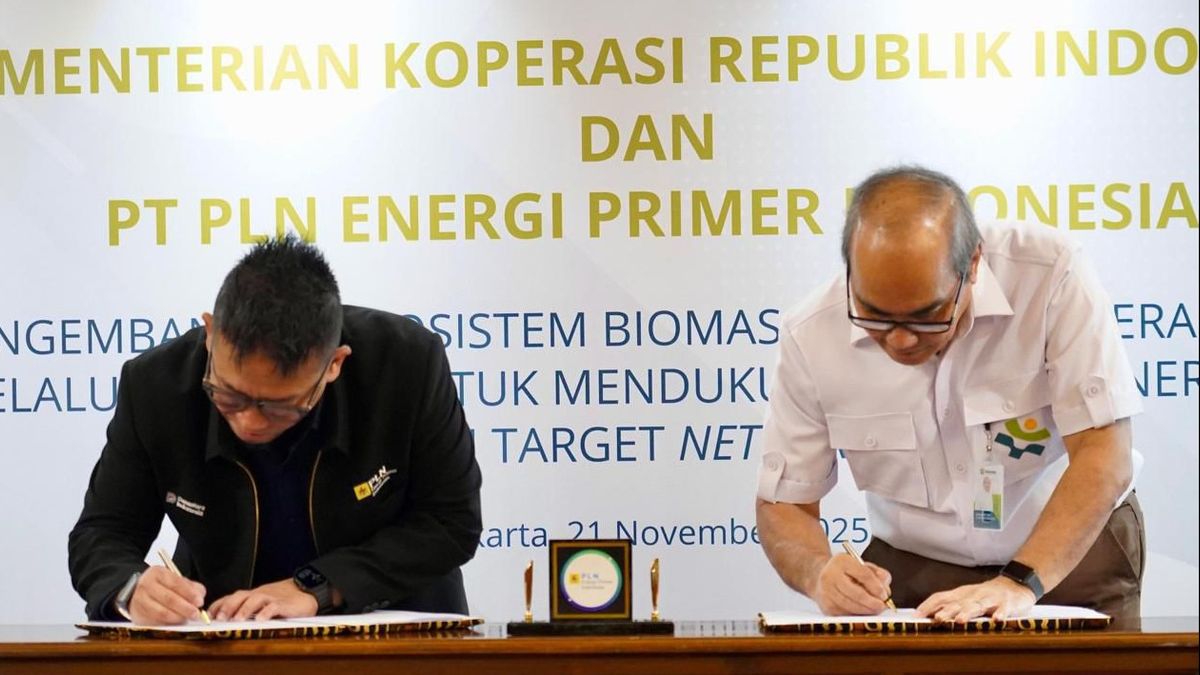


JAKARTA - The Ministry of Cooperatives (Kemenkop) together with PT PLN Energi Primary Indonesia (PLN EPI) signed a Memorandum of Understanding (MoU) related to the development of a community-based biomass ecosystem through cooperatives.
The signing of the MoU between Kemenkop and PLN EPI was carried out by the Deputy for Cooperative Supervision (Kemenkop) Herbert HO Siagian and the Director of Biomass at PLN EPI, Hokkop Situngkir at the Ministry of Cooperatives, Friday, November 21.
Deputy for Cooperative Supervision, Herbert HO Siagian, emphasized that the role of cooperatives has great potential to become aggregators for biomass products produced by the community, especially in villages or sub-districts.
"This cooperation is a strategic step to strengthen the renewable energy ecosystem in Indonesia as part of the clean energy transition, as stated in the medium-long government targets contained in various national documents," said Herbert, Friday, November 21.
According to Herbert, the raw material for biomass that has been one of the main needs of PLN EPI can be supported by Cooperatives to maintain the stability and sustainability of supply.
The existence of the Red and White Village/Sub-District Cooperative (Kopdes/Kel) is in line with the target of PLN EPI to ensure the availability of these supplies because the Red and White Kopdes/Kel are spread throughout Indonesia to remote areas.
"If this cooperation is realized, it could be an initial effort or an initial guarantee of supply stability for biomass energy," he explained.
Herbert emphasized that biomass is not just energy, but also economic opportunities for people in villages/kelurahan. So far, some commodities that should have become biomass raw materials are not optimized and even thrown away. With this synergy, biomass raw material products that were originally not worth being economic-valued goods.
Kopdes/Kel Merah Putih, continued Deputy Herbert, can encourage the public and its members to start utilizing waste or other biomass raw materials to be collected until they reach certain aggregates. In this way the Kopdes/Lel Merah Putih can encourage the creation of new jobs in a sustainable manner.
"That way, people not only contribute to clean energy, but also get additional income," he said.
According to Herbert, currently there are still many villages that do not have electricity networks, which are estimated at around 5,000 - 6,000 villages. With the synergy with PLN EPI, it will open up opportunities for expansion and addition of electricity services by utilizing the sources of biomass raw materials in the vicinity.
"This is an opportunity how the village can be overcome with renewable energy sources, not just conventional electricity. Hopefully, the Ministry of Cooperatives together with PLN EPI can immediately follow up through piloting with cooperatives that are already running and potential," he said.
Meanwhile, the Director of Biomass of PLN EPI Hokkop Situngkir emphasized PLN's readiness to develop a biomass supply chain.
According to him, biomass is very close to the economic activities of the community so that cooperation with the Ministry of Cooperatives is a concrete step to ensure the sustainability of raw material supplies.
"We express our gratitude for the support from the Ministry of Cooperatives. This commitment will provide a solid basis for the formation of a structured, sustainable, and added value for the community," said Hokkap.
According to him, with the assurance of a sustainable supply of raw materials, the dependence of the Power Plant on the supply of fossil energy sources can be suppressed and then substituted with more environmentally friendly fuels, including biomass.
SEE ALSO:
-
 | EKONOMI
Turun, Harga Minyak Mentah Indonesia Oktober Dipatok 63,62 Dolar AS per Barel
21 November 2025, 15:25 -
 | EKONOMI
Wamen PU Sebut Sedang Hitung-hitung Besaran Diskon Tarif Tol Libur Nataru
21 November 2025, 14:24
Skema kerja sama untuk pasokan bahan baku biomassa telah dilakukan PLN EPI dengan berbagai pihak, namun hal itu dirasakan masih perlu ditingkatkan agar kestabilan pasokan terjaga di masa mendatang.
"Ke depan harapannya masing-masing koperasi bisa register, menjadi pengepul, suplai, atau hub investasi biomassa karena PLTU butuh kestabilan pasokan. Kalau kita mampu mengoptimalkan koperasi maka akan tercapai kestabilan (pasokan),” katanya.
SEE ALSO:
-
| EKONOMI
Turun, Harga Minyak Mentah Indonesia Oktober Dipatok 63,62 Dolar AS per Barel
21 November 2025, 15:25 -
| EKONOMI
Wamen PU Sebut Sedang Hitung-hitung Besaran Diskon Tarif Tol Libur Nataru
21 November 2025, 14:24
The cooperation scheme for the supply of biomass raw materials has been carried out by PLN EPI with various parties, but it is felt that it still needs to be improved so that supply stability is maintained in the future.
"In the future, we hope that each cooperative can register, become a collector, supply, or biomass investment hub because PLTU needs supply stability. If we are able to optimize cooperatives, stability will be achieved (supply)," he said.
The English, Chinese, Japanese, Arabic, and French versions are automatically generated by the AI. So there may still be inaccuracies in translating, please always see Indonesian as our main language. (system supported by DigitalSiber.id)


