

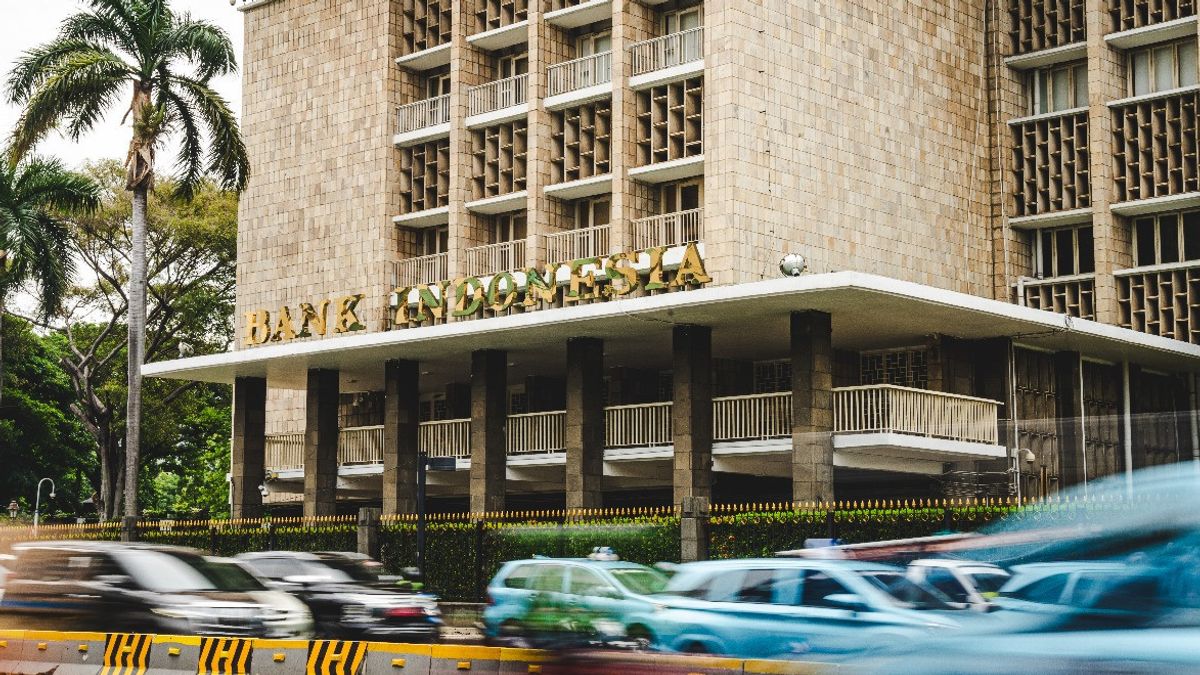


JAKARTA - Bank Indonesia (BI) said that in order to maintain stability and encourage economic growth, it has taken four main steps for monetary policy.
BI Governor Perry Warjiyo explained that these steps were designed to keep monetary policy effective, in line with the inflation target and stability of the rupiah exchange rate.
He conveyed that in line with the direction of monetary policy, Bank Indonesia had lowered the policy interest rate (BI Rate) by 25 basis points each in July, August, and September 2025, so that in September 2025 interest rates to 4.75 percent.
"With this step, since September 2024, Bank Indonesia has lowered its BI rate six times, bringing the total down 150 basis points or 1.5 percent," he said at a press conference on the Financial System Stability Committee (KSSK) IV in 2025, Monday, November 3.
According to him, this decision is in line with efforts to strengthen economic growth, supported by an estimated inflation of 2025'2026 which remains low in the target of 2.5 percent plus minus 1 percent, and a stable rupiah exchange rate according to its fundamentals.
Perry menyampaikan penurunan suku bunga ini juga berdampak pada turunnya yield Surat Securang Negara (SBN) secara signifikan, sehingga mengurangi beban biaya utang pemerintah
"With a decrease of 1.5 percent or 150 basis points 6 times from the BI rate, the SBN yield also decreased drastically. Thus, Bank Indonesia's policy of decreasing the SBN yield and thereby reducing fiscal costs related to debt costs from the government," he said.
In the future, Perry said BI would continue to pay close attention to the effectiveness of the transmission of this loose monetary policy to the prospects for economic growth, inflation, and stability of the rupiah exchange rate, including space for a further reduction in the BI Rate.
Perry added that the second step of Bank Indonesia continues to strengthen the strategy for stabilizing the rupiah exchange rate, which is supported by adequate foreign exchange reserves.
He conveyed that the stabilization step was carried out through intervention in the financial market, both spot transactions and Domestic Non-Delivery Forward (DNDF) abroad, as well as NDF interventions abroad.
In addition, Perry said that BI also purchased SBN in the secondary market to maintain liquidity and financial market stability, so that the rupiah exchange rate remained under control amid high global dynamics.
He said the next step was for Bank Indonesia to continue expanding monetary liquidity through a pro-market monetary operation strategy to strengthen interest rate reduction transmission, increase liquidity, and deepen the foreign exchange market and market.
"The expansion of monetary liquidity was pursued by Bank Indonesia, among others, through a decrease in Bank Indonesia's Rupiah Securities. If we count since the beginning of the year, Bank Indonesia's rupiah securities has decreased by IDR 210.8 trillion from the initial position of IDR 916.9 trillion to IDR 706.7 trillion, October 27, 2025," he said.
In addition, he said BI also lowered the Deposit Facility interest rate to 3.75 percent, so that banks were more motivated to channel excess liquidity to the real sector.
SEE ALSO:

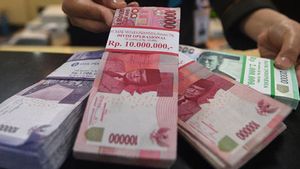

Perry conveyed that market deepening efforts were carried out by expanding the underlying repo for monetary operations not only with SBN, but also with high-quality corporate securities issued by government-owned financial services institutions.
BI also issued a Bank Indonesia Floating Rate Note (FRN) and developed an Overnight Index Swap (OIS) for tenors above overnight. In addition, BI expands its ownership of Sukuk Bank Indonesia so that it can be owned by banks, non-banks, and foreign investors.
Perry conveyed that the last step in monetary policy was the purchase of Government Securities (SBN) from the secondary market, as a form of close synergy between monetary and fiscal policies.
From January to October 30, 2025, BI has purchased SBN of IDR 269.97 trillion, consisting of purchases in the secondary market and a debt switching program with the government worth IDR 199.9 trillion.
"Those are four monetary policy steps in maintaining stability and also encouraging economic growth," he concluded.
The English, Chinese, Japanese, Arabic, and French versions are automatically generated by the AI. So there may still be inaccuracies in translating, please always see Indonesian as our main language. (system supported by DigitalSiber.id)


