


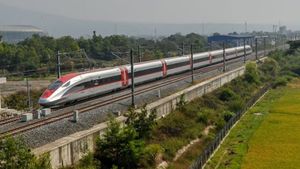
JAKARTA - The commotion of throwing each other over the responsibility of the Jakarta Bandung High Speed Train (KCJB) aka
Like rice has become porridge, Senior Researcher for Strategic Initiation of Transportation (Instran) Deddy Herlambang sees the project has become an item and its operation is impossible to stop.
"It is better to think critically and strategicly to save our SOEs so that they do not disband," said Deddy in an official statement received by VOI, Tuesday, October 28.
PT Kereta Cepat Indonesia China (KCIC) is also recorded as having a share portion of 60 percent, while the rest are Chinese entities. This means that of the total debt of around Rp. 119 trillion, Indonesia needs to pay Rp. 71.4 trillion.
"Indeed, the government does not need to pay debts to Bank China through the APBN worth Rp. 119 trillion. However, at least think about how to save our SOEs," he said.
Deddy explained, although since the beginning the KCJB was confirmed without the support of the APBN through Presidential Decree 172/2015, the evaluation in 2021 opened up space for fiscal support from the government.
The hope is that BPI Danantara, who is now responsible for SOEs, can complete it on a business to business (B2B) basis.
He encouraged the government and the Danantara to renegotiate their debts by changing exchange rates from US dollars to Chinese yuan. This takes into account the stability of the yuan towards the rupiah, rather than the US dollar.
It didn't stop there, Deddy also supported debt restructuring from 40 years to 60 years to grass period, so the installment value was cheaper every year.
If the tenor period is longer, said Deddy, automatically the interest value can decrease or at least the interest rate decreases, referring to effective interest rates or floating interest rates.
For KCIC financial health, Deddy assessed that there needs to be another business model. For example, a non-fare box for the development of a transit-oriented development (TOD) area at the KCIC Karawang station node, KCIC Padalarang (there is already a Parahyangan City, only integration) and KCIC Tegalluar.
"TOD can financially assist KCIC's income in the land/tenant rental sector. On the other hand, with TOD at KCIC station nodes, it will naturally cause a new rise and pull of travel by the community," he explained.
Reflecting on the Commuter Line in the Bintaro, BSD and Cisauk (Banten) areas which used to be quiet, now it is crowded and crowded because their housing is crossed by KRL.
SEE ALSO:
-
 | EKONOMI
Danantara Bakal Kirim Tim ke China untuk Negosiasi Utang Kereta Cepat Whoosh
23 Oktober 2025, 20:13 -
 | EKONOMI
Indef: Kereta Cepat Harusnya Dongkrak Ekonomi, Bukan Jadi Beban APBN
23 Oktober 2025, 17:25 -
 | EKONOMI
Luhut Sebut China Bersedia Bangun Kereta Cepat Surabaya, Tapi Minta Utang Dilunasi
16 Oktober 2025, 20:55
If the KCJB tariff is affordable, it has the potential to become a Commuter Train for Halim Station 'Karawang', it is forbidden if KCJB users work in Jakarta or Bandung. Understandably, currently the fare forASH is priced at IDR 350,000 to IDR 600,000 per trip.
Furthermore, Deddy emphasized that the big benefit of rail-based transportation modes is to reduce the use of highway/toll motorized vehicles, reduce the number of accidents on roads/tolls, reduce traffic congestion, reduce carbon emissions and reduce fuel subsidies very large.
For this reason, Deddy believes,PORTsh will be a transportation requirement in the future. Given, vehicles on toll roads are quite congested and continue to grow every year.
"When the toll road saturation, maybe in 5-10 years the KCJB is not an option / alternative anymore. However, it is already a need for fast transportation without traffic jams," he added.
The English, Chinese, Japanese, Arabic, and French versions are automatically generated by the AI. So there may still be inaccuracies in translating, please always see Indonesian as our main language. (system supported by DigitalSiber.id)
Most Popular Tags
#Prabowo Subianto #donald trump #firearm #8791 #giias 2026Popular


