
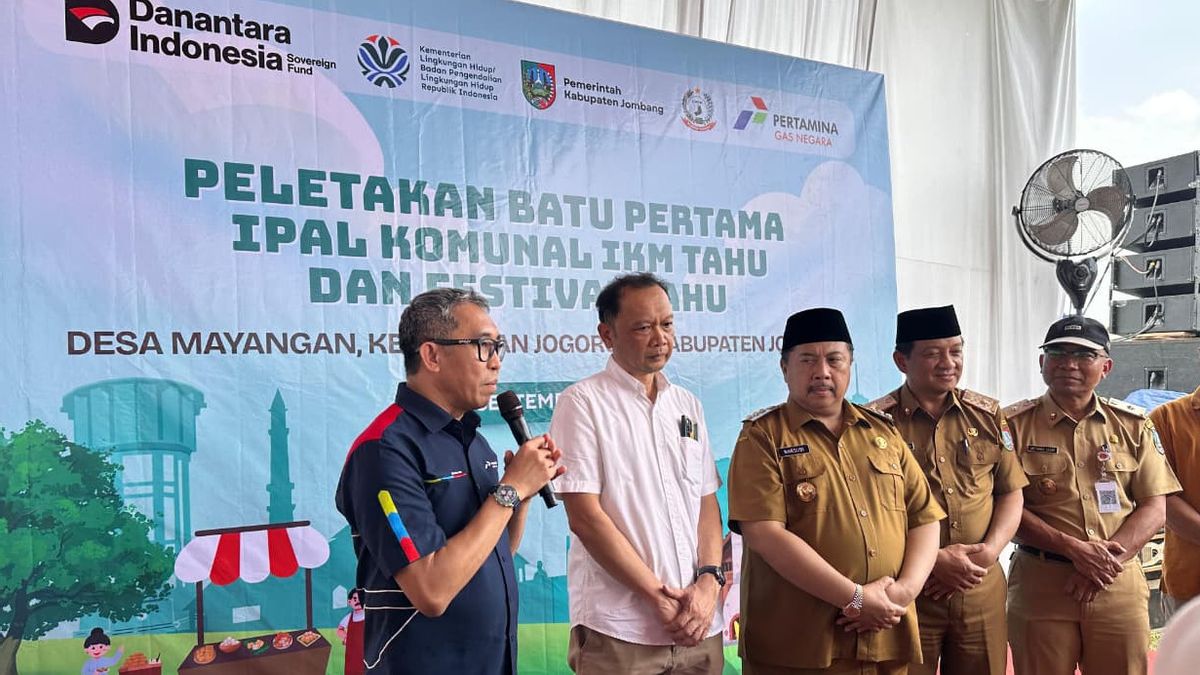


JAKARTA - PT Pertamina Persero as Oil and Gas Holding through Gas Subholding, PT Perusahaan Gas Negara Tbk (PGN) together with the Ministry of Environment and the Jombang Regency Government established synergies through the Social Responsibility (CSR) program to implement the Community Development program of BERSINAR Food Village (Environmental, Hygienic and Tenar).
This program is intended to encourage Jombang Regency as an environmentally friendly tofu industry center. Furthermore, the Food Village is also initiated to help improve the economic level and social welfare of the community.
The initiative of the BERSINAR Food Village stems from the problem of tofu factory waste in Jombang Regency which has been a serious environmental issue for years. There are 88 tofu industries that do not yet have a waste management system, thus having a negative impact on the quality of river water, agricultural land and the health of the surrounding community.
The activity of the Kampung Pangan Bersinar program will be carried out at various points. In the environmental aspect titled 'Tangguh Jombang', a Communal Wastewater Processing Installation (IPAL) will be built to process tofu wastewater and can accommodate approximately 88 home tofu businesses.
Of the 88 tofu factories operating in Jogoroto District every day, the supply of soybeans reaches 84 tons per day. From this production process, liquid waste is produced with a volume of about 1,260 m3 or the equivalent of 1,260,000 liters per day, with Biological Oxygen Demand (BOD) content reaching 4,200 kilograms per day.
Through processing with the Communal Wastewater Processing Installation (IPAL), BOD levels were significantly reduced to only 960 kilograms per day, so that the quality of the waste produced was more environmentally friendly and in accordance with environmental management standards.
"Sentra tofu jombang was chosen by KLH to be assisted, because a report from DLH Jombang was to find solutions for waste management and improve the water quality of the Brantas River. This is also to reduce horizontal friction and groundwater conservation management," said Tulus Laksono as Director of Mutu Air Protection and Management, in his statement, Tuesday, September 16.
"The tofu factory in Jogoroto Jombang, which absorbs thousands of workers with income above the UMR, carries a big challenge in managing tofu waste that pollutes the river. We are very grateful for the collaboration in the construction of IPAL Communal between KLH and DLH Jombang with the full support of Pertamina Group through PGN," said Jombang Regent Warsubi.
"As Pertamina's Gas Subholding, PGN collaborates with KLH and the Jombang Regional Government to formulate an integrated solution to address existing environmental issues. Tofu-based businesses are superior products for the people of Jombang, with the support of strengthening on the environmental, social and economic side, it is hoped that it can be an added value for the quality of tofu typical of this area," explained PGN's HR and Business Supporting Director, Rachmat Hutama.
Other environmentally friendly activities are the construction of a fitness pool that utilizes water processed by waste tofu as agricultural irrigation. Other environmental insight-based activities include processing hyacinth into fertilizer, energy shifting from firewood to using natural gas and collecting crude oil.
Then in the social aspect with the theme 'Jombang Personnel', activities will focus on establishing Cooperatives, empowering women, and increasing awareness of safety and sanitation.
Meanwhile, from the economic aspect of Tangkas Jombang, the activities that will be carried out are the development of MSMEs, branding training and product packaging, facilities for halal certificates, PIRT and business licenses.
BACA JUGA:

"We also want to help the economy of residents through financial literacy, MSME training and environmental literacy centers," said Rachmat.
The groundbreaking, which was carried out on Tuesday, September 16, marks the start of the BERSINAR Food Village and Communal IPAL programs. The approach is the Life Cycle Assessment (LCA), which is a systematic method to evaluate the impact of the existing environment and identify the processes that must be done to get optimal results for the community.
Overall, the BERSINAR Food Village program aims to create a greener environment, more empowered communities and more resilient local economies. Not only solving the waste problem technically, but providing comprehensive benefits to the community.
This collaborative effort is expected to be a concrete step to preserve the environment as well as encourage economic independence and develop local potential. No less important, this program is expected to strengthen the harmonious relationship between PGN as Pertamina Gas Subholding and the community, business actors and the government," concluded Rachmat.
The English, Chinese, Japanese, Arabic, and French versions are automatically generated by the AI. So there may still be inaccuracies in translating, please always see Indonesian as our main language. (system supported by DigitalSiber.id)
Most Popular Tags
#Prabowo Subianto #donald trump #Febrie Adriansyah #8791 #giias 2026Popular


