

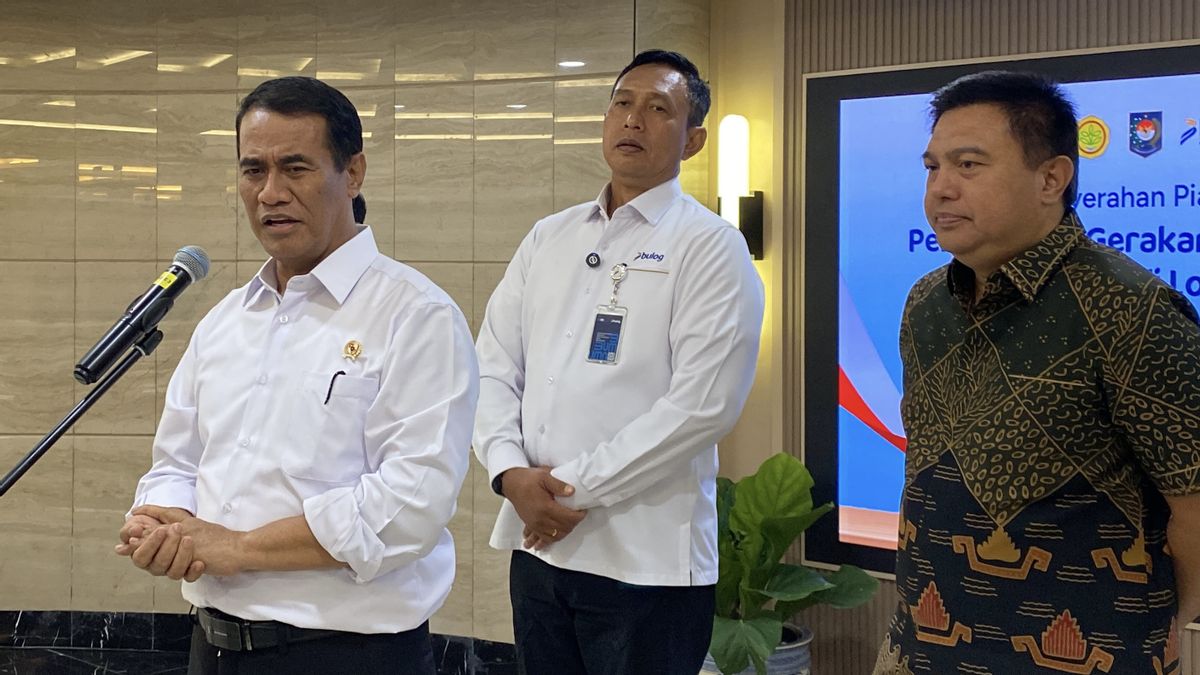


JAKARTA - Minister of Agriculture Andi Amran Sulaiman denied that the current shortage of premium rice in modern retailers is due to a rice shortage.
Amran said the sluggish rice supply to modern retailers is due to a shift in distribution from mills. He said there is currently a change in distribution patterns, with mills supplying more to traditional markets.
"There is a shift in the pattern now, filling the gap in traditional markets. From small mills to traditional markets, which used to be dominated by large mills, there is a slight shift to traditional markets," he said at the State Logistics Agency (Bulog) office in Jakarta on Tuesday, September 2.
Amran said this situation has also had a positive impact on traditional market traders, whose turnover has increased.
"Traditional market turnover has increased," he said.
Therefore, Amran emphasized that the current situation cannot be called a shortage. A shortage can only be considered to occur if rice production decreases.
"So it's not a shortage, there's a lot of rice. What's considered scarce is a decrease in production. Well, that's scarce, but there's a shift," he said.
Previously, Director General of Domestic Trade (PDN), Iqbal Shoffan Shofwan, revealed that retailers are currently starting to be cautious about selling premium packaged rice from suppliers.
However, Iqbal said that entrepreneurs affiliated with the Indonesian Retailers Association (Aprindo) are still serving premium rice and have not withdrawn it from retail stores.
Furthermore, Iqbal also stated that this is in line with a letter issued by the National Food Agency (Bapanas).
"Yesterday, we also communicated with Aprindo. Aprindo actually doesn't withdraw (premium rice from retail). It's just that now they're more careful about accepting new rice from purchases," he said when met at the Ministry of Trade Office in Jakarta on Monday, August 4.
"They're thoroughly checking. We don't want to end up causing them trouble," he continued.
Iqbal said retailers must also go through a verification process to ensure the rice received meets the packaging, volume, and quality standards, all in accordance with the Indonesian National Standard (SNI).
"They have to verify what's listed on the packaging, the weight, and then what the SNI is," he said.
As a result, Iqbal continued, the verification process slows down the circulation of premium rice displayed in modern retail outlets.
"So, the rice displayed from Aprindo member outlets ultimately has a somewhat slower turnover. That's because of the verification process. So, it's not that it's scarce because it's withdrawn, but because the verification process takes a long time. It's verification," he explained.
The English, Chinese, Japanese, Arabic, and French versions are automatically generated by the AI. So there may still be inaccuracies in translating, please always see Indonesian as our main language. (system supported by DigitalSiber.id)


