


JAKARTA - President Prabowo Subianto has determined that the Ministry of Public Works (PU) will get a budget of IDR 118.5 trillion in the Draft State Revenue and Expenditure (RAPBN) for Fiscal Year (TA) 2026.
This is as stated in Book II of the Financial Note along with the 2026 RAPBN. When compared to the effective ceiling of the Ministry of Public Works for the 2025 FY, the available budget is only IDR 73 trillion.
Even so, the ministry led by Dody Hanggodo has proposed an additional budget of IDR 12.5 trillion by 2025. Thus, the budget portion of the Ministry of Public Works for the 2025 will be IDR 86 trillion.
This means that the budget contained in the 2026 RAPBN of Rp. 118.5 trillion will increase by around 37.79 percent compared to the final ceiling of the Ministry of Public Works in 2025 which amounted to Rp. 86 trillion.
Referring to Book II of the Financial Note and the 2026 FY RAPBN, it is stipulated that the government will only build a 28.19 kilometer new expressway or toll road (km).
In addition, the government will also carry out the construction of national roads along 194.75 km, the preservation of national roads along 1,507.08 km and the construction of 3,954.74 meters (m) long bridges.
Then, the basic infrastructure that will be built next year includes the construction of flyovers/underpasses, the development of airports and ports to the construction of on going dams and the rehabilitation of irrigation networks.
Until now, it is not known for sure how much the total infrastructure budget of President Prabowo's administration will be in FY 2026. In contrast to the leadership period of the 7th President of the Republic of Indonesia, Joko Widodo (Jokowi), in the President Prabowo regime, the infrastructure budget was merged into the Economic Functional Budget which was set at IDR 820.4 trillion in the 2026 RAPBN.
In addition to covering the infrastructure budget, the Economic Functional budget also includes costs for the distribution of LPG subsidies, distribution of KUR interest subsidies to the distribution of certain fuel subsidies such as diesel.
"The Economic Functional Budget is carried out by several ministries/agencies that carry out economic functions, including the Ministry of Public Works; Ministry of Transportation; Ministry of Agriculture; Ministry of Communication and Digital Affairs; Archipelago Capital Authority; Ministry of Maritime Affairs and Fisheries; Ministry of Forestry; Ministry of Manpower; and Ministry of Energy and Mineral Resources," the regulation reads, quoted Tuesday, August 19.
The book also explains that the main economic function budget will be used to support the government's agenda, including continuing the construction of infrastructure projects and strengthening food security.
Then, the Economic Functional Budget will also be used to empower energy security, optimize the utilization of ICT and subsidy assistance to MBR, MSMEs, farmers and fishermen in increasing productivity and competitiveness.
SEE ALSO:
-
 | EKONOMI
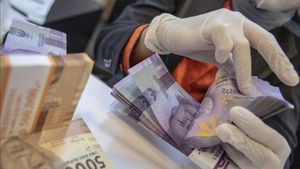
Pemerintah Bakal Gunakan Rp60 Triliun SAL untuk Kurangi Utang dan Jaga Defisit
19 Agustus 2025, 17:05

The following is a list of infrastructure projects that the government will build in 2026:
1. National road construction of 194.75 km;2. National road PREservation of 1,507.08 km; 3. 28.19 Km;4. Construction of a 3,954.74 meter;5 long bridge. Construction of a flyover/underpass of 362.71 meters;6. Development of two airport units; 7. development of the Patimban port (project I and II); 8. Construction of 15 dams on going; 9. Construction of irrigation network 4,000 hectares (ha); and 10. Rehabilitation of irrigation network 100,000 ha.
The English, Chinese, Japanese, Arabic, and French versions are automatically generated by the AI. So there may still be inaccuracies in translating, please always see Indonesian as our main language. (system supported by DigitalSiber.id)
Popular


