

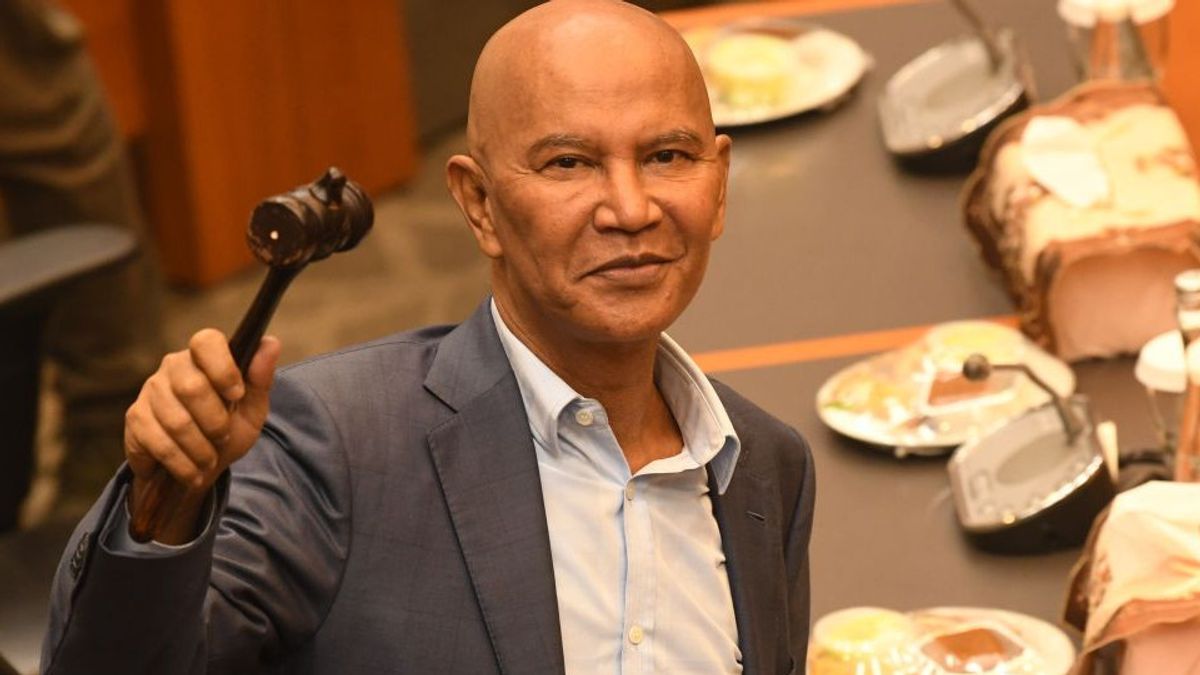


JAKARTA - The government has submitted a Financial Note of the 2026 RAPBN which was delivered directly by President Prabowo Subianto to the DPR in the inaugural plenary meeting at the Parliament Complex, Friday, August 15, yesterday. The chairman of the DPR Banggar, Said Abdullah, observed the moderate and realistic targets taken by the government as well as provided several notes.
"There are a number of interesting things that we need to pay close attention to, among others, the government chooses to take moderate and realistic targets in the numbers in the 2026 RAPBN," Said told reporters, Saturday, August 16.
This, continued Said, can be seen from a number of indicators for macroeconomic assumptions in 2026. Where economic growth is targeted at 5.4 percent, the target for inflation at the level of 2.5 percent, Yield SUN 10 years is projected at 6.9 percent, while the rupiah exchange rate is IDR 16,500 per US dollar. Meanwhile, the price of ICP is 70 US dollars/barrel, oil lifting is 610 thousand barrels/day, and natural gas llimiting is 984 equivalent to thousands of barrels/day.
According to Said, the proposal for the macroeconomic figure shows that the government chose a moderate path, or a midpoint of the lower and upper limits on the agreement between the DPR Banggar and the government on the PPKF Kem agreement.
"This moderate number choice shows that the government is realistic in calculating the challenges of 2026 which are not easy, due to the impact of the implementation of tariffs from President Trump, the impact of the geopolitical conflict, the decline in household purchasing power, and the large number of layoffs in the manufacturing sector," said Said.
"What about the draft 2026 State Budget posture, as I previously suspected, for the state revenue target of IDR 3,147.7 trillion, the government prefers an upper limit to the initial talks at the PPKF Kem, while for state spending, IDR 3,786.5 trillion shows a different choice, namely taking moderate figures from the lower and upper limits," continued the PDIP politician.
With this choice, according to him, the consequence of the percentage deficit for the 2026 RAPBN is lower than in 2025, which is 2.48 percent equivalent to Rp638.8 trillion.
"The high level of state revenue targets chosen by the government should be supported, but the government must be extra careful, especially in terms of tax policies," said Said.
Said said, currently there is a high sensitivity in the midst of society, especially negative sentiment over the imposition of high taxes which has increased by hundreds of percent on Land and Building Taxes (PBB) which is enforced in many local governments.
For this reason, said Sais, the government should be careful and reconsider if it takes a tax expansion policy, or increases tax rates to increase revenue targets.
"I suggest that, first, the government is more focused on pursuing rogue taxpayers who evade taxes. Second, taking advantage of opportunities from global taxation after the agreement in OECD, especially for the operation of various multinational corporate services across countries," said Said.
Third, he continued, the government must optimize the carbon tax. This effort also encourages the transformation of the national economy to be more environmentally friendly.
"Fourth, increasing investment in the natural resource sector, so that state revenues from the distribution of natural resources sectors will increase," he added.
BACA JUGA:


Meanwhile, on the side of state spending, Said assessed that the government needed to take the middle number position from the discussion of the PPKF Kem. As a result, Said said, this strategy could suppress the APBN deficit below 2.5 percent of GDP, thus the financing needs were not too large.
"Against the posture of state spending, the allocation of central expenditure is much larger than transfers to regions and villages. The central expenditure plan is IDR 3,136.5 trillion, while the 2025 State Budget is IDR 2,701.4 trillion, or an increase of IDR 435.1 trillion, on the contrary, the allocation of transfers to regions and villages has actually decreased to IDR 650 trillion from the 2025 State Budget of IDR 919.9 trillion or a decrease of IDR 269.9 trillion," he explained.
Said added that the tendency to escalate the state budget to the center needs to be reconsidered by the government. At the same time, he said, the local government's authority is also getting smaller after the Job Creation Law.
"This situation makes regional fiscals will weaken, so that development initiatives in the regions will only rely on the central budget," he concluded.
The English, Chinese, Japanese, Arabic, and French versions are automatically generated by the AI. So there may still be inaccuracies in translating, please always see Indonesian as our main language. (system supported by DigitalSiber.id)
Popular


