

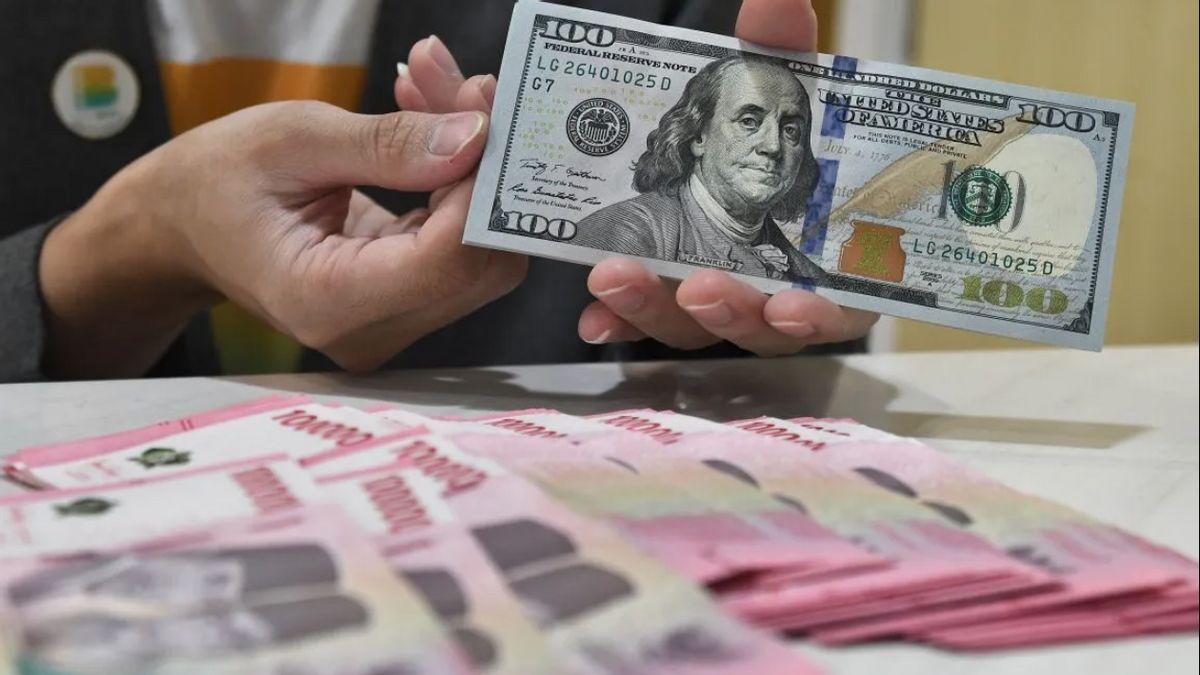


JAKARTA - Institute for Development of Economics and Finance (Indef) Economist Fadhil Hasan considers the United States (US) Reciprocal Tariff (US) reciprocal tariff policy to have the potential to make the rupiah exchange rate against the US dollar depreciated.
"Fortunately, we are still on holiday right now, so we don't know exactly after this policy, in that shortter how the impact on the rupiah exchange rate will be, although yesterday we found out that there was indeed a slight weakness, although yesterday he said there was a slight strengthening again," he said as quoted by ANTARA, Friday, April 4.
With this policy, continued Fadhil, the price of imported products sold in America is increasingly expensive and can trigger inflation. In response to this situation, the Federal Reserve (The Fed) is likely to increase or refrain from lowering interest rates to control inflation.
If there is pressure on US inflation accompanied by an increase in Fed interest rates, it could lead to capital outflows from developing countries, including Indonesia, as US bonds become more attractive to investors.
"This is what then I think causes further depreciation than our rupiah exchange rate.. That's kanspillover everywhere, to debt, to our fiscal, and to all. So, I think in addition to the impact of trade, but also the impact on depreciation of the rupiah exchange rate and others we also need to anticipate," he said.
In terms of trade, he considers the impact of US reciprocal tariffs on Indonesia tends to be moderate.
Several Indonesian export products will be affected by this policy, namely textiles, garment, footwear, and then palm oil. In total, he stated that 10 Indonesian export products would be affected by US reciprocal rates.
However, considering that tariff policies apply to all countries, especially Indonesian competing countries such as Vietnam, Malaysia and Thailand, Fadhil considers the impact experienced by the country to be more moderate.
Currently, the US is Indonesia's second largest trading partner after China with a total share of Indonesia's exports to America of around 10.5 percent. Indonesia also obtained a trade surplus with America of 16.8 billion US dollars.
On Wednesday (2/4), US President Donald Trump announced a rate increase of at least 10 percent to many countries around the world, including Indonesia, on goods entering the country.
Indonesia is in eighth place on the list of countries affected by the US tariff increase, with a rate of 32 percent. Around 60 countries will be subject to a half-reciprocity rate from the rates they apply to the US.
SEE ALSO:
-
 | BERITA
Buntut Tarif Dagang Trump, Macron Desak Perusahaan Prancis Setop Investasi di AS
04 April 2025, 13:49 -
 | BERITA
PM Israel Netanyahu Puji Hongaria Berani Keluar dari ICC yang Dianggap Korup
04 April 2025, 12:52 -
 | BERITA
Ratusan Ribu Orang Mengungsi saat Israel Merebut Rafah di ‘Zona Keamanan' Gaza
04 April 2025, 12:35


Based on this list, Indonesia is not the only country in Southeast Asia that has been a victim of the US trade. There are also Malaysia, Cambodia, Vietnam and Thailand with a rate increase of 24 percent, 49 percent, 46 percent, and 36 percent, respectively.
Trump said that the reciprocal rate aims to create more jobs in the country.
He and his government officials argue that the US has been "harmed" by many countries due to trade practices deemed unfair.
The rates that Trump has long threatened were announced at the "Make America Wealth Again" event at Rose Garden, White House.
The English, Chinese, Japanese, Arabic, and French versions are automatically generated by the AI. So there may still be inaccuracies in translating, please always see Indonesian as our main language. (system supported by DigitalSiber.id)


