

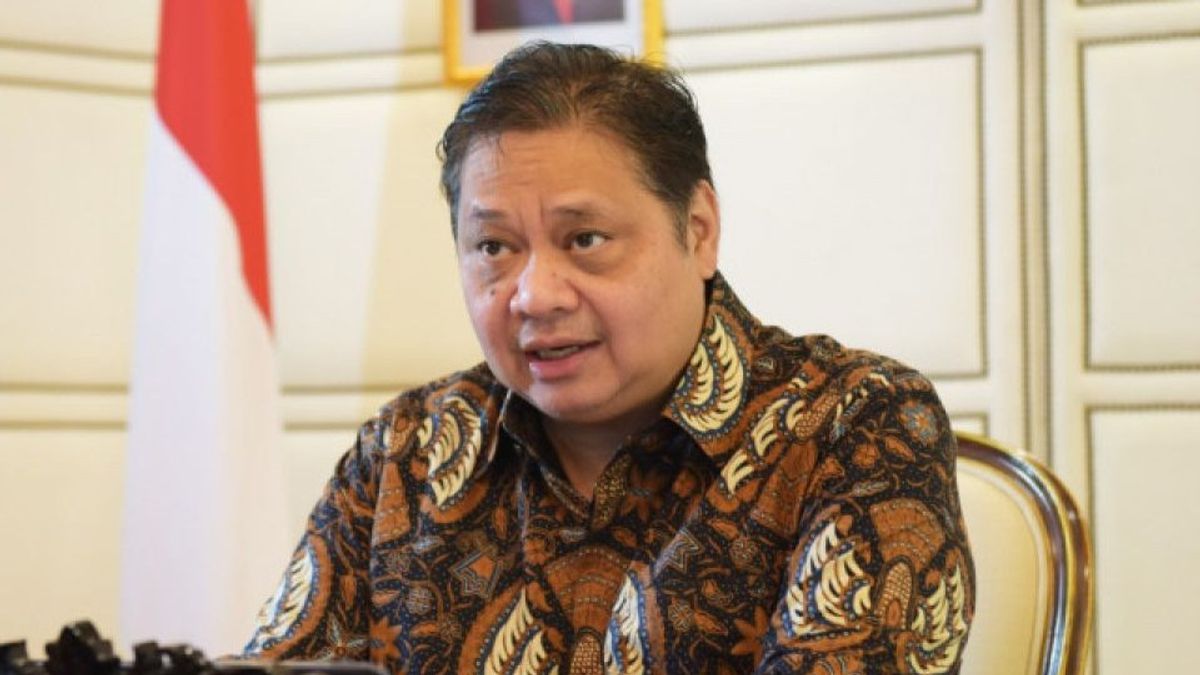


Coordinating Minister for the Economy Airlangga Hartarto revealed that Indonesia won an important victory in the World Trade Organization (WTO) regarding palm oil policy, which confirmed Europe's discrimination against Indonesian palm oil products.
Airlangga emphasized that this is proof that Indonesia is able to compete and win international cases and Europe has been proven to discriminate, especially against palm oil and biodiesel products.
According to Airlangga, this is because Europe's policy, which previously prioritized rapeed and soyabean-based biodiesel. So it is hoped that it can open up opportunities for biodiesel based on palm oil (CPO) more widely to the global market.
"So that the biodiesel that we are now taking as a policy, like it or not, the world must accept that not only rape-based biodiesel, soyabean and others are based on CPO," he explained to the media crew, Friday, January 17.
In addition, Airlangga conveyed that the discrimination carried out by the WTO also influenced the European Union's policy on products free of deforestation or European Union on Deforestation-free Regulation (EUDR).
Airlangga said that Europe decided to postpone the implementation of the EUDR, which was originally planned for this year to 2026, provided an opportunity for Indonesia and Malaysia to strengthen their implementation strategy so that palm oil would no longer be discriminated against.
"This provides an opportunity for Indonesia and Malaysia to strengthen strategies for implementation so that palm oil is also not discriminated against," he explained.
Airlangga said the government was working on finalizing the Comprehensive Economic Partnership Agreement between Indonesia and the European Union or the Indonesia European Union Comprehensive Economic Partnership Agreement (IEU-CEPA).
"With this victory, the obstacles that have plagued the IEU CEPA negotiations can be lost and we can immediately finish the IEU CEPA," he said.
SEE ALSO:
-
 | EKONOMI
Menko Pangan Kritik BRIN: Kita Butuh Bibit, yang Diteliti Malah Nasab
15 Januari 2025, 21:02
The IEU-CEPA negotiations consist of various aspects such as customs rates, removing non-tariff barriers, and simplifying customs procedures to facilitate the flow of goods between the two regions and so on.
To note, the trade dispute between Indonesia and the European Union regarding palm oil began in 2019, when Indonesia asked for consultations on policies implemented by the European Union and its member countries related to palm oil and palm oil-based biodiesel from Indonesia.
Then on December 10, 2019, other countries such as Costa Rica, Guatemala, Malaysia, Colombia, and Thailand also submitted similar consultation requests. The dispute resolution process continued with the formation of a panel in mid-2020, and finally the results of the circulation of the dispute were announced on January 10, 2025.
The English, Chinese, Japanese, Arabic, and French versions are automatically generated by the AI. So there may still be inaccuracies in translating, please always see Indonesian as our main language. (system supported by DigitalSiber.id)


