

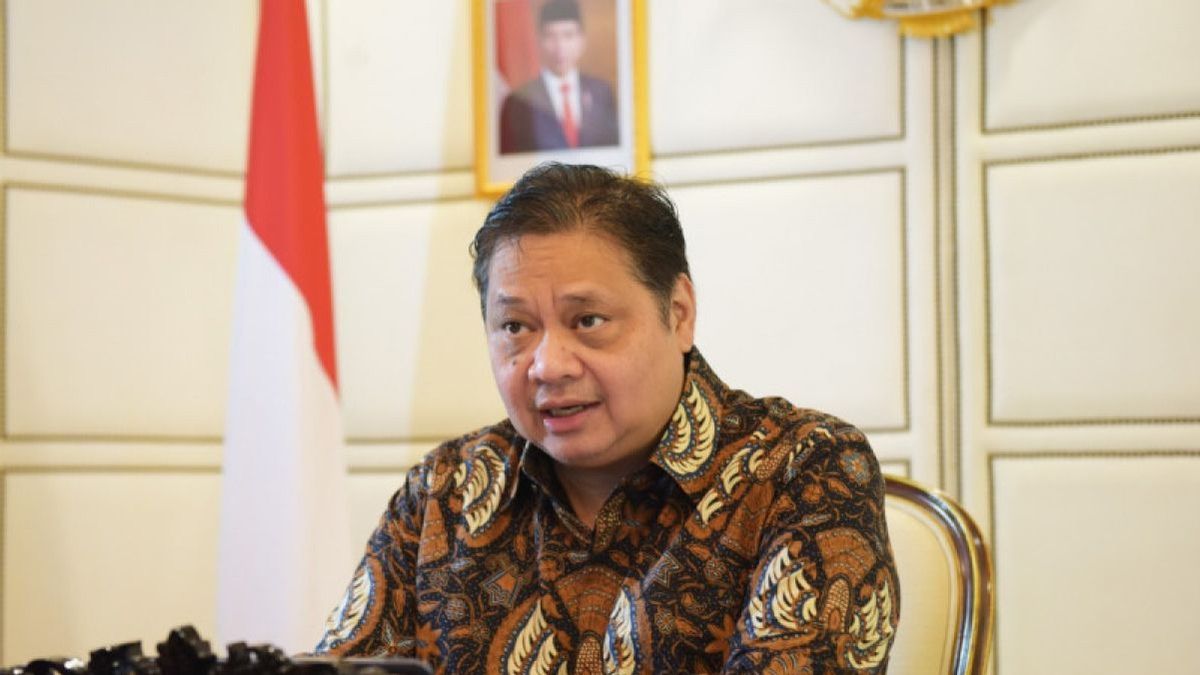


Coordinating Minister for Economic Affairs Airlangga Hartarto said the reduction in poverty, which reached its lowest level, was driven by a number of strategic steps to encourage middle class growth.
"Yes, first yesterday there was a program to reduce poverty. Well, this gap index is what we have to boost. That's why our President's direction must boost the middle class," said Airlangga to the media crew, Friday, January 17.
Airlangga said strengthening the middle class was the main focus of the government, one of which was through the Micro, Small and Medium Enterprises (MSMEs) sector and formal workers.
According to Airlangga, one of the steps that has been taken by the government is the income tax (PPh) policy borne by the government for employees with an income of up to Rp. 10 million per month.
"Between other middle class, it's in MSMEs and employees or female workers. So that's what we encourage, that's why one of the packages we sent this year, which pays up to Rp. 10 million, the PPH is borne by the government. So it will boost purchasing power," he said.
SEE ALSO:
-
 | EKONOMI
Menkop Budi Arie Sebut Program Makan Bergizi Gratis Miliki 4 Tujuan bagi Masyarakat
06 Januari 2025, 12:50


Previously, the Central Statistics Agency (BPS) noted that the poverty rate in Indonesia in September 2024 reached 8.57 percent of the total population of Indonesians. This figure is the lowest in history since BPS announced poverty data in 1960.
BPS noted that the percentage of poor people in September 2024 decreased by 0.46 percentage points compared to March 2024 which was at 9.03 percent. Meanwhile, when compared to March 2023, this percentage decreased sharply by 0.79 percentage points.
The English, Chinese, Japanese, Arabic, and French versions are automatically generated by the AI. So there may still be inaccuracies in translating, please always see Indonesian as our main language. (system supported by DigitalSiber.id)


