



JAKARTA - The government considers that the 8 percent economic growth target needs to be supported by strengthening the regional economy. The region must continue to be encouraged because national growth is a combination of regional economic performance.
Coordinating Minister for the Economy (Menko) Airlangga Hartarto said that strengthening the regional economy was important in the midst of global uncertainty. The government needs to strengthen synergy with local governments and the financial services sector.
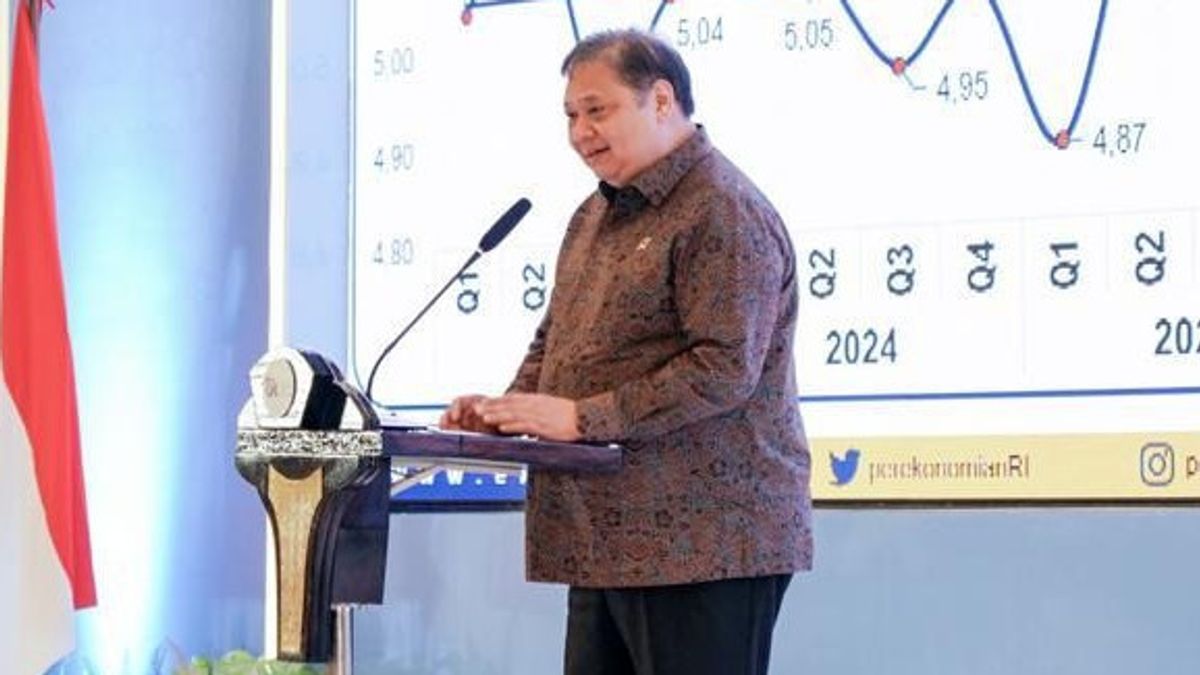
"We have a big target for economic growth of 8 percent. To achieve this target, the regions must continue to be encouraged because national growth is basically an aggregation of regional growth," said Coordinating Minister for Economic Affairs Airlangga at the National Conference on Regional Economic Development in Jakarta, Monday, May 25.
Airlangga said that Indonesia's economic fundamentals are still solid. National inflation is maintained at 2.4 percent. The rupiah depreciation is around 2.6 percent, better than in previous periods of economic pressure.
The government also encourages MSMEs as a mainstay of the regional economy. The People's Business Loan or KUR program is allocated around Rp. 300 trillion.
According to Airlangga, KUR is able to increase the capacity of MSMEs by around 34 percent and contribute to an increase in Regional Original Income or PAD by 18-27 percent.
Until April 2026, the realization of the distribution of KUR was recorded at around IDR 111 trillion through various financing schemes.
In addition to MSMEs, the government is encouraging digital economy in the region. Indonesia's digital economy is currently estimated at US$150 billion and has the potential to rise to US$400 billion by 2030.
Airlangga said that if the integration of ASEAN's digital economy ran optimally, the region's digital economy could reach 2 trillion US dollars. Indonesia has the opportunity to obtain approximately 600 billion US dollars from this value.
The government has also begun to develop the national semiconductor industry. In the next three years, the government targets the training of 15 thousand semiconductor talents.
In the initial phase, a thousand participants have taken part in the training. The number of applicants reached around 4,500 people.
In addition to preparing human resources, the government will encourage areas that have silica potential to develop silica-based downstream. This step is aimed at strengthening the national semiconductor industry ecosystem.
The conference was attended by members of the DPR, the Financial Services Authority, the Ministry of Finance, the Ministry of Home Affairs, Bank Indonesia, regional governments, business actors, and financial services institutions.
The English, Chinese, Japanese, Arabic, and French versions are automatically generated by the AI. So there may still be inaccuracies in translating, please always see Indonesian as our main language. (system supported by DigitalSiber.id)


